

TLDR: Constellation is one of the best science fiction series I have seen in a while. A must watch!
I recently watched the Apple TV series Constellation. The series is gripping, engages you both visually and conceptually and explores some of the deep fears and facts of the human condition.
So what is the series about? Well, Jo answers it for us!
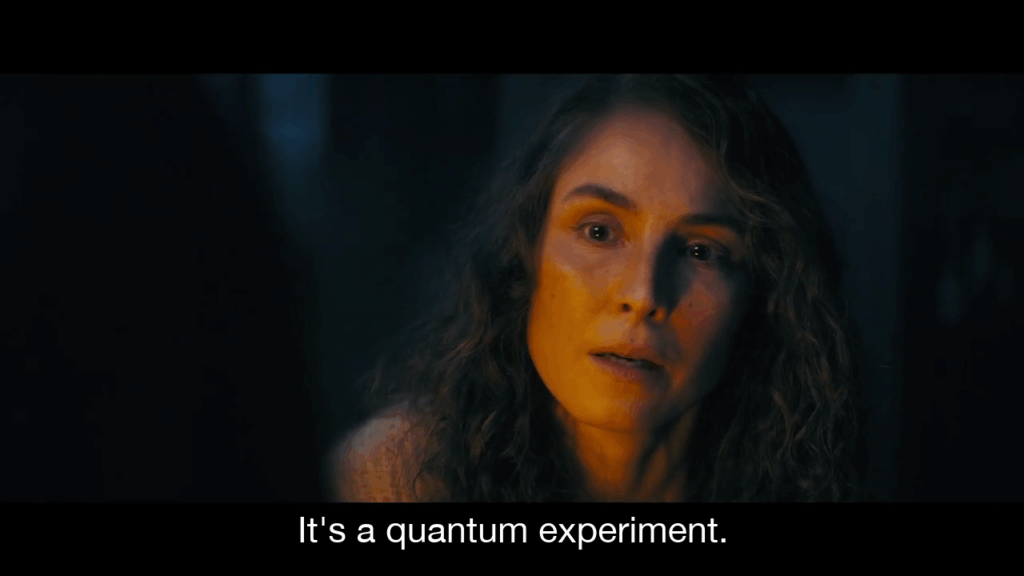
Quantum mechanics, developed at the starting of last century, is one of the most counter-intuitive scientific theory that we humans have created. Our notions of “common sense” and our perception of “reality” around us are challenged and refuted in the realm of the quantum. That being said, during its development several gedankenexperiments were done by the pioneers of quantum mechanics. One of the most iconic gedankenexperiment is that was posited in 1935 by German physicist Erwin Schrödinger, the so called Schrödinger’s Cat
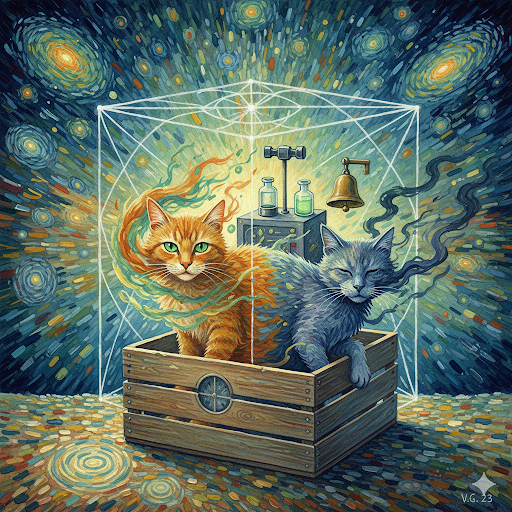
The experiment is described as such by Schrödinger
One can contrive even completely burlesque [farcical] cases. A cat is put in a steel chamber along with the following infernal device (which must be secured against direct interference by the cat): in a Geiger counter, there is a tiny amount of radioactive substance, so tiny that in the course of an hour one of the atoms will perhaps decay, but also, with equal probability, that none of them will; if it does happen, the counter tube will discharge and through a relay release a hammer that will shatter a small flask of hydrocyanic acid. If one has left this entire system to itself for an hour, one would tell oneself that the cat is still alive if no atom has decayed in the meantime. Even a single atomic decay would have poisoned it. The psi-function of the entire system would express this by having in it the living and dead cat (pardon the expression) mixed or spread out in equal parts.
It is typical of these cases that an indeterminacy originally restricted to the atomic domain turns into a sensually observable [macroscopic] indeterminacy, which can then be resolved by direct observation. This prevents us from so naïvely accepting a “blurred model” as representative of reality. Per se, it would not embody anything unclear or contradictory. There is a difference between a shaky or out-of-focus photograph and a snapshot of clouds and fog banks. (link)
Stated thus, it questions the very nature of our understanding of reality as seen with our macro senses. How do we understand this? Can the living AND the dead cat exist at the same time? According to the law of excluded middle in our logical system, we assume that proposition is true OR its negation is true. This principle is fundamental in classical logic and asserts that there are no other truth values beyond true or false. So how could the cat exist in both the states: dead AND alive? How do we understand and interpret phenomenon?
There are several interpretations of the cat paradox depending on one’s worldview. The Copenhagen interpretation, one of the more widely accepted interpretations amongst physicists, posits that a measurement results on only one state. This interpretation does not provide an “explanation” for the state of the cat while the box is closed. When the box is not opened, the wave function description of the system consists of a superposition of the states “decayed nucleus/dead cat” and “undecayed nucleus/living cat”. An observer can only assert a statement about the cat only when the box is opened. Thus we can say that the state of the system remains indeterminate, superposition of possible states. The very act of observation collapses the wave function to one of the possible states. Thus observing a system makes the realisation of states possible.
Another way to look at this is the so called many worlds interpretation (MWI) posited by Hugh Everett in 1957. In this interpretation it is posited that there is a universal wave function and in contrast to the Copenhagen interpretation there is no collapse of the wave function. This implies that all states whose superposition creates the wave function are physically realised, but in different “worlds”. What does this mean? The many-worlds interpretation implies that there are many parallel, non-interacting worlds. MWI views time as a many-branched tree, wherein every possible quantum outcome is realized. MWI’s main conclusion is that the universe is composed of a quantum superposition of an uncountable or undefinable amount or number of increasingly divergent, non-communicating parallel universes or quantum worlds. Sometimes dubbed Everett worlds, each is an internally consistent and actualized alternative history or timeline.
So given the MWI framework how do we interpret Schrödinger’s cat paradox?
In the many-worlds interpretation, both alive and dead states of the cat persist after the box is opened, but are decoherent from each other. In other words, when the box is opened, the observer and the possibly-dead cat split into an observer looking at a box with a dead cat and an observer looking at a box with a live cat. But since the dead and alive states are decoherent, there is no communication or interaction between them.
When opening the box, the observer becomes entangled with the cat, so “observer states” corresponding to the cat’s being alive AND dead are formed; each observer state is entangled, or linked, with the cat so that the observation of the cat’s state and the cat’s state correspond with each other. Quantum decoherence ensures that the different outcomes have no interaction with each other. Decoherence is generally considered to prevent simultaneous observation of multiple states. (emphasis added)
Thus every observation event, creates as many worlds as there are states in the superposition. And within each world the events follow as they should. In one world the cat is dead in the other it is not.
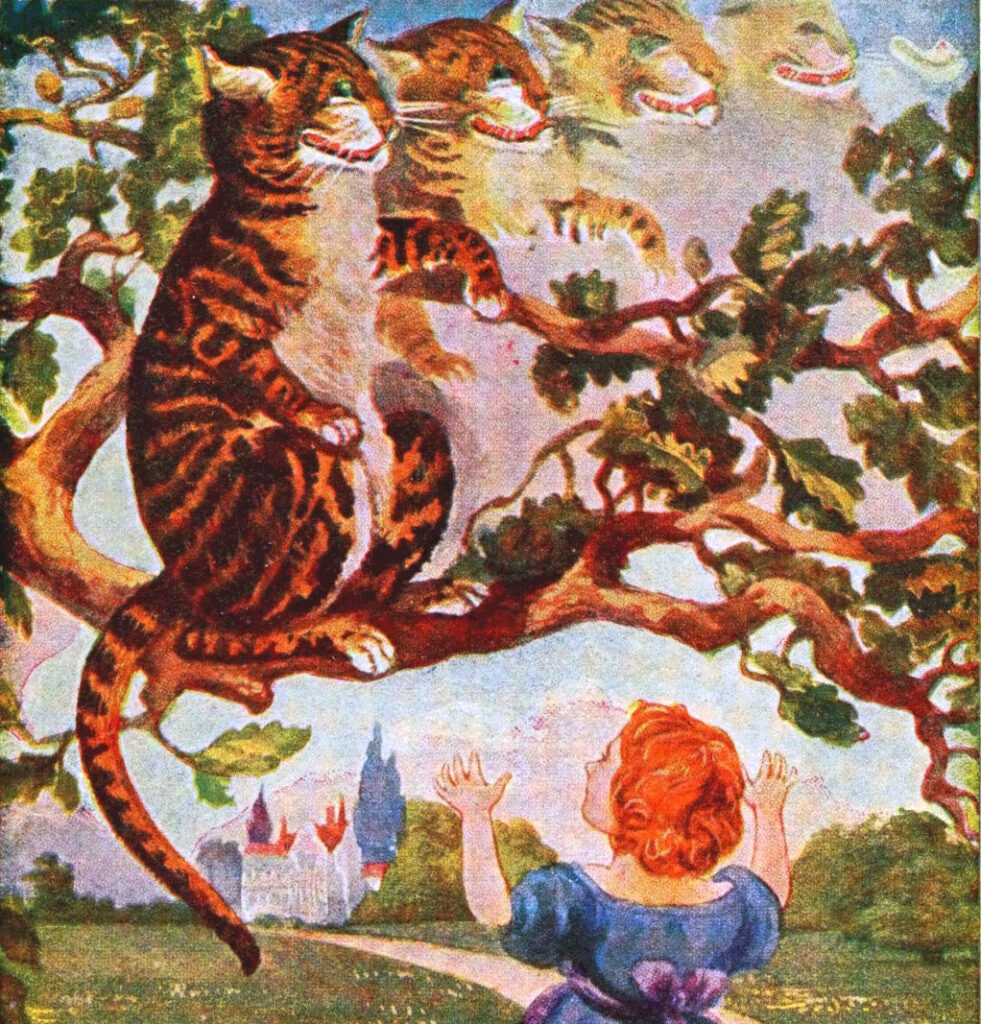
Now what would happen if these two worlds, which are split by a certain observation, somehow interacted? There is no “common sense” way to understand or interpret this. It screws your way of thinking, there is no “coherent” way to think about this, it is all “de-coherent”. More you think about it more it becomes perplexing. Curioser and curioser….
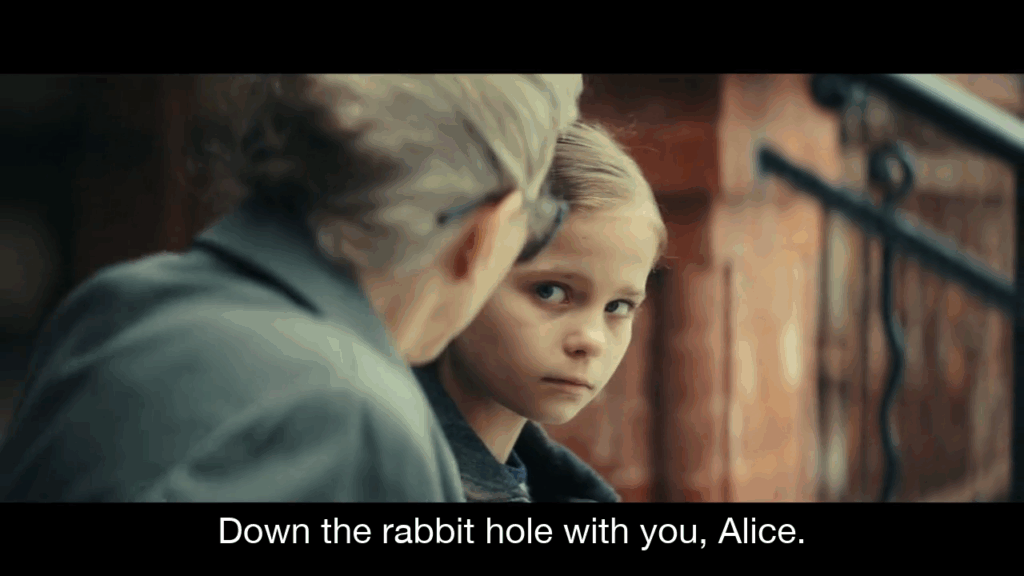
And this is exactly the idea that is explored in Constellation series!
All is going well abroad the International Space Station (ISS), where cosmonauts from US, Russia and Europe are placed. Swedish ESO cosmonaut Johanna “Jo” Ericsson (played by Noomi Rapace ) is talking to her daughter Alice (played by Davina Coleman and Rosie Coleman) from the space station. At the same time Paul Lancaster (played by William Catlett) of the NASA astronauts is conducting an experiment to find out about a new state of matter which they think should exist in zero gravity. This is the Cold Atomic Laboratory (CAL).
This is where the story begins. The operation of the CAL is the event which blurs the timelines between the two worlds and allow communication and juxtaposition of the persons and ideas across the worlds which is not supposed to happen in the MWI.
The performance of this experiment gives the predicted result, but causes things to go haywire. There is a collision of the ISS with an unknown object which causes several life-support systems to go out of order. The cosmonauts have to perform an emergency evacuation.
In all this chaos, the Paul is critically injured and eventually succumbs to his injuries. Now for the emergency evacuation, the remaining operational module can only fit three cosmonauts. So a decision is made Jo will remain on the ISS, repair the Soyuz 1 module and return to Earth later, while three other astronauts return to Earth. Jo being alone on the ISS suffers hallucinations (or real visions?) and is on emergency power. These hallucinations (visions?) set the tone for the rest of the series. This is some top-class space-horror. I am not giving out the spoilers..
When Jo returns to Earth she feels somethings are different than what she remembered before being up on the ISS. She has been on the ISS for some time (few months). There are strong elements of jamais vu in her experience. For example, Jo remembers her daughter Alice could talk in Swedish, but currently she finds that Alice cannot speak Swedish. Then there are elements of conspiracy theories and Soviet state secrets very seamlessly added to plot. Little things like this take their toll and Jo has a mental breakdown.
Along with Jo, Alice is also finding things disturbing. She also has visions of another Alice in another world, where instead of Paul her mother is dead in the ISS accident. Apart from these two, Bud/Henry Caldera (played by Johnathan Banks) who has designed the CAL experiment also has visions. Thus Jo, Alice, Bud, and Paul are entangled by the event of operating CAL and connections (or cracks?) appear in the divergent worlds between them.
How is this resolved? Do people who are part of these multi-world realities realise that they are in parallel worlds with their counterparts in another world? Well to find out do watch the series!
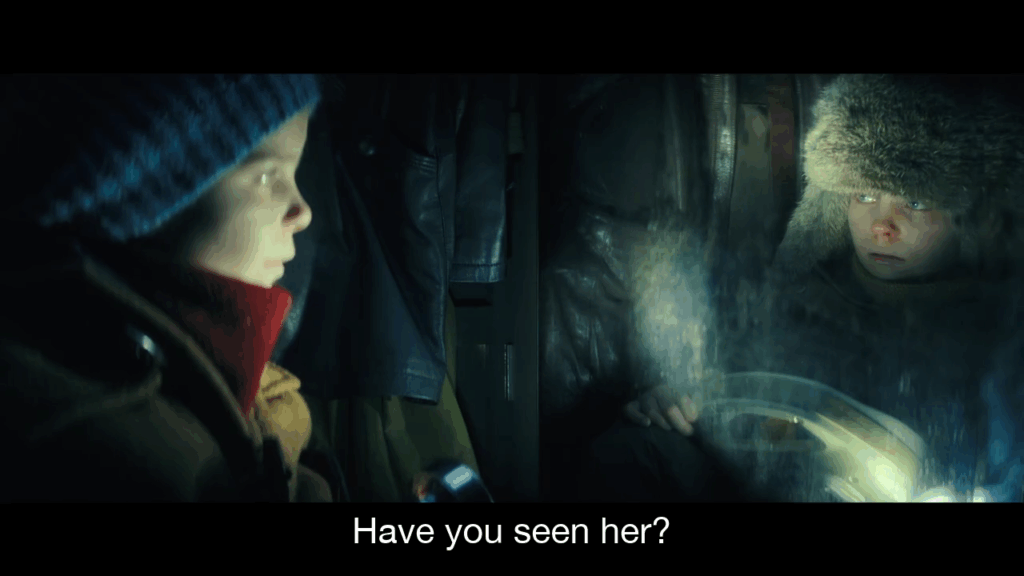
PS: A special appreciation for the role of two Alices played very very ably by the twins Davina Coleman and Rosie Coleman. The sheer sense of helplessness, fear and anxiety portrayed by them when they are trying to find “their mother” is exceptionally brilliant.