Three Femmes

That day three remarkable events happened. All of them involved females. The first one I call strange attractor. In the morning I was supposed to go at the RTO, for the test of the permanent driving license. When we were still at the driving school, which incidentally is just across the road of the Centre, one particular female caught my attention. She was in her late 30’s and had a typical look of a Northern lady, who has maybe brought up in Delhi or some place nearby. This I deduced from the kind of dress and its fit she was wearing. Somehow I don’t know, but I felt suddenly attracted very much to this lady. This particular lady was not that attractive, neither she had a very curvy figure, but nonetheless I felt a strange attraction towards her. She was standing on the other side of the road, I could not see her properly, but still this strange charm of her, had been cast over me. Why? I could not understand. 


The lady found some friend, who was on the same side of the road as I was. They both came to the middle of road, at the divider and started talking across the street. This was funny. Two women talking in the middle of the road [literally], talking loudly as they could not hear each other clearly. So that they became the centre of attention [again literally]. Anyways the lady, then came to my side of the road, then I saw her close by. She had not put on any make-up, even if she had it must be very light, the kind of which is unnoticeable. As for my attraction, I still didn’t know why I strangely felt attracted towards this particular female, I had no reasons to. If she had a very striking face, I would have fell for her, or if she had an awesome figure, I would have fell for her, or if she was wearing a very hip dress, I would have…. But, but neither was the case, then why, why did I fell for her?


I did not miss a chance to see her, see her move, see her talk, trying to figure out why, I felt so attracted to her. With her I felt a sort of familiarity, which I should not have felt, because I was seeing her for the first time. I felt familiar with her face, her body and her body language, the way she talked, it was so familiar. I had seen her. Deja vu. But why? I could not figure out….


And the feeling was very strong, I felt as if I had known her for so long, that I could not imagine things without her. Why should such a case occur with a complete stranger? Not that I have not been attracted to strangers, but this was something different. Some connection was present here, which I could not comprehend or understand even when I wanted to. I felt a sense of belonging to her, which you usually do not feel with complete strangers….

For the next hour or so, my mind was intensely struggling about this. I had to find a solution, I had to. Otherwise memories of her and the strange attraction that I felt would not let me be in peace. They say there are two types of things that you cannot see. One when the things are too small, and other when they are too large, too large for you to imagine. I guess the cause of my attraction to the lady was of the later type. Epiphany! And the mystery was resolved. The familiarity with the face was striking, it must be, for it was her face. How could I over look such a simple thing?  This one, was definitely too big. This should have come to my mind as the first thing, when I saw her. As with other problems, once you have had looked at the solution, you find otherwise cryptic steps simple. Once you decipher a cipher all the mysteries surrounding it, are gone. So was this case, she was as beautiful as her, but maybe 6-7 years in the future. But she had all the elements of her, she really had them all…. All the charms of her, were present in her. But anyway, I felt a bit relieved when I could figure out what had happened…. 


Finally things made sense….


The second case was in the evening. We went to the bus stop to drop her. There was a young [most probably college going] couple sitting at the bus stop. When we went pass them, they seemed to be having a serious talk. The body language of both was heavy, both were carrying, it seemed, a huge burden on them. The girl was fair, maybe 18-19, a real PYT. She was wearing a pink top, which matched with her fair appearance, and had right mass at right places. They were having a silent argument, in which all the violence is in the mind instead of the words. These are the more dangerous types, as you don’t know when the other person will erupt, burst out, when will the physical manifestation of this struggle would occur. I am more this kind of person. 


When we went to our stop, the fighting I guess intensified, not verbally but mentally. Just as her bus
was at the gate, I saw the guy throwing a bag or something towards the girl, the things
were getting out of hand. Then she said something to him, and…. Smack! He hit her right on the face, with a forceful blow. We were standing maybe, 25-30 feet away but I could still clearly hear the unmistakable sound of someone being slapped. They were not looking, they were too keen about the bus that was coming. Though for me the sound of the slap lasted for briefest of moments, for her I guess, it would be audible in her head  for some time to come. It was all happening like it does in the movies. After this incident, the girl could not be seen, as 2-3 buses obstructed our view and when they cleared the girl had already walked out of the depot. The guy was still sitting there on the stop, with an expression on his face as if, nothing had happened. Then came the discussion that whether we should have intervened in what happened. Had the girl still been there, there was a chance that we could have done something about it. May be if she had replied in kind, people around her and us would have supported her. But she did not stay, she offered no resistance and so all our discussions on this issue are all theoretical…. Is this also not the plight of the women who suffer, that they do not offer resistance? They do not face and stand things when they should? May be other people will come to support them, maybe they will not…. If she had shown the guts to face him, I would have of course taken her side, even not knowing who was the wrongdoer. Was it the girl or the boy?


Should we have gone to the guy and asked “Why did you slap her?” Or we as all others at the depot be mute spectators of this event and just be away with it. May be if we had asked he would have attacked us, may be we should have asked her instead. What would be her reaction? What made this guy do this thing to her? What were their troubles which led to this event? These and a lot of other questions will go unanswered and maybe will bother me for some time to come….


Now, to the third one. The enchantress. We went to have ice cream in the night. As soon as I parked and we entered the parlour, I was dumbstruck. For there were a pair of eyes, with almost enchanting and magical effects staring straight at me. The light colored eyes, were full of make-up, with eye-liners and eye-shadows, but even without them, just with a line of kohl, the effect would have been the same. Lisa Ray has the eyes of same color, but this female’s eyes and body were much bigger than hers. With the gaze that female wore, there was no escaping, when she stares at you, you have to look back. And once you look you cannot look for long, as she stared straight right up to your soul, it touches and stirs somethings deep inside you, which you yourself don’t know exist. The gaze penetrated right through your flesh and went beyond, much beyond. It was a glare of something un-human and there was something about it, which I cannot describe in words. You have to experience it to see what I saw. Something in it was not natural, the eyes were scary and yet fatally attractive at the same time. When I stared back, I felt what a moth must be feeling when it goes straight into the flame. The sort of feeling that you get is some sort of fanaticism. The beauty was such that it looked raw, fearful, yet pristine and supreme. I felt a strange attraction towards her, but I could not stare at her, for it was too much for me to handle. Maybe this is what they say happens to you, when a tiger in the wild stares at you, you just cannot let the gaze go….


“Did you look at her?” was her first reaction. She was too scared of her, too scared after the first look itself. So scared that she did not dare to look back at her, for the fear of the gaze of those enchanting eyes. She wondered sleeping next to a person, with eyes like this, and in the middle of the night they suddenly open their eyes. You will not be scared like anything? The female was fair, but not so fair. If she was a bit darker the effect of her eyes and complexion would have been really awesome. Somehow I like dark toned women who have light colored eyes. They just steal the show. There is something about them, which makes them so desirable, they are different and yet they are the same. Simply put it is beyond words, find her and look for yourself what I mean….


Khuda Ke Liye [In the Name of God]

Much I had heard about the movie Khuda Ke Liye [खुदा के लिए] by Shohaib Mansoor, before I went to see it. The chance I had to see it in the month before did not materialise. I was all set to see the movie when I got the chance this time. When everyone who has seen the movie, gives you good reports about it, your own expectations from the movies are a bit elevated. So was my case, and IMHO, the movie did not fail my expectations. But in seeing the movie I could not keep my Indian bias away, and I could see and relate to it only through that. The movie has three focal themes, formation of a fundamentalist, women rights, American view towards Muslims post 9/11. 

The movie starts with a rehearsal of a music concert for the new years eve, which is targeted by right wing fundamentalists. The scene is reminiscent of so many things that happen here. The lead singers are brothers Mansoor [played by Shan, if Salmaan Khan gets too fat he will probably resemble him] and  Sarmad [played by Fawad]. They are from an elite family. The family is progressive in its outlook towards life. What is emphasised in portraying this family is that you don’t have to be staunch fundamentalist to live by one’s religion. The location of the family could have been very well set in India or anywhere, without much difference. The two brothers who have more or less a shared life and ideals till now, which diverge as the younger one is influenced by some Islamic fundamentalists. The character of the Maulana Tahiri [played by Rasheed Naz] is one of the most impressive characters in the film. The power and control that he displays while delivering the dialogues is great. 

The entire process of conversion of Sarmad from a pop singer to almost becoming a fundamentalist is perfectly shown. Slowly but surely Maulana Tahiri changes Sarmad’s outlook in a very convincing way. The Maulana seems to have justification for every act that is considered pro-liberal. With such convincing attitude he manages to convert Sarmad from a pop singer, who does not even do namaaz, to a dedicated follower of Islam. The change in Sarmad’s outlook is very visible, as now he considers the music which has been his soul as blasphemous. When he asks his mother to have a hijaab, removes the photos from his home, the family realizes that the things are just about to go out of hand. Just change the characters and the process is equally applicable to any fundamentalist group. Is this not reminiscent of how all the fundamentalists find their new cadres? When reasoned in a biased way, even the most idiotic things appear to be correct and justified. Just consider the politics of hate that is being perpetrated in India.

The other major theme in the movie is with respect to women’s rights. Mary [played by Iman Ali] is a British Muslim girl, born to a Pakistani father. The father has himself married and is living with a British women, but takes a complete U turn when it comes to his only daughter. Thus he is ready to sacrifice the life of his daughter, in order not to become “a laughing stock of the entire Pakistani community.” By deception he takes his daughter to Pakistan to get her married. This is because otherwise her offsprings would be out of Islam, which is a crime. When his brother [Sarmad and Mansoor’s father] refuses to take part in this act of forcible marrying Mary to one of his son’s, the desperate father approaches Sarmad. Sarmad who is assured by Maulana that this would be a noble deed indeed, takes the father and daughter to the remote tribal area on the Afghan-Pak border. In this remote area Mary is forcibly married off to Sarmad, who does this in order to save the religion. Is this not a common story? Heard not only in tribal and rural areas of Pakistan, but also in urban areas of India?

Meanwhile Mansoor is off to America for musical training. In America he finds a mate and enjoys the learning of music there. As the time passes the two become close and finally decide to get married. Just as they get married 9/11 takes place. And Mansoor is taken into custody for being a “terrorist”. Meanwhile Sarmad has changed almost into a fully fundamentalist, makes Mary pregnant forcibly so that she cannot flee from the village, which she has tried once before. The situation of the women in the remote area of Pakistan is not different from that of many women in urban parts of India. Only maybe a freedom of clothes is there, otherwise the fact remains that most of the women are powerless, inspite of the fact that they are educated. 

The liberation that is provided to the women is a psuedo one I believe in most of the cases. The choices that a woman can make are already limited by men, but they may not be explicit. The story of Mary is also that of innumerable other women who are forced into marriage by their family. This is story which is also repeated in India in all the states, in all the religions, and classes. This aspect has more to do with gender than with religion. Had Mary being a male, things would have been entirely different, her relationship with a white would have gone unnoticed.

During the film the main characters don’t loose their Pakistani character and identity. When Mansoor is being tortured in America, the dilemma of progressive muslims is perfectly portrayed. Back in Pakistan they are targeted as being, “liberal” in America they are seen as the face of terrorism, with which they themselves do not identify with. Also the dumbness of the American agencies, just in order to get some leads is exposed. This is true for numerous cases which happened post 9/11. 

All muslims are not terrorists, but all terrorists are muslims.

So all the three focal themes of the film are derived from real experiences of people, which makes them feel real and appealing. 


Just
as things get worse for Mansoor, Sarmad goes for war, things get a bit better for Mary. She is finally able to call for help, and the help does come. She is taken back to Lahore, where she decides to take to court, her husband Sarmad. In what follows in court the intense dialogs try to evoke the logic behind all this matter. Each side is presented in a balanced way, with their own perspectives and logic. To say that Maulana Tahiri is completely wrong is to miss the point of what is being told. Every character has a world view, the point is to understand that from our perspective. Here the guest appearance of Naseer-ud-din Shah as Moulana Wali, is simple superb.What is being portrayed that the interpretation that most people have about any fundamental thing can be multifaceted. One chooses the examples in such a way so as to fit one’s world view, whereas simply and conveniently disregarding the rest of them which do not fit in. When Moulana Wali is called by the court as a religious expert to present the Islamic views on forced marriage, music and other things the view presented are that of a thinker who puts Islam in an entirely new perspective. The views expressed appeal also to the mind, and not only to heart. But people like Moulana Wali are a few, and mostly unheard. Finally at the end of the film, Mary choses to stay back in Pakistan to start a school, Mansoor is deported to Pakistan in a paraplegic state, and Sarmad realizes his mistakes.

As for the music of the film, it is well merged with the visuals. The chants of Allah, Allah … during some of the tense sequels do fit in well. The characters and the story of the film though set in Pakistan, and has a distinct Pakistani touch to it, is equally applicable to many situations. The characters of the film can be set in any situation, where there are fundamentalists forces at play, and so is the story. The dilemma of progressive Muslims is perfectly captured by the director. How the situation changed for many post 9/11 is also effectively shown. The last letter of Mansoor touches ones heart, by telling that you don’t have to punish an entire community for the wrongs of few. This being the directoral debut of Shoaib Mansoor, kudos to him for showing such boldness on screen and capturing what most people knew, but could not show to others. And doing this in Pakistani industry deserves another credit, may he continue making good films, and may more follow him.

So my final rating: 4.7/5 [Must See]


Summer and Spring Special

With the onset of spring and offset of winter variety of trees bloom their buds. In the spring the trees are just bustling and trying to “show off” what real beauty they have. Grasses, shrubs and giant trees are in a race to outdo each others. Most of them get new lives in the new leaves. After that those who do not bloom in the spring, do it in the heat of summer. In the scorching heat of Indian subcontinent the trees full of colorful bloom do offer some respite.
So here are some of them collected in last few years:
As long as I get shots at these, this post will be updated:
Cassia fistula (अमलतास)


Lagerstroemia reginae (तामण)
Queens Flower Tree


Delonix regia (गुलमोहर)
Flame of The Forest

Plumeria alba (पाढंरा चाफा)
Indian Pagoda Tree


Peltophorum pterocarpum () Copper Pod

Cassia siamea


Tabebuia rosea
Trumpet Tree


Tabebuia argentea
Tree of Gold


Erythrina variegata (पांगारा) Indian Coral Tree


Bombax ceiba (शेवरी) Red Silk Cotton

Windwolf Re-Registered

The Plan

 To ride to Pune [पुणे] and get the registration of WindWolf done on the same day.
 This was something long overdue. I had to ride to Pune to get the registration of WindWolf done again. The validity of the registration was till 18th May 2008. When the date was written on the RC book [is it not a wrong nomenclature Registration Certificate Book?] five years ago, I thought this date was long in the future. Even now it is hard to believe that WindWolf has become a part of my life from last five years. It has been five years she has been with me! Now its almost impossible to think life without her…
The RC Book Cover

The Doom Day: 18/5/2008
Any way when that dreaded date became a reality, that the validity of the registration certificate for WindWolf would be over on the 18th. We missed one opportunity to ride to Pune, as the Insurance papers were missing. But thats another story….
Now the missing papers were found, and the time to the deadline was approaching, this ride was a must. So here we go. We ride for Pune on the 15th of May.
The Ride
The plan was to ride early in the morning, when the sun has yet to rise [Does it really everyday?]. Since it is summer, I did not want to face the sun when riding. So anyways the ride begins at 5:10 am. I had put on a jacket and gloves just in case, but they did prove to be useful Who says you do not need them in the summers?
Riding early in the dark gives you pleasures that you cannot get in the daylight. When you are alone for quite some distance; so to speak that there are no vehicles with their headlights on for quite some distance, the reflectors give you an awesome view. When you ride on the road with your headlights on, and there is no one else, the reflectors shine just for you. So your bike makes you feel special. You feel like as if you are The King of The Road. Just as you turn the beam of the headlight, the different reflectors just light up in the areas which were just a moment before completely dark. The path is made by you and it is made for you. You must be feeling like you are on an air strip, trying to land a plane [though I do not know what pilots feel!]. This is another thing that has to be felt, and cannot be understood only in the words, the feeling runs much deeper, much deeper than the words can dwell. Maybe this is the feeling The reflectors on the road light up till very far away, so that you get an effect of road going far, far away from you…
 
The petrol was not enough and we did hit the reserve just after Vashi [वाशी]. So had to fill in at the first pump. But did fill it in at the second one as the first one was exclusively for diesel vehicles.
With the petrol filled in we rolled on the highway. I used the JNPT [Jawaharlal Nehru Port Trust] exit for leaving Panvel [पनवेल], which was discovered by me and Ritesh in a hard way while going to Karnala [कर्नाळा] last year. 
Windwolf and Damitr: The incredible duo.
I prefer this way because the traffic is very less as compared to the way through Panvel. From the ‘T’ point where the right way goes towards JNPT and the left one goes towards Goa and Pune. 
Here after the Panvel exit, the patch before the crossing of the Mumbai-Pune Expressway, the once [in]famous dance bars come into view. Thanks to R. R. Patil, they have lost their old glory now, but their neon signs glow even now. There is still some fire left in the ashes, will they rise one day again? All along the way till Panvel there was smog in the lower parts, this maybe partly due to the brick ovens, or the factories that are in the Navi Mumbai [नवी मुबंई] area. The presence of smog gives a surreal look to the entire landscape. At one point there was a lot of free space, in which there were some sparse trees. All you could see was the trees and their tops, most of the ground was covered with smog. So the scene looked as if the trees were growing in clouds instead of land… 
Panvel from the JNPT bypass ‘T’ point early in the morning, looks as if it is sleeping cozily in the blankets of smog. Here I saw one very prominent feature of the mountain visible from Panvel, which I missed during all my last rides. This is Prabalgad [प्रबळगड]. Its peak looks impressive and is asking to be climbed…
Panvel in the morning haze, with Prabalgad in foreground, notice the clouds far away, they do look like mountains.
Prabalgad.
The weather was very fine. The cold wind kisses you on the cheeks and leaves you with a pleasant and warm feeling. The extra sheath of insulation was almost perfect for the kind of weather I was riding into. Another thing about riding in the dark, as the time goes by, the color of the sky changes gradually. The gradients of colors are amazing and cannot be described in words they have to be seen. There are things about riding which you cannot capture in words, but only can be experienced, so time and again I am referring to this feeling of being felt. [If you have not read Robert Pisrig’s Zen And The Art Of Motorcycle Maintenance maybe you should.] For each phase before the dawn, there are different shades which are dominant. And if, the sky has some clouds, the colors and clouds can play amazing tricks on you. If the road is winding you see clouds in different directions, in different shades, shapes and sizes. Also if the sun is behind the mountains, it gives rise to spectacular silhouettes of the mountain; the mountain is dark black and the sky appears in shades of orange and red. In the background of the mountain range, the distant clouds at a particular time appear themselves as mountains. At the horizon you cannot distinguish between the lines of distant mountain ranges and the array of clouds present beyond them.  They appear so similar, that it is hard to tell them apart. But as the sun rises on the sky they become more demarcated, and they just dissolve. Many of them become thinner and then ultimately melt away… 
Another thing about riding the bike that thrills me is that the silence that you get with it. When you are riding alone, you are alone. There are no other sounds, except that of the firing of the engine and the voices of yourself that you hear in the head. The riding on the bike gives you a  solitude, which is so difficult to get with the lifestyle that we have adapted. This is a aloneness in which you can engage in a dialogue with yourself. I am saying dialogue with oneself, not a monologue; because many times I ask myself questions as somebody else, and answer the questions as somebody else. Some times is it the other way round? And I tend to forget myself in all this? Anywhere where am I? [See interesting and highly readable articles about “I in Douglas Hofstadter and Daniel Dennet’s Mind’s I]
Since it is summer, and the spring is almost finished, the trees on the sides of the road greet you with their new and tender leaves. This is a different shade of green, which has its own charms. The green leaves, against the start blue background of the sky mark the summer and spring for me. This marks completion of another cycle for them. Here is a summer time song that I liked and echoes many of my feelings…
After Khopoli [खोपोली], the real climb begins. There is an Electric Power Station, run by the Tata’s, also there is the residential colony till half part of the climb. Just near the colony there is a very sexy curve, which sets the adrenaline up by many levels. O! I just can’t describe the feeling….
Windwolf in The Ghat.
After many windings on the road we finally touch upon the familiar yellow and blue bands which declare that now you are riding the Mumbai-Pune Expressway. Here two wheelers and three wheelers are not allowed, and so are tractors and pedestrians not. After riding a little on the expressway, we get down at the Lonavala exit. The sun is quite high up now as compared to the time of the day. Anyway, now the scene created is interesting. As I am riding eastwards I face the rising sun, and it feels like summer, while in both the rear view mirrors I could see dark gray clouds rising. So these two were two entirely different world. One was the future, and one was the present, that of the forthcoming monsoon’s and that of the present summer. It was feeling as if the clouds were following you in the time, I felt as if I was the harbinger of the monsoons which will hit in the coming two weeks [The IMD website claims June 10 is the time it will hit Mumbai]…
You can see some  photos from a ride last year here.
By the time I reach Deccan plateau [दख्खनचे पठार] the sun is quite high, but the wind temperature is still low. Now the local road traffic beings to emerge, but sill is quite low. Near the Bhaje [भाजे लेण्या] caves, I can see the twin forts of Visapur [विसापुर] and Lohagad [लोहगड] still immersed in clouds. They are a sight to watch and trek in the Monsoons. I have done one and a half treks of Visapur fort. Both during the monsoons. I say half because that trek had to be abandoned midway, due to “footware” problems of a six foot hobbit ;). Lohagad I have trekked thrice and not one time in the monsoons. 
At 7:30 I had crossed Kamshet [कामशेट] and by 8:00 am I was riding happily in Wakad [वाकड]. They are making a fly-over there, good less jams. I was all happy for this wonderful ride and thought that this will never come to an end. The joy of riding was with me. But ….
As soon as I departed from the highway at the Hinjewadi [हिंजवाडी] junction, the ugly, chaotic, mean, non-rational, messy, unregulated traffic of Pune was attacking me, complimented by the pathetic and distressed conditions of the roads. It took me just over 20 minutes to reach IUCAA from Hinjewadi, but this was the worst part of the ride. UGhhhhh……..
There was dust in my eyes and they became sore. People here don’t respect traffic laws, everyone makes the rules, where all are equal, but they themselves are more equal than the others. So be it. If there is a demise of Pune as a city, the chaos of the roads and one that is on the roads will be one of the biggest reasons for sure. But let go prophecies and we are back to the reality that it was a nightmarish thing after such a wonderful time I had
with her.
I reached IUCAA at Sam’s place at 8:25, which means that we reached here in about 3 hrs 15 mins, have to improve on this…
This is the sort of timing I remember for the various points in the ride; they maybe off by 10-15 minutes or so [except the start and end times].
0510 Ride Begins
0545 Petrol Pump
0610 Panvel Exit
0650 Khopoli Exit
0710 Lonavala Exit
0730 Kamshet
0800 Wakad
0825 Sam@IUCAA
So far so much for the ride now for the real work that had to be done. Which will take more of my time and energy and would be also less rewarding.
The RTO
Well my last visit to the Mumbai RTO for the learners license was not a particularly cheerful one. Last time I had visited the Pune RTO it was five years back in 2003, when I got the WindWolf transferred to my name. 
Pathi had come to Samir’s at 9:30 we chatted for a few minute. We started for the Alandi Road [अाळंदी रोड] RTO office, where I had last time got the extension, at about 10ish. We met another traffic snarl at the Holkar bridge, just before the area of The Bombay Sappers. There is a ghat here, which is just one of the numerous buildings built by the one of the able and admirable lady rulers of India, Ahilyabai Holkar [अहिल्याबाई होळकर] in the late 18th century. 
Ughhh, so much I hate these jams …. People just won’t listen, there were two wheelers even on the side footpaths, trying to get an edge [of  a few seconds] over the other riders [And then where are pedestrians supposed to go?]. All this for what, reaching their respective destinations just 2 minutes before? 
I knew we had to take a left turn after the Holkar bridge. But thereafter I did not remember the way… So I did the best, when in doubt, ask! And that we did. So finally we reached the RTO office, when I saw it I remembered it.
As soon as you are near the gate there is a line of ‘agents’ greeted us, though not they were not these ones here. But they all bore one similarity to the Agents of The Matrix, they all wore dark goggles. And no ordinary goggles were these; they were the ones not to be hidden. “Never Hide” says baseline of the latest ad campaign by Ray-Ban and believe me these people were following it religiously. And they were definitely not hiding. Maybe they will make a good footage for the next ad series. The goggles they wore were the same yet different, meaning they all had golden frames with dark glasses. No other type of Ray-Ban would suffice, it doesn’t fit the requirements.
The trend of wearing starched cotton shirts [preferably white], with one or two thick gold chains hanging down the neck and sporting a Ray-Ban is a sort of status symbol in Western Maharashtra. Every Tom-Dick and Harry, who is a bit affluent will have one Ray-Ban. And those who do not have one, want one. 
Anyways so all these agents ask is what work had to be done. Then I got one, and explained what exactly I wanted. So he agreed, and the cost was settled. I specifically told him that I wanted the papers today only, and that is why I am paying him his share. So then he told me the procedure. The procedure was very simple[?] and was as follows:
[FYI: There are two RTO offices in Pune city, one at Alandi Road, and another one near Sangam bridge [संगम पुल], the distance between them is about 8-9 kms. Its not that they are representing different regions, but they are part of the same office.]
Step 1: Fill a fee of Rs. 60. [This fee was told to me as Rs. 160, which I learnt later.]
But there is a catch here, as already told we were at the Alandi Road Office, this fee was to be deposited at the Sangam Bridge Office.
Step 2: Fill up a form for the re-registration, which has to have the details of the vehicle. This form should have the chassis and engine number which has to be embossed from the vehicle body. Any vehicle has the chassis and engine number imprinted on the body itself. This is sort of an unique ID that the vehicle has got. 
With the form following documents were to be attached.
  1. The original RC book.
  2. Valid insurance papers.
  3. A PUC
I had all these so no need to worry.
Step 3: The RTO will then inspect the vehicle in terms of its condition, and the original papers along with their validity. Then the RTO will decide, whether to give the extension or not. Will stamp the RC book with his due sign.
This was it and we were done. 🙂
The Steps 2 and 3 were to be performed at the Alandi Road Office. Why this to and fro business between these two offices I do not understand [and I guess no body else does]!
So be it….
So the agent said that he will manage for paying the fees at the Sangam Bridge office, and also reassured that we wont have to do anything. Okay then he said he will be sending a person at the Sangam Bridge office and said that I give him the fees first, so I did. The time was about 10:30ish. We were told that by 12 we would be done with the work there. So by 12 it will be achieved what I had come to do. He said as soon as the person comes with the paid receipt from the Sangam Bridge office he will call me, till then i have to wait.
So me and Pathi went under a cozy shade of a tree nearby and  waited. We were standing in front of a ground where there were two huge figures of “8” where the novice riders were going to give their tests for their driving licenses. Supposed
ly if you can drive the bike around the figure of “8” you are eligible for the license. Why this test is so or who devised this test is something lost in the mists of time or I do not know where to ask this question. Some of the more adventurous ones were actually practicing on the track.
Pathi had a lot of nostalgic memories of being here, some 10-12 years back. He narrated the incidents that took place at that time, when the people who actually had come to give the test fell on the “8” track. They say “driving is a privilege not a right.” And to get this privilege you have to give this test. Maybe this was true in the times of Nehru and pre-liberalization, but has not driving vehicles become a sort of necessity in this era. Given the pathetic and bad shape of the public transport, why won’t people choose to get their own vehicles to reach their destinations? If the authorities can provide cheap and reliable public transport why won’t people use it? Why do most of the people choose to buy their own vehicle, rather than use the public transport? I think one of the main reasons is the un-reliability of the public transport. This is true especially for the PMT buses in Pune. Mumbai has I guess the best public transport systems in India both on tracks and on road. Though I did find Delhi’s metro service very good, but the same cannot be said about the buses, autos and rickshaws there. They say Kolkata’s metro service is also good, but i haven’t been there and seeing is believing. And for Bangalore [from what I have witnessed and heard] the situation is as same [or worse] as Pune. I think both the cities are competing with each other as to how worse you can get in terms of roads and the traffic on them. 
Most of the PMT buses are in really bad shape. They do not even look good even in the outer appearance, the engines are screaming to get in better shape and I think need an overhaul and servicing urgently. Ughhhh! Compared with the BEST buses PMT don’t stand any where near. Maybe they should learn a lesson or two from them. Some times the question comes to my why should be there so much difference between the buses. Is it due to the fact that most of BEST buses are Ashok Leyland make and most of the PMT buses are TATA make? 
This is for the traffic on the road, but what about the roads themselves? In Pune the roads that I saw this time, were worse that I ever saw in the ten years. All the roads are “repaired” of potholes, but the repairing is done in “patches.” So that you have a small patch of even, repaired road and then some bad road and then the cycle repeats endlessly. This is more irritating than having a road full of potholes. The only roads which were free of potholes were those made of concrete. So is making all the roads of Pune concretized, the only concrete solution to the problem? Or can it be done by managing properly what we already have? Everybody who had to visit through the University circle maybe 2-3 years back will have vivid memories of the kind of nasty jams that were present during the construction of the now completed fly-overs. The entire University road from Shivaji Nagar was taken hostage for the construction of these fly-overs. The scheduled date was far from over, but the fly-overs were far from over at that time [if I remember it correctly the scheduled date of completion was somewhere in October-November 2005]. The amount of work hours and petrol lost in those jams was a terrible wastage of resources. Now that fly-overs are complete had everybody forgot the horror that they were subject to during those days? People who were responsible for this “delay” must be brought forward and held accountable for it. It must be people, it cannot be the concrete or the pillars that caused the delay. So who was responsible, were it the builders or the government bureaucracy or was it the “common man” who did not react to the atrocities committed? 
So much for the road and the traffic now back to the RTO’s office in Alandi Road. It was already 11:30 and we were not called by the agent. So I went and enquired about it, he said that the person who had gone to the Sangam Bridge office had not come back. So we had to wait. Now the only worrying factor was that the original papers with him. Maybe it was nothing to worry for them but for me it was for I had no copies of the RC book or the insurance papers. Even if I had the copies original are original. As the time was passing and no information about the person at Sangam Bridge office I was getting impatient. I pinned the person many times about the same, but he assured me as soon as the person from the Sangam Bridge office would some my work would be done in 15 minutes.  
The RTO’s office at Alandi Road is huge in terms of the extent, but it has no amenities whatsoever. I mean it has a few trees, placed randomly, but for what would be called as office, there are a few tin roofed sheds. This place was almost the same of what I had seen last time, five years back. So much could be done for this place, so many facilities could have made the place a better one for the people who do their jobs here, and also for those who come here to get the work done. There was no visible sign of any toilet. When I enquired about one, they told me to go to a place behind an abandoned room. But behind that room the space was entirely open. I just could not go there. Then at the other corner of the plot there was a huge arrow with some thing written on the wall in huge alphabets, 
येथे लघवी करु नये
[Please do not pee here.]
And just besides that there was an arrow which said मुतारी [Urinal] and pointed towards a shabby looking shed in the corner. Well then this was it, it was the urinal of the office. I dared to go there and use it. And not at all to my surprise, the toilet was in bad shape. There was a clogging of the wastewater and the stench was unbearable. Why this should be so? Why can’t the people of India provided with decent toilets? This is the bane of India. Anywhere you go the toilets are usually in bad shape. If you think you have got the worse one, wait till you go to the next one, and you will have to redefine the definition of worse. And what about women? What about the torture they have to go through when they use the public toilets? The bad condition of toilets is not just the characteristics of the government offices, the schools, colleges, hotels, bus and railway stops are equally bad. And most of the people feel, bad but are [like me] oblivious when it comes to do something about it. Who is responsible for this? When we are paying taxes to the government is it too much to expect clean and hygienic toilets? I don’t know when the things are going to change….
At the Mumbai airport they charge you Rs. 2 for using the toilets. And the toilets are ordinary in construct and cleanliness. Why this should be so? 
And as far as some eateries or canteens are concerned the Alandi Road offers just a few taparis [टपरी], giving you vada pavs and other things. But hygiene is a big question mark. With the space available there, a decent canteen can easily be constructed, if the authorities will.

Anyways, back to the work. So the guy who was supposed to come back from the Sangam Bridge office, did came at about 12:45. My worry was that the work should get over before the lunch. So that we can have our own lunch in peace. But destiny had other plans for us. After that the ritual of filling up the form, in which they put the chassis number by rubbing a pencil on the paper, while the paper is pressed on the numbers embossed on the body of vehicle. With all the details filled in we went to the office of the officer-in-charge, which was really a room with a shed and a few windows. The officer had an attendant who checked all the documents before passing on to the officer-in-charge. When the documents were presented the officer came and looked at the chassis number on the vehicle. And asked me
ईडिंकेटर वैगरे सुरु अाहे ना?
[Are indicators etc. working?]
When he was assured of that he just signed the documents and we were done. Only a stamp from some office was required, which would  take 5 more minutes, I was told. So happy, I was. So after 5 minutes the actual sign and stamp happened and gave the remaining money. And then I was told something I was not at all prepared for. After the checkup here we were supposed to go back to the Sangam Bridge office and take the sign of another officer there, and get the work done registered in a register. What the Efff? [Mind you, Efff is a four letter word.] I meant this was not told to me originally, nor was part of the deal, I was not supposed to go to the Sangam Bridge office!! 
Anyways, he told me that at the Sangam Bridge office, the work is minimal and will be done very easily. It was a two step process. So add these two steps to the three I have already listed. 
Step 4: Get the Officers sign on the papers.
Step 5: Get these papers to a clerk, who will do the actual re-registration in a register. The clerk will do the actual stamping on the RC book, of the extended date. 
And after this we are really done.
Our agent said that after submission of the documents the clerk will tell us, after how many days we had to come back, to collect the documents. This news was not certainly good. I had to get the documents today. So I asked him, are there any other agents, who can help me there. He gave me number of some other guy there, who sits under Tree No. 4 [झाड क्रमांक ४] at the Sangam Bridge office. Curiously when we went there I saw that the trees are labelled by the numbers and the agents actually sit under them. 
We were feeling quite hungry, so decided to have lunch first and then go for the remaining work.
पहिले पेट पुजा, फिर काम दुजा.

So we went to Bamboo House in Shivaji Nagar and finished lunch by 2:15 and by 2:25 we were at the Sangam Bridge office. We had called the agent at the Sangam Bridge office saying that we, were coming there and that he should help us. When we went under Tree No. 4 the person we were looking for was not there, he had gone for lunch. We were told by the others agents that this was a work which was easily doable by us, and we should go to the third floor to get it done. So we did. We went to the third floor and in the corner was office of the officer concerned. Here again there was an assistant/clerk who checked the documents before sending it to the officer-in-charge. He checked and promptly sent it in. But after 15 minutes of wait there was no response. And at 1440 hrs the officer-in-charge went for lunch. Well, we wait. Then there came peon, who cleaned the office. So I enquired with him about the process that has to be done, he explained in details. 

Officer in charge came back at about 1520 hrs, all other people were going into his cabin for getting the documents signed. After the peon prompted I also went in. The officer-in-charge was already busy signing the heap of documents that was unleashed before him. I told him what my purpose was, and that I had already given the documents in. So he said in a very assuring tone:
तुम्ही दिले अाहे ना, मग होऊन जाईल.
[You have submitted [the documents], then it will be done.]
And done it was, in next five minutes the documents came to the clerk who was sitting outside the cabin. Then he told us that we had to go to the ground floor, for actually getting the registration done. And so we descended, to the lower floors. The life here was bustling with activity, people running around seemingly randomly. The system here is something like this. Every clerk has been alloted a few ‘series’ of the registration numbers. By this it is meant that each clerk only does work for a certain number, like lets say MH-12 AG or MJE etc. So first we had to find the clerk who has our series. In the lists that were present, my series MGE did not show up anywhere. I became a bit tense, everybody thought it was MJE and general confusion followed. Everywhere, everyone was busy. Then finally I was directed to one person, who seemed to be the master in all such matters. The situation became further tense for me, when someone told that this registration was at Nigdi [निगडी] RTO’s Office. Then someone saw the RC Book and to my reassurance told that, although the passing is from Nigdi office, it had been transferred to Pune Office. 
The know-it-all guy directed me to, one person, who was in all this chaos not looking busy at all. When I presented him with the papers, he told me that this was not his series to work with and asked me to go back to the know-it-all guy. Then I clarified to him that, ‘that’ guy only had send us to him and further added the newly acquired information about the transfer from Nigdi RTO. Then he looked at the watch it was 1530 hrs and told us to come back at 1700 hrs. I asked his whether the work would be done or not, he replied it would be definitely done.
So we had to wait till 1700 hrs. But at that time, I thought about the agent we had left under, Tree No. 4. I called him and asked him whether anything could be done. He did not reply positively. So I went and met him under the Tree No. 4. He was a bit pissed off that we did not come to him first, and was totally non-cooperative. He told that once we go directly to the clerks/officers there is no deal for them left. And was visibly annoyed, he also called the agent at Alandi Road office and told that we had done this. So anyways I asked him would he be of any help now, he said no, and we left him.
Now back in the office we had no other option but to wait. So we waited in the great hall on the ground floor, where all the counters for various activities were present. There were counters for licences, fees, registration etc. Also on the boards various rules and by rules were present, along with portraits of national heroes. The posters gave in written and details how complicated it was to get the work done, it actually told how many times one had to go to and fro even between the two offices, to get even simple work done. So be it. Also the various district wise numbers of the vehicles for Maharashtra state were given. 
After watching all this we felt a little bored it was 1600 hrs already. Pathi suggested that I go and check on the progress of the work. Main worry was the fact that we did not have any proof that we had submitted the documents to them, all the papers and receipts were attached with the form, so if the form is lost or misplaced I will be left with nothing. And the sort of chaos that was present there it was very likely that it will get lost. So I went to check. The clerk did have a good memory, for he recognised me immediately, and also reminded me that he had asked me to come at 1700 hrs. He sort of warned me that, why he should not ask me to come next day for collecting the documents? With this sort of warning I receded back to our hall where we sat from last few minutes. 
Just at the entrance to RTO’s office there is a cabin of the PRO. This cabin has a seat for the PRO and a CGI [computer graphical interface] which had the links to all the services that one could avail from this office. This console was touch sensitive and was courtesy of some IT company. So we went and checked with some details, they were explicit and well done. But you had to come here to access this, why cannot they put this on the internet? It would be great help if they do. Here in the great hall I noticed another thing, there were paan [पान] and gutkha [गुटखा]  spits on all the pillars, corners and walls inside the hall. This is another major thing that annoys me, people spitting where ever they find space. The problem is acute in the stairways, where the corners are especially targeted for this purpose. People don’t feel ashamed for this and they do it with pride. When will this attitude change? It they fined Rs. 500 per spit. I think some things will change…
So it was about 1650 hrs, the time that I was given was coming nearby. So I went to him and to my relief my they had found the records for series MGE and also located entry of my vehicle in that register. And after I had gone, they did the needful and entered the renewed registration in the register. Finally it was done, or so I thought.
The clerk who showed me the entries, told me that I have to submit xerox [carbon?] copies of the insurance and the RC book. Now after all this only these copies were not going to stop me. So I just dashed to get them, when he called me back again and told me that it was not needed, as he had checked the originals….
Phewwww…..
So finally the day came to a close at 1705 hrs. And below is the result of a complete days work.
The Doom Day Now Reset to 15/5/2013

I felt like resetting a nuclear device, to five years later, when this ordeal has to be repeated again. Till then 
I ride,
The WindWolf  with pride…

Flamingos!!

Flamingos are a genus of migratory birds which come to India in the summer. The classification is as given under [from Wikipedia]:

Kingdom : Animalia
Phylum : Chordata
Class : Aves
Order: Phoenicopteriformes [Furbringer, 1888]
Family : Phoeniconteridae [Bonaparte, 1831]
Genus : Phoenicopterus [Linnaeus 1758]

There are a total of six species of the flamingos, out of which two the Lesser Flamingo [Phoeniconaias minor] and the Greater Flamingo [Phoenicopterus roseus] come to India. In Mumbai the area near Sewri [शिवडी] mudflats form the Flamingo habitat zone. The mudflats and mangroves here at Sewri accumulate organic richness to draw lots of avians to this region. The Flamingos can be seen here from mid-October to May. The Lesser Flamingos are more abundant than the greater ones with numbers reaching and estimated ten to fifteen thousand. More information about the flamingos can be seen at the Wiki site.
Last year me and Ritesh had visited the Sewri site, but could not get a glimpse of the Flamingos as they were too far away for our eyes and instruments to see. But none the less we saw some sandpipers, ibises, kingfishers and kites et al. But no flamingos!! You can see the images of this trip below.


Bartailed Godwit Limosa lapponica (Linnaeus)

Common Sandpiper Tringa hypoleucos (Linnaeus)
A huge flock of plowers.
So this year we decided to go about it. Ritesh heard that form the Mahul Village boat rides are arranged so that we can get a closer look at the flamingos. Accordingly the plan was made. There was a group of 10 from HBCSE. And others were to join us from BARC. Mr. Krishna was supposed to arrange for the boats at Mahul village.
Anyway we left for Mahul village in autos and an Alto at about 10:45 am. We reached there at about 11:15 am. The auto fare was about Rs. 50. At Mahul village one has to take a turn from the main road to the jetty. Another option to go to Mahul village form HBCSE is to take the Best Bus No. 364 which takes you to Mahul Village and back, via Govandi. The road to the jetty goes through the Mahul village, which is largely a fishing community. On the road to the jetty and at the jetty itself there were posters advertising the Flamingo rides. So we finally reached the jetty and the boat which would take us there was already waiting. In case if any of people with me have not noticed the color of the boat was [Flamingo?] pink, and of course the name of the boat was Flamingo. See the picture below.
The two Koli brothers Shashikant and Chandrakant were the Captians of the boat. They can be contacted on the phone numbers on their visiting card given below to arrange for a ride to watch the Flamingos. They can also arrange for the ride to the Elephanta Island.
The Captain with the cap, Shashikant Koli [शशिकांत कोळी]
The first mate Chandrakant Koli [चंद्रकांत कोळी].
The area of Mahul jetty presents us with a combination of nature and urbanisation at the same time. Along the ground you can see lush green mangroves and just beyond them endless line of factories and other industries, along with power transmission cables form the Tata Power Station. Kudos to the Port authorities who have till date kept the area still habitable to the migratory avians who flock here every year.
We alighted the boat and the journey began, with paddles first then the petrol engine of Yamaha make. Out of the two Chandrakant had quite good knowledge of the bird species in the area, he told us that he had referred to Salim Ali’s book for the same. He could identify all of t
he bird species that we saw. Though not formally educated in Zoology his knowledge about the same was amazing.
When we went out of the channel from which the Mahul jetty emerges, the tide was still low and we could actually see the mudflats. The water is only about 3-4 feet deep here. We saw our first view of the Flamingos here. Refer to the map below drawn form Wikimapia image, to see how our journey went. In the lower right hand corner the scale of the map is provided. The are in pink denotes the Flamingo habitat zone along the mangroves and mudflats.

As we went by we saw numerous Flamingos who shied away as we went near them. Some of the best shots I took were from this region. The return journey was not that rewarding in terms of the closeness.
So here are the first few shots taken of the flamingos…
A more close up one.
It was a wonderful sight, rows of Flamingos standing on the mudflats, against the backdrop of the South Mumbai skyscrapers. Where else can such a scene be present?


White Ibis Threskiornis aethiopica (Latham).
Along with the Flamingos other waders such as Ibises and Egrets were found to be peacefully having their share of the algae in the mudflats.


Large Egret in flight.

Large Egret Ardea alba (Linnaeus)

Median or Smaller Egret Egretta intermedia (Wagler)

Common Tern Sterna aurantia (J. E. Gray)

Jack Snipe Gallinago minima (Brunnich) [?]

The New Captain of the Boat
The Flamingos in flight are a wonderful sight to see.


Also they make a sort of low humming sound, which is more like a sound of drums beating far away if I can remember it correctly. We had to go through a long route as we had to follow the water channel which was deep enough to take our boat.
During the ride I enquired about the cost of the boat. The cost they said was about Rs. 3 lakhs. The motor engine which was Yamaha made costed around Rs. 2 lakhs and the rest of the boat body which is made of fibre costed around Rs. 1 lakh. So this is an expensive toy to have ;)… So my dreams of having a small boat in the near future are all drowned.
Anyways we were sighting different smaller birds who were busy in finding some food in the mud which was exposed due to the low tide. On our left hand side we could see the Tata Power Plant, which is said to have constructed a bund, where there was none, this is supposedly affecting the ecosystem of the area. Further left, we could see the Elephanta and the Butcher islands. If you make a trip to the Elepahnta islands from here, it will be very easy as they are very near.
The tide was rising and we could feel the force of water rushing in on our little boat. The areas where the water was shallow were especially turbulent. And the waves were a bit high there. So it was decided that we wait in a bit deep water for some time and let the water rise a bit near the shores. When you are anchored in the water and the water is moving around you as in the case of a tide, this illusion as if the boat is also moving comes very strongly. The first time I experienced it was when I was returning to the land from Arnala [अर्नाळा] island fort. And believe me that this illusion can be really strong. We could see some fishes flying form water, and making multiple skips on the water surface before going back in water. Far away we could see a line of pink which got unusually bright at one particular spot. I think there was a great concentration of Flamingos at this spot.
The Great Pink Spot

During this we saw a flock of whistling ducks or teals, which made quite a few acrobatics before landing. But unfortunately we could not hear them whistle.


Large Whistling Teal Dendrocygna bicolor (Vieillot)

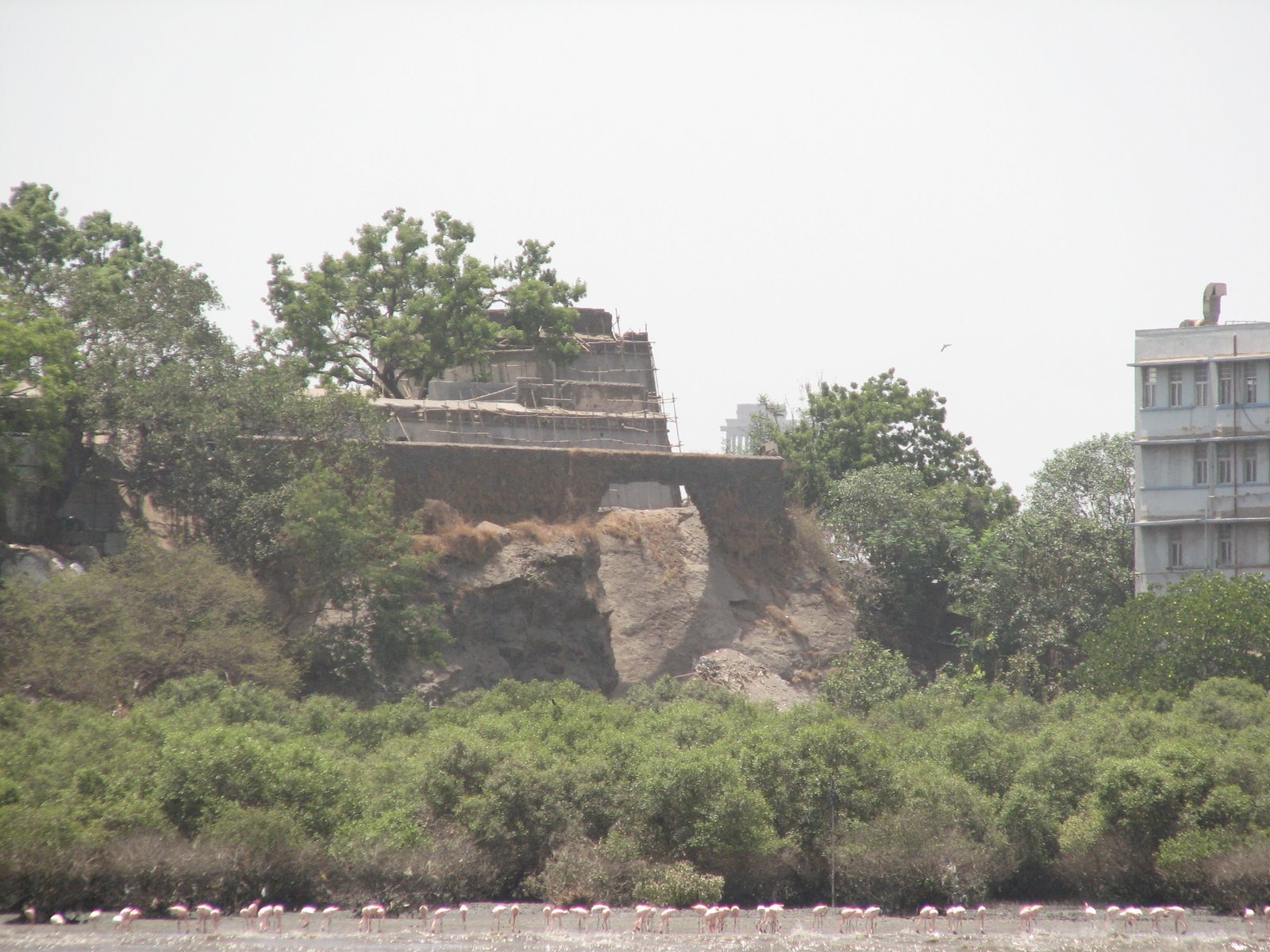
One of us wanted to alight at Sewri, so the boat was taken there. Due to rocks under water there was a bit of delay for this, but ultimately it came through. Then we began our journey towards the birds. We could see the ruins of Sewri Fort on the coast, which we missed on the last visit to Sewri. This is the fort to be visited in the near future.

The Sewri Fort with Flamingos at the bottom.
The water had quite risen, even though at the deepest it was just 3-4 feet. The Flamingos were now standing with their feet almost in water. This was the time for them to leave for the dry lands. They would come back here with the low tide.
Meanwhile there were two people with pro-looking cameras who were in a smaller row boat, who went really close to the Flamingos. I wish I was there in that boat. Next time we take that boat instead of this bulky one so that we can get really close to the pink avians we have come to see here. But that is for the next time.
So one by one each flock of Flamingos was going to the dry lands. We went for one of last remaining ones. When they fly in rows they make a scene to watch. Also when they start to fly they take a sort of ‘run-up’ before they get airborne. We could see all this happening in a wave like fashion, as when one of the Flamingos got off the rest of the flock followed.

Just taking the flight


Videos of Flamingos in flight.
These words, photos and videos cannot capture the true beauty and awe of witnessing this thing phenomenon; you have to see it with your own eyes to understand what I mean…
When all were gone we left for the Mahul jetty and then back to the Centre. The return journey was much more easier as the water was now high, hence opening pathways which were not accessible initially. The total cost of the trip went to Rs. 100 per head for the ride, which was totally worth it. So you too find the road to Mahul and meet the pink avians if possible this year.!!!
So till next time ciao…
P.S. Which ones did we see?
Although it was said that we only saw the Lesser Flamingo, after looking at the features of the Greater Flamingo in Salim Ali’s book, we came to a more confusion. The final conclusion was that we saw both the species!!
Here is what Salim Ali’s book says about the identification of two species.
Greater Flamingo
Field Characteristics: A long-necked rosy white stork-like bird, with a heavy pink bill, turned down at an angle from about half its length. Sexes alike. In flight outstretched legs and neck, and the black bordered brilliant scarlet wings are diagnostic.

Lesser Flamingo
Field Characteristics: Upper mandible not overlapping with lower. Bill dark colored with crimson feathers around its base. Plumage darker rose-pink than in the flamingo. Size smaller. Crimson and dark underwings, shorter trailing legs in flight diagnostic.

So what do you say from the images and the sightings that we have?
Me and Ritesh concluded that we saw both!
Correct us if we are wrong…
Ciao
Reference

The Book of Indian Birds
Salim Ali
Oxford, 1996

A Sociological Perspective On Education Part 1

 
Education is a part of an individuals becoming a social member. In this article we are considering the question of what education is from a sociological framework. What functions in the society actually the process of education serve? So we are considering two main questions viz.
  1. What is the role of education in the society?
  2. Why are the different social groups differing in their educational levels?
The idea of formal education for the masses is very recent. Only after the industrial revolution the masses were provided with free, compulsory, education by the state. Why? Earlier the education was limited to a few people who were rich enough to afford it or were part of the clergy. The same case was in the Indian context also. There were no state run “schools” which made sure that the education would be provided to the masses.
 
But in the last 100 years or so, education has become a major growth industry. And when anything becomes a commodity, the classical demand and supply theory does come into picture. The same has happened with education in the contemporary era. Now higher education being a prized commodity, the consumers are those who can pay for it.
 
First we take into account the functionalist perspective on education. The two questions that we have started with are
 
“What are the functions of education for the society as a whole?”
In the functionalist perspective this leads to an assessment of the contribution made by educational to the maintenance of the social structure.
 
The other question is:
“What are the functional relationships between education and other parts of the social system?”
This leads to analysis which examines the relationship between educational and the economic systems for example.
 
The functionalist view point in general tend to focus on the positive contributions made by education to the social structure.
 
We now consider the stand points of various functionalists’ on this issue.


According to Durkheim the major function of education was the transmission of society’s norms and values.
 

Society can survive only if there exists among its members a sufficient degree of homogeneity; education perpetuates and reinforces this homogeneity by fixing in the child form the beginning the essential similarities which collective life demands.

Without these “essential similarities” the social life is impossible. The creation of social solidarity is an essential task for the formation and sustenance of the societies; and education does this. Durkheim argues that:

To become attached to society, the child must feel in it something that is real, alive and powerful, which dominates the person and to which he also owes the best part of himself.


Education and in particular, the teaching of history, provides this link between the individual and the society. This view can be illustrated by the educational practice in India. The common curriculum developed by NCERT has helped to instil the shared norms and values into a population with diverse backgrounds. It has provided a shared language and a common history for immigrants from every country in Europe. The Indian student learn about the great leaders, the freedom movement and the heritage that they have. In every textbook the pledge that is presented actually socializes the student into a commitment to society as a whole. You can look at the other article in which the history and its relation to the curriculum is present.
 
Durkheim argues that in complex industrial societies, the school serves a function which cannot be provided either by family or peer groups. Membership in the society as a whole is not based on kinship or personal choice. In the school the individual must learn to cooperate with those who are neither their kin nor their friends. Thus the school provides a small scale model for the society.
 

It is by respecting the school rules that the child learns to respect the rules in general, that he develops the habit of self control and restraint simply because he should control and restraint himself. It is first initiation into austerity of duty. Serious life has now begun.

Also Durkheim argues that education teaches the individual specific skills necessary for his future occupation, which is particularly important in the industrial societies where a complex division of labour exists. The social solidarity in the industrial society comes from the interdependence of the labour in the process of production. The necessity of combination produces cooperation and social solidarity. The schools thus transmit both:
  1. The general values which provide ‘necessary homogeneity for social survival.’
  2. The specific skills which provide ‘necessary diversity for social cooperation.’
The industrial society is thus united by value consciousness and a specialized division of labour. Durkheim assumes that the norms and values of transmitted by the educational system are those of the society as a whole rather than of the ruling elite or ruling class. This produces a very different view of the role of education in the society.
 
 
Parsons argues that after the primary socialization within the family, the school takes over as the ‘focal socializing agency’. The school acts as a link between the family and the society as a whole, thus preparing the child for his adult role. In the family the child is treated in terms of ‘particularistic’ standards whereas in the society the standards are ‘universalistic’. By particularistic it is meant here that in the family the child is treated as their particular child rather than using yardsticks which can be applied to everybody; and by universalistic it is meant that the child is judged in terms of yardsticks which are applicable to all individuals.
 
Within the family the status of the child is ascribed, by birth. But the status in adult life is largely achieved. Thus the child moves on from the particularistic standards in the family to the universalistic standards of the society in general. The school is the preparing ground for this transition. The school has universalistic standards against which all the students are measured, these are independent of the sex, race, family background or the class of the student. The schools operate on meritocratic principles; status is achieved on the basis of merit. This is one of the essential aspects of the modern industrial society, where meritocratic principles are applied to all its members. The children are ‘trained’ to be the future citizens in the schools; they are imparted with the basic values of society. This value consensus is essential for the society to operate smoothly. Two major values that the schools inculcate in the students are:
  1. Value of achievement.
  2. Value of equal opportunity.
The value of achievement is itself fostered by rewarding the students which have high levels of achievement; and by placing the individuals in the same situation in the classroom so allowing them to compete on equal terms in examinations, schools foster the value of equality and opportunity. These values have an important role to play in the society as a whole. An advanced industrial society requires highly motivated, achievement oriented skilled workforce; and the school prepares the students exactly for this. All the students high and the low achievers see system as just and fair, as they all had an equal chance to begin with.
 
Another function that the school serves is that of selection of the individuals for their future role in the society. By testing, evaluating the students for their skills and capacities they can select the future jobs for which the future citizen is best suited for. Thus the school is seen as a major facilitator in the role allocation for the future citizens.


Kingsley Davis and Wilbert Moore
 
Davis and Moore agree with Parsons about the role allocating function of the school but they link educational system more directly to the social stratification. The social stratification is seen as a mechanism which ensures that the most talented and able members of the society are allocated to those positions, which are functionally most important to the society.
Though the thoughts of Davis and Moore represent the common sense view of education, there are certain criticisms of them. Particularly important is the questionable relationship between academic credentials and occupational reward is loose. Another reason is doubt about the proposition that the educational system grades people in terms of ability, it has been argued that the intelligence has little effect upon educational attainment. Finally there is considerable evidence that suggests the influence of social stratification largely prevents effective grading of individuals in terms of their abilities.
Criticisms: 
References:
Sociology: Themes and Perspectives
Harlambos and Heald
Oxford 2002

Zero: A history of the idea and the number, its development and evolution

For a proper understanding of the evolution and the need for the concept of zero we need to understand how our current number system has evolved from its ancestors. The very need for the concept of zero did not arise till the number systems themselves were well developed. The advancement in the number system necessitated the need for the concept of zero as we now know it. We can identify two distinct manifestations of zero; one is zero as a placeholder and the other is zero as a number, the former has  much earlier origin than the later.
Humans probably before having the concept of numbers or counting then, would have begun with enumeration. By enumeration it is meant that we simply keep a track of objects in a collection or a set by matching the objects with other objects used as counters. A shepherd can keep the track of sheeps in the flock, by keeping pebbles which are equal in number to the number of sheep s in the flock or equivalently [if possible] by counting body parts. Then just by matching each sheep with each pebble the record of number of sheep s can be maintained. When the number of sheep s is increased or decreased the same number of pebbles or other counters can be increased or decreased correspondingly. The other counters that one can have for this type of counting can include the human body itself. In fact many primitive societies do indeed have a counting system based on the body parts. This is the most basic system of counting that we can have. No language is needed for such one-to-one counting.
When the languages developed, particular words were created for various body parts, so these words were used instead of the body parts themselves. This is a transition from enumeration to numeration. Thus one has to remember only the word names in order for counting. But this does not imply the idea of cardinality of number being present in this numeration. For the notion of cardinality of a number to be used in the idea of numeration it required some time. When the questions were asked in the form How many…? in the ancient texts, the answers to these type of questions are given best in terms of the cardinal number. From this further growth would be, the concept of ordinality i.e. the order of things is not important when counting objects. It relates to the fact that the last number enounced in a set not only assigns a certain name to the last object in the set to be matched but also tells us how many objects are there in that set altogether.

The further development of this numeration is the formation of numeration systems. The need for the number systems typically arose from the following question:

What is to be done when the finite ordered sequence of counters is exhausted, yet more objects remain to be matched?

This particular question was answered in different ways only one of which led us to the current number system we have. One of the most simple solutions to this is to extend the ordered sequence of counters. So that we invent new symbols or names to accommodate the excess objects that are to be matched. But this approach makes no sense when we have large number of objects that are to be matched.
A simpler way which lends itself well to the written representation, was extension by repetition. The extension by repetition implies a number system which is based on the additive principle. Most of the primitive number systems are based on the additive principle. Here the figures are entirely free. Their juxtaposition entails adding together their values. In a number system based on the additive principle it makes no difference where you place the symbols corresponding to the numbers. Some of the numbers systems based on the additive principle are; Egyptian, Cretan, Hittite, Greek, Aztec, Roman, Sumerian etc. As an example of the additive principle we consider the Egyptian system. In this system if we want to represent the number 5247 it can be represented in following ways:
When we break down the representation based on the additive principle we get the following:
Thus we see that in the representation of a number in the number systems based on the additive principle. Since addition is both commutative and associative, irrespective of where we place the base numbers the final number that is represented by the various combinations of these numbers remains the same.
This system though seems simple puts a lot of cognitive load on the user. First of all there are different symbols for different numbers and in many of these number systems the symbols have some intuitive association [at least in the lower range] to the number that they represent. So to represent large numbers a large number of different symbols were to be used. In our example of representing the number 5247 in the Egyptian hieroglyphic notation  we have used a total of 18 symbols. Many times for representing large numbers new symbols had to be introduced. The arithmetic operations with these systems presented another difficulty. The number systems based on the additive principle are not well suited for arithmetic operations. For example consider the following sum in the Roman notation:
The above sum gives us no clue to what is supposed to be done. Though there are methods to perform this operations, but the procedures involved are very complicated. The above sum in the current notation would be:
In the number systems based on the additive principle the number signs are static in nature, which have no operational significance. The number signs in this case are more like abbreviations which can be used to write down the results of the calculations performed by some other means. To do arithmetical calculations, the ancients generally used auxiliary aids such as abacus or a table with counters.
The enumeration, numeration as we have seen do not have any requirement for the concept of zero as a numbe
r or a placeholder. The same is true with the number systems based on the principle of addition, in these systems there is no requirement of the concept of zero.
The next step in the evolution of the number systems was the hybrid system, called so because it involves use of both addition and multiplication. In the hybrid system when the symbols for lets say symbols for 1000 and 5 are presented together, they meant 5 x 1000 = 5000, whereas in the additive system they will mean 1000+5=1005. In the hybrid system there were basic symbols for the numbers, and symbols for various powers of the base, for example in a base 10, system the symbols for 100, 1000 etc. These number systems used the additive principle for representing numbers below 100.
In case of complete hybrid systems there were special symbols for the numbers 1 – 9, and all numbers including the tens were represented as a product of these base numbers and the powers of 10. This increased the range of numbers that can be represented. The notable hybrid systems are Assyro-Babylonian, Phoenician, Singhalese, Mari, Chinese, Ethiopian, Tamil, Malayalam, and the Mayan. We consider an example from the complete hybrid systems to represent the number 5247 from \cite{uni1}.
When we break down the representation based on the multiplicative principle we get the following:

The hybrid systems thus need a specification of the powers of the base which, determine the value of the number in a given position. This brings us a step closer to the positional number systems based on the multiplicative principle. The hybrid system are not all forgotten and are still in use today. When we verbally read a number it is more of a hybrid number system that we use that a positional number system. That is to say when we read the number 5247, we spell it out as five-thousand two-hundred and forty-seven. Here when we verbally read a number we also explicitly give its corresponding powers just like in case of the hybrid number system. Even in this case the need for zero is not there, the hybrid systems can work without the use of the concept of zero.
So to conclude the hybrid systems are  “Systems based [at least after a certain order] on a mixed principle [both additive and multiplicative] that invokes multiplication rule to represent consecutive order of units.”
We now move to the positional systems or multiplication based systems. These systems have a more abstract representation. The value of a figure in these positional systems varies according to the position in which it occurs in the representation of the number. Due to this the coefficients of the power of the base, into which the number has been decomposed appear. For example in a particular representation the actual value of a number, lets say 5 will depend on which position 5 is present in. If 5 is present in the units place then it represents 5, when it is present in the tens place it represents 50, and so on. If in the hybrid system if we remove the symbols used and just have the numbers only we have a positional number system. In this case the powers of the base for our case take base as 10, are implicitly figured out from the position of the numerals in the representation of the number. We know that in the positional representation of the number 5247, 5 is in the thousands place, 2 is in the hundreds place etc. Once this order is fixed then can we represent a number without any ambiguity? If we just consider the coefficients of the number 5247, the the answer to this probably seems to be true. But is it always so? For answer to this consider another example. Suppose we want to represent a number 1043 in the positional number system. In case of hybrid number system the representation would be like this:

so if we now drop the powers of the base, and just take the coefficients we are left with:

But this is not correct, since 143 is another number and not 1043.Similarly if we take just the coefficients of the number 10403, they are again 143. In case of the non-positional system this was not a problem, since every power and the corresponding coefficient was made explicit. But here if we just consider the coefficients of the number in a particular base, we cannot be sure that the number that we are representing is correct, unless we know for sure that a particular coefficient corresponding to a particular power is not present. In case of 1043 we have the coefficient of 100 absent. Some of the earliest positional systems that were developed suffered from the same problem. In case of the Babylonian system, we are not sure of how to read a particular number in many clay tablets, and the number has to be guessed from the context of the problem. Since the Babylonians used a base of 60, so a number [lets take 5247] was represented as:

In this case there was no ambiguity in base 60 number would be written as [1;27;27]. But even in this case there was no guarantee that the number represented is the number that we want. Suppose if we want to represent 3627 in this notation, then it would be represented as:

which is very easy to confuse with

Thus we see that in case of the positional number system we required a notion that tell us whether a particular coefficient is absent. This requirement initiated the need for the concept of zero. So the discovery of zero was therefore a necessity for the strict and regular use of the rule of the position, and it was therefore a decisive stage in the development of mathematics. So how do we make sure that something is not present in a particular position in a given positional representation of a number. It becomes essential then to have a special sign whose purpose is to indicate the absence of anything in particular position. This thing which signifies nothing, or the empty space, is in fact the \textsl{zero}. As \cite{uni1} pg. 668 puts it: “To arrive at the realisation that empty space may and must be replaced by a sign whose purpose is precisely to indicate that it is empty space: this is the ultimate abstraction, which required much time, much imagination, and beyond doubt great maturity of mind.”
The concept of zero has been discovered three times in the history independently. It was discovered first by the Babylonians, the Mayans and the Indians. All these three civilizations used the positional number system for which the concept of zero is needed. The Babylonians tried to get away with this difficulty by l
eaving empty space where the missing  coefficients of particular order were to be found. Hence they would write a number such as [1; 6] for lets say 3606. But this did not solve the problem completely. In copy or reading these spaces could be overlooked, and particularly when two or more space were to be given it could be confused with one space. But since the Babylonians has the base as 6o the need for writing numbers with zero in between arises on a very few occasions than it does in the number system with base 10. In case of the sexagesimal numeration only in 59 integers below 3600 this arises; as compared to 917 cease in the base 10 system \cite{boyer}. The Babylonian zero is the first zero to arrive on the scene. To denote absence of a coefficient of a particular order in their representation of the number, the Babylonians used a special sign [after fourth century BCE], which is the a cuneiform sign looking like a double oblique chevron. The Mayans developed their positional system with base 20, but they were not consistent with the use of the powers of the base after the third position \cite{uni2} pg 670. The Mayans understood the concept of zero sign, but they did not have its operational usability due to their inconsistent positional system. In case of the Babylonians it was never understood as a number synonymous with empty and never corresponded to the meaning of null quantity. So we see that in spite of having the notion of zero the Mayans and teh Babylonians did not get much further in this. The Mayan and the Babylonian zeros are as given in the figure.
If we work out the number represented in these notation the numbers are:
In the Babylonian notation.

In the Mayan notation.

The credit of having a well conceived positional system, which is operationally useful goes to the Indians. This step was taken by simplifying the hybrid notation, by suppressing the signs indicating the powers of the base. This required a much higher level of abstraction: the zero. This can be regarded as “… the supreme discovery of mathematicians who soon would come to extent it, form its first role of representing empty space, to embrace truly numeric meaning of a null quantity.” The Indian civilization was the only one to achieve this great feat. This system came up as a result of conjunction of three great ideas :
1.The idea of attaching each basic figure with signs removed from intuitive associations.
2. The idea of a positional number system, in which the value of a number depends on its position in the representation.
3. The idea of a full operational zero, filling the empty spaces of missing units and at the same time having the meaning of a null number.
In the system thus developed it does not matter what signs or base we use for the system, if it rests strictly and rigorously of the principle of position and incorporates the full concept of the symbol for zero. The discovery of zero in India and the place value were inventions unique to the Indian civilization. The roots of the development of the positional number system in India can be traced to the use of spoken sanskrit [संस्कुत] numeral system [Treatment of the development of Indian positional system follows from \cite{uni1}, \cite{uni2}]. The sanskrit spoken language has for each power of ten an individual name, “… so that to express a given number, one only had to place the name indicating the order of units between the name of the order of units that was immediately below it and immediately above it.” In fact there are names to the powers of 10 till 10^140 \cite{uni2} pg. 134. This is what is required in a positional number system. From the sanskrit spoken numeral system the Indian system of numerical symbols was formed. As soon as place value system was rigorously applied to the nine simple units, the use of a special terminology was indispensable to indicate the absence of units of a particular order. The sanskrit language already possessed the word shunya [शुन्य] to express void or absence, which also an element of mystical and religious philosophy. So to express the new mathematical notion of zero the term shunya could be used. This is how the word came to perform the function of zero as a part of the counting system.
Indian mathematicians before discovering the place value system, used their fingers or concrete mathematical devices. The most common was the abacus; from left to right, the columns representing the various powers of ten. The first nine numerals were traced in sand or dust, inside the column of a particular decimal order. Thus the number 5247 would have been represented in the following manner :
If a particular order of units was missing, one only needed to leave that particular column empty. Thus for representing 5047 we would write:
So with all this the necessary ‘ingredients’ for the creation of the written place value system had been amassed by the Indians:
  • Distinct representation of one to nine numbers, which had forms unrelated to the number they represented.
  • Discovery of the place value system.
  • Invention of the concept of zero.
Still some things were still absent for the perfection of the number system:
  • The nine numerals were only used in accordance to addition principle for analytical combinations using numerals higher than or equal to ten, the notation was very basic and limited to numbers below 100,000.
  •  Place value system was only used with sanskrit names for numbers.
  • Zero was only used orally.
The only thing that remained was to combine these ideas. By using the nine bramhi [ब्राम्ही] numerals on the dust abacus this stage already had been reached.
The two methods of expressing the numbers bramhi numerals and sanskrit names of numbers were known to the Indian mathematicians. In the dust abacus the numbers were drawn in contemporary style. The numbers in sanskrit were expressed in orders of ascending powers of ten; from the smallest to the highest. So that 4769 is written as:
And it is read in sanskrit as:
नव शष्टि सप्तशत् च चतुरसहस्त्र
Meaning: nine sixty seven hundred and four thousand.
In the written numerals however the opposite order was used. The evidence for these methods goes back to third century BCE. IF we look at these two opposite ways of representing the number, indicates an inconsistency. This is what the Indian mathematicians expressed as :
अंकानाम वामतो गति:
Meaning: principle of the movement of numerals from the right to the left.
Since the brahmi had a limited numeral base [highest number expressed was 90,000], so any calculation larger than this was to be expressed in the sanskrit names for the numbers. In the dust abacus extremely large computations could be performed, and the successive columns in the abacus always rigorously corresponded to the consecutive powers of ten. The same mathematical structure was present in the sanskrit counting system. Thus each system was a mirror image of the other. Though the numbers are read from the right to the left from the smallest to the largest. The structure of the abacus is such that the mathematician has no other choice but to follow the principle
अंकानाम वामतो गति: principle of the movement of numerals from the right to the left.
The solution to write a number in this way was to start with the column for the simple units. This led to the abandonment of the old system. By beginning with highest power of ten, one immediately knows the size of number we are dealing with, but this did not facilitate drawing. Hence the opposite system was adopted; no matter how high a number, there could be no mistake as to which column to write it in. This was conserved when the positional notation was invented using numerical symbols.
All this lead to the following notation, “the numbers reading from left to right in descending powers of ten, constituting a faithful reproduction, minus the columns, of its representations on the abacus, as well as reflection of the abridged form of the corresponding sanskrit expression. Thus came the decimal position values which were given to the first nine numerals of the old notation. This was the birth of the modern numerals.
Now to convey the absence of units in a particular decimal order a new symbol was necessary. This was not required in the case of the abacus, but in the new positional system it became a necessity. The  language already had the word symbol that expressed the concept zero, the shunya, it also conveyed the concepts such as sky, space etc. The circle has been considered as the representation of the sky, hence through a simple transposition of ideas it came to represent the concept of zero. Another sanskrit term representing zero was bindu [बिंदु], which literally means “point”. The point is the most insignificant geometrical figure, but for Indians the point represents the universe in non-manifest form. The point is the elementary of all geometrical figures, with potential for creating all the shapes, and hence was associated with zero. Zero is the most negligible quantities, but most fundamental of all abstract mathematics. The point also thus came to represent the zero. The two forms of the Indian zero are as shown in the figure below.The most likely time that the positional value system and zero were discovered is in the middle reign of the Gupta dynasty which ruled the Gangetic plains from about 240 to about 535 CE.

Along with the loaded philosophical connotations that were associated with the word shunya it served to mark the absence of units within a given decimal order in any position; the point or the little circle were used in the same way. This zero was also a mathematical operator; if placed after a number, it meant the number was multiplied by ten. Thus the three significant ideas that we have mentioned earlier were combined to give us the modern positional number system. Soon after this the concept of zero was perfected. Zero was given the status of a number, i.e. to say its cardinality was recognised. After this various arithmetic operations on and with zero were defined, which led to foundation of modern algebra .
The Arabs got this positional number systems from the Indians. The Europeans in turn got this system from the Arabs. The origin of the word zero or cipher can be traced back to this transfer of the positional number system to the Europeans from the Arabs. The Indian word for zero is shunya, from this the Arabic name sifr meaning vacant was given. When this was transferred to the Europeans the sound was kept but not the sense; Fibonacci called it zephirum. This was then passed over as zeuro, ceuero, and zepiro, which finally led to the current day synonyms which are the zero and the cipher.
References
 
Boyer C. B. :
Zero: The Symbol, the Concept, the Number
National Mathematics Magazine, Vol. 18, No. 8 , May 1944
Irfah G. :
The Universal History of Numbers I
Penguin, 2005
Irfah G. :
The Universal History of Numbers II
Penguin, 2005
Ore O. :
Number Theory and Its History
Dover, 1948

Kohlberg’s Theory of Moral Development


Moral Development

In this article the Kohlberg’s Theory of Moral Development is discussed. Kohlberg’s theory is a direct continuation of the Piaget’s work on the same issues. Kohlberg’s methodology, and why he considers structure more important than content are discussed. The key aspects of the typical reasoning in the moral judgments of each level are discussed. The developmental issues and the criticisms of the theory are presented in the later sections. Also the various aspects of morality being context, culture and time dependent are discussed.

 Introduction
The very word ‘moral’ colloquially means of or relating to principles of right and wrong in behavior. Moral behavior as understood in a everyday notion, relates to the behavior of an individual which is acceptable in the contemporary society. One thing is for sure that the moral development is not innate, it comes through our own thinking about the moral problems, with inputs from the interactions that we have with the society. There are three major components of morality, viz. the emotional component, cognitive component, behavioral component. The emotional component reflects the fact that we can relate to the harm that we cause to other person. The cognitive component emphasizes the fact that
thinking about the social understanding helps us to make more elaborate judgment’s about actions. Finally the behavioral component relates to the fact that exposure to morally relevant thoughts and feelings can only increase the chances that we will act accordingly but does not guarantee the same.

The biological and the psychoanalytic theories focus on emotional aspect of the morality, cognitive developmental theories on the moral thought, whereas the social learning theory has focused on the behavioral aspects. These theories disagree with what is the primary cause, but the trend that is seen
in the moral development is that a person starts from “externally controlled responses” and goes on to “behavior that is based on inner standards.” In the following sections we mainly consider the theories of moral development of Piaget and Kohlberg which elaborate the cognitive developmental aspect of
morality.
 Piaget’s Theory of Moral Development 

From this perspective the maturity in cognition and social experience lead to the development in the moral understanding of the child as a whole. Piaget’s work on the aspect of the moral development in children is the pioneering work in the cognitive development aspect of morality. For studying the
children’s ideas about morality Piaget depended upon open ended clinical interviews. By clinical interviews it is meant that a child is asked some questions and probed futher in the reasoning behind a particular response given. Piaget in particular asked about the rules in game of marbles. The children were also given stories in which the character’s intentions [ either wrong or right ] and the consequences of such a action were varied. The best kno twn such example is that of John and Henry. In these stories each of the boy breaks different number of cups, one with ‘wrong’ intention and other with no intention. The children are asked the question that which one of them is naughtier and why. The two
stories are like this [1]:

Story A: A little boy who is called John is in his room. He is called to dinner. He goes into the dining room. But behind the door there was a chair, and on the chair there was a tray with fifteen cups on it. John couldn’t have known that there was all this behind the door. He goes in, the door knocks against the tray, bang go the fifteen cups and they all get broken!

Story B: Once there was a little boy whose name was Henry. One day when his mother was out he tried to get some jam out of the cupboard. He climbed up on to a chair and stretched out his arm. But the jam was too high up and he couldn’t reach it and have any. But while he was trying to get it he knocked over a cup. The cup fell down and broke.
The responses that Piaget got from children between ages 5 and 13 he could identify two general stages of the moral understanding viz. heteronomous and autonomous morality.
 Heteronomous Morality [ ∼ 5 – 10 years]
Before the beginning of this stage the children show little understanding that rules govern the social behavior. At about 5 years of age the children enter the period of heteronomous morality and begin to show concern for the rules. The word heteronomous means under the authority of other, the children view the rules as handed down by the authorities. The rules are unvarying and require strict obedience. The factors that limit the child’s understanding according to Piaget are:
1. The unquestioned respect for rules and those enforce them.
2. Egocentrism.

As young children think that view of all the people about the rules are same, their moral understanding is characterized by realism, which means that they regard the rules as “external features of reality, rather than as subjective, internal principles that can be modified at will.” The presence of realism and egocentrism leads to young children focussing on the objective consequences rather than the intent. In the stories about John and Henry, John is considered more naughty because he broke more cups, even if he did not wrong intent in doing so. Another thing that the children having heteronomous morality believe in is the concept of immanent justice i.e. they believe that wrong doing always leads to punishment. The punishment thus received is inescapable and can be through a variety of events.

Autonomous Morality [ ∼ 10 years and above]
The autonomous morality is the next stage in Piaget’s theory of moral development. Through the interactions with peers children become aware that people have different views
than their own. They realize that intentions are more important than the objective consequences in moral judgments. Thus
in the two stories mentioned, they do not consider John as naughty, even if he broke more cups because he simply did not intend to do so. On the other hand Henry is considered naughty as he has intent to steal the jam, even in the process he broke less cups. The conflicts with peers are settled in mutually beneficial ways. The concept of reciprocity is developed in children. By reciprocity it is meant that, “they express the same concern for the welfare of  others as they do for themselves.” The most familiar expression of reciprocity is the Golden Rule:

Do unto others as you would have them do unto you.

Reciprocity is the main driving force in the understanding of children in autonomous morality. Children realize that, “rules are flexible, socially agreed on principles that can be revised to suit the will of the majority.” The children can question the logic of the rules and just do not blindly follow them, they can realize that at times there may be good reasons to break a rule. Punishment are also seen in the light of principle of reciprocity. The punishment should be meted in an even-handed way to everyone responsible for the offense, thus guaranteeing justice for all.

Evaluation of Piaget’s Theory
Piaget’s two stage theory gives a general account of the development of the moral understanding in children. The essential aspects of the theory relate with Piaget’s view that child’s development in general goes through a stagewise manner dependent on the age. The followup studies indicate the conclusions of Piaget that “moral understanding is supported by cognitive maturity, release from adult authority, and peer interaction. We now consider some aspects of this theory that have been questioned.

Intentions and Moral Judgments


Considering the stories of John and Henry, they present a biased view of child’s reasoning as more damage is coupled with good intentions and vice versa. If the same scenario is presented on the same grounds of damage, even the younger children can judge the ill intentioned person as naughtier. Also by the age of 4 years children are able to recognize the difference between lying and truthfulness, two morally relevant intentional behaviors. Thus the capacity to consider intentions appears in children much earlier than Piaget believed a deeper understanding does not arise till they reach autonomous morality.
Reasoning About Authority

Piaget assumed that heteronomous children assume the authority of adults with unquestioned respect, but studies have revealed the contrary. The preschoolers judge stealing, hitting as wrong regardless of the opinions of authority. Also peers can be regarded as authorities, e.g. a class captain. Thus “young children’s concepts of authority do not focus solely on status and power.” Contrary to
this many factors are responsible at an earlier age than assumed by Piaget, these factors include, “the attributes of the individual, the type of behavior to be controlled, and the context in which it occurs.

Stagewise Progression

Another aspect of Piaget’s theory is that characterstics associated with each stage do not correlate very highly, as would be expected if each stage represented a “general unifying organization of moral
judgments.” Thus child’s moral thought appears as “patchwork of diverse parts.” But to this Piaget recommended that, “the two moralities be viewed as fluid, overlapping ‘phases’ rather than as tightly knit stages.” Also studies indicate that the moral development goes beyond the two stages of Piaget. Kohlberg’s work presented in the later sections is a direct continuation of the Piaget’s work on moral development.

 Kohlberg’s Extension of Piaget’s Theory

Lawrence Kohlberg [1927 – 1987] following Piaget’s work on the aspect of moral development in children began on similar lines the search for stages of moral development and study of how moral understanding is intimately tied to the cognitive growth. The methodology that Kohlberg adopted for the study of moral was same of Piaget viz. the clinical interviews, but instead of asking children to
judge the naughtiness of a character of a story Kohlberg presented children with moral dilemmas. A moral dilemma is “a conflict situation presented to subjects, who are asked to decide both what the main actor should do and why.” In a moral dilemma two moral values are pitched against each other. The conflict in the mind of sub ject with regard to these two moral values, and its subsequent
resolution serves as an index of the moral development. This enables the experimenter to get a better picture of the reasoning behind the moral decisions. The best known moral dilemma is the the ‘Heinz dilemma,’ in which the subject is presented with conflict between two moral values viz. obeying the law [not stealing] and value of human life [saving a dying person] [2]:

Heinz Steals The Drug
In Europe, a woman was near death from a special kind of cancer. There was one drug that the doctors thought might save her. It was a form of radium that a druggist in the same town had recently discovered. The drug was expensive to make, but the druggist was charging ten times what the drug cost him to make.
He paid $200 for the radium and charged $2,000 for a small dose of the drug. The sick woman’s husband, Heinz, went to everyone he knew to borrow the money, but he could only get together about $ 1,000 which is half of what it cost. He told the druggist that his wife was dying and asked him to sell it cheaper or let him pay later. But the druggist said: “No, I discovered the drug and I’m going to make money from it.” So Heinz got desperate and broke into the man’s store to steal the drug-for his wife. Should the husband
have done that?

In the response received from the sub jects [72 boys of ages 10, 13 and 16 in the core sample] to the moral dilemma presented above Kohlberg was more interested in the structure than the content of the response. So just a ‘yes’ or ‘no’ response to the question presented above will not provide us with the reasoning behind this moral judgment. In fact for the first four stages that Kohlberg identified, both the responses are found with different reasoning at each stage. To find out this reasoning the ‘why’ questions are asked and the sub ject is further probed with other related dilemmas. Based on the different response he got from the children Kohlberg was able to classify them into various stages.
Kolhberg was able to identify three general levels and six stages in all for the moral development in childr
en.

Kohlberg’s Stages of Moral Development

Level I Preconventional Morality
At this level the morality of the person is externally controlled and can be identified with the main features of the Piaget’s heteronomous stage. The children accept the rules of the authority and the actions are judged by the consequences and not the intent. The moral understanding is based on
rewards and punishments.

Stage 1 Obedience and Punishment Orientation
This stage is similar to Piaget’s heteronomous stage of moral thought. The child regards the rules as fixed, handed down by adults which must be obeyed at all costs. The child is unable to take two points of view for the moral dilemma.
The typical pro-stealing and anti-stealing responses are as follows [Taken verbatim from [1]]:
Pro-Stealing: “If you let your wife die, you will get in trouble. You’ll be blamed for not spending money to help her, and there’ll be an investigation of you and the druggist for your wife’s death.”

Anti-Stealing: “You shouldn’t steal the drug because you’ll be caught and send to jail if you do. If you do get away, your conscience would bother you thinking how the police will catch up with you any minute.”

Stage 2 Individualism and Exchange
At this stage the children become aware that different people have different perspectives in a moral dilemma, but this awareness is very concrete. The right action is considered that satisfies ones personal needs. Reciprocity is considered as equal exchange of favors. The typical pro-stealing and anti-stealing responses are as follows:
Pro-Stealing: “The druggist can do what he wants and Heinz can do what he wants to do . . . But if Heinz decides to risk jail to save his wife, it’s his life he’s risking; he can do what he wants with it. And the same goes for the druggist; it’s up to him to decide what he want to do.”

Anti-Stealing: “[Heinz] is running more risk than it’s worth unless he’s so crazy about her he can’t live without her. Neither of them will enjoy life if she’s an invalid.”

Both the stages in the first level talk about punishment, but the perception in each stage is different. Whereas in the first stage punishment is linked with [proves] wrongness of disobedience, in the second stage on the other hand punishment is regarded as “simply a risk that one naturally wants to avoids.”
The stage 2 children are considered to reason at the preconventional level as they think “as isolated individuals rather than as members of society.” Also “they see individuals exchanging favors, but there is still no identification with the values of the family or community.”
 
Level II Conventional Morality

In this level as the name suggests the individuals continue to regard the conformity to social rules as important, but the reason not being self-interest but rather maintaining the “positive human relationships and the societal order.”

Stage 3 Good Interpersonal Relationships
The desire to obey rules in stage 3 is in the context of close inter-personal feelings such as love, trust and concern for others. The main belief is that “people should live up to the expectations of the family and community and behave in ‘good’ ways.” The stage 3 person has a capacity“ to view
a two-person relationship from the vantage point of an impartial, outside observer,” which supports this new approach to morality. The motives are considered to be important than the consequences. As in Piaget’s two stages similarly in Kohlberg’s stages, “there is a shift from unquestioning obedience
to a relativistic outlook and to a concern for good motives. For Kohlberg, however, these shifts occur in three stages rather than two.”
The typical pro-stealing and anti-stealing responses are as follows:
Pro-Stealing: “No one will think you’re bad if you steal the drug, but your family will think you’re an inhuman husband if you don’t. If you let you wife die, you’ll be never be able to look anyone in the face again.”
Anti-Stealing: “It isn’t just the druggist who will think you’re a criminal, everyone else will too. After you steal it, you’ll feel bad thinking how you brought dishonor on your family and yourself; you won’t be able to face anyone again.”
Stage 4 Maintaining the Social Order

In stage 4 person has a intent for the benefit of the society as a whole. The moral judgment and behavior is in the context of maintaining social order and no longer depend on the close ties to others. As the stage 4, “subjects take the moral decisions from the perspective of society as a whole, they think from a full-fledged member-of-society perspective.” The typical pro-stealing and anti-stealing responses are as follows:
Pro-Stealing: “He should steal it. Heinz has a duty to protect his wife’s life; it’s a vow he took in marriage. But it’s wrong to steal, so he would have to take the drug with the idea of paying the druggist for it and accept the penalty for breaking the law later.”

Anti-Stealing: “It’s a natural thing for Heinz to want to save his wife, but it’s still always wrong to steal. You have to follow the rules regardless of how you feel or regardless of the special circumstances. Even if his wife is dying, it’s still his duty as a citizen to obey the law. No one else is allowed to steal, why should he be? If everyone starts breaking the law in a jam, there’d be no civilization, just crime and violence.”

It might at the first glance seem that stage 1 and stage 4 sub jects are giving the similar responses, but the reasoning that the stage 4 is quite elaborative. Stage 1 children cannot elaborate the reasons, except that stealing will lead to jail, stage 4 respondents, on the other hand have a broade
r conception of the function of societal laws as a whole, which exceeds the capacity of the stage 1 child.
Level III Postconventional Morality

Individuals in this level move beyond the unquestioning support for the rules and the laws of their own society, hence the name. The morality for such individuals is “in terms of abstract principles and values that apply to all situations and societies.” The individuals in this level of moral reasoning with
a pro-stealing answer to the Heinz dilemma, the reasoning being of course different from the previous levels.

Stage 5 Social Contract and Individual Rights

The stage 5 individuals consider the rules as “flexible instruments for furthering human purposes.” They can argue for a change in the societal laws [considered to be unchangeable by the previous stages] when a good enough reason is pressent. At stage 5, people begin to ask, “What makes for a good society?” They begin to think about “rights and values that a society ought to uphold,” and
then see the society from these perspectives.
The typical pro-stealing response is as follows:

Pro-Stealing: “Although there is a law against stealing, the law wasn’t meant to violate a person’s right to life. Taking the drug does violate the law, but Heinz is justified in stealing in this instance. If Heinz is prosecuted in stealing, the law needs to be reinterpreted to take into account situations in which it goes against people’s natural right to keep on living.”

The stage 5 people regard society is “best conceived as a social contract into which people freely enter to work toward the benefit of all.” Even with some differences in the society the stage 5 people believe that rational people in the society would agree on some basic points. “First they would all want certain basic rights, such as liberty and life, to be protected, and second they would want some democratic procedures for changing unfair law and for improving society.

Stage 6 Universal Principles
The stage 5 respondents are strong believers in the democratic process. But during a democratic process he outcomes are not always just for the minority group. Hence Kohlberg believed “that there must be a higher stage–stage 6–which defines the principles by which we achieve justice.” At this highest stage the right action is defined by the self-chosen ethical principles which are valid for the humanity as a whole regardless of societal laws. Most of the social reformers and the moral leaders will fall in the stage 6. The claims of all individuals need to be looked at in an impartial manner respecting basic dignity of all people.
The typical pro-stealing response is as follows:

Pro-Stealing: “If Heinz does not do everything he can to save his wife, then he is putting some value higher that the value of life. It doesn’t make sense to put respect for property above the respect for life itself. [People] could live together without private property at all. Respect for human life and personality is absolute and accordingly [people] have a mutual duty to save one another from dying.”
The stage 6 is called as a theoretical stage as not many individuals are consistently able to respond at this stage. The fact that the moral dilemma presented is not very convincingly able to distinguish between stage 5 and 6 makes this more clear. One issue that can tell the difference between stage 5
from stage 6 is of civil disobedience. Stage 5 believe more in the democratic process so will be less willing to go in for a civil disobedience. The violation of the law is justified only when a right is at stake. In stage 6, in contrast, “a commitment to justice makes the rationale for civil disobedience
stronger and broader.”
 Theoretical Issues

In this section we briefly consider the main theoretical issues regarding the theory. They include the developmental aspects of the theory, the Piagetian stage concept in the context of Kohlberg’s theory.

How Development Occurs

Kohlberg’s views are strongly influenced by the Piagetian framework of child development. The stages of moral development are not seen as a product of maturation i.e. there is no “genetic blueprint” for the stages to occur. The socializing agents do not directly teach new forms of thinking. The stages
that are externally seen are a manifestation of one’s own thinking about moral problems.

Social experiences promote the development of moral thinking, by stimulating our mental processes. When we discuss with others, our view are challenged due to which we are force to think about ‘better’ positions that we can take. The stages of moral development reflect these broader viewpoints. Thus our interactions with the society and our own thought process combined gives us the ability to advance from one stage to the next.

The Stage Concept

As already mentioned Kohlberg being a close follower of Piaget, has taken the stage concept of Piagetian framework criteria very seriously. The following aspects of his theory are shown to be related to the Piagetian framework.

Qualitative Differences

The qualitative differences in the different stages is evident from the different response that is given by the individuals in different stages. Quantitatively the stages do not seem to have much differences.

Structured Wholes

The stages are not just isolated responses present given by the individual, but are a more general patterns of response that are found across many domains. Thus the stages are structured wholes in the sense that they truly depict the whole moral development of the individual which is valid across domains.
Invariant Sequence
The stages according to Kohlberg form an invariant sequence. The stages are skipped or moved in a random order. Mostly the cross-sectional data in which children of various age group were interviewed suppor
ts this claim of the invariant stage sequence. But the data from the cross-sectional studies are
not conclusive, as a child at higher age could have possibly skipped some previous stage. To resolve this issue longitudinal studies were undertaken. In longitudinal studies the same children are tested regularly after a period of 3 – 4 years. Almost all children in one of the longitudinal study moved through stages without skipping. Another aspect of moral development is that it is very slow and gradual process.

Hierarchic Integration

The knowledge that is learned at the earlier stages is not lost when the individual advances to the next stage, but is very well present in the individual. The higher stage persons are able to understand the arguments of the lower stage but consider it to be naive. When Kohlberg says that his stages are
hierarchically integrated, he means that people do not lose the insights gained at earlier stages, but integrate them into new, broader frameworks. Thia is a very important concept for Kohlberg because it explains the directional nature of the stage sequence. Since the stage sequence does not have a genetic blueprint, the previous stages must form a ‘platform’ for the next stages to emerge. Thus each new stage provides a broader framework for dealing with moral issues and is thus more cognitively adequate than the prior stage.
The stages of moral development also represent increasingly differentiated structures. The stage 5 people have abstracted the value of life, for example, has become differentiated from other considerations and say that “we ought to value life for its own sake, regardless of its value to authorities (stage
1), its usefulness to oneself (stage 2), the affection it arouses in us (stage 3), or its value within a particular social order (stage 4). Stage 5 sub jects have abstracted this value from other considerations and now treat it as a purely moral ideal.”
Universal Sequence
The sequence for the stages of moral development should be universal according to Kohlberg. By the term universal it is meant that it should be same across all cultures. Since different cultures bring up their children differently this [the universality of the stage sequence] is not naturally expected. Kohlberg’s response is that “different cultures do teach different beliefs, but that his stages refer not
to specific beliefs but to underlying modes of reasoning.”
Cross-cultural research shows that individuals in ‘technologically advanced’ societies move rapidly through the stages of moral development that from the societies which are not. Also in isolated communities nobody goes beyond stage 3. These studies indicate two possibilities, first that societal factors
that help the advancement of the stages are prevalent in the ‘technologically advanced’ societies, second that the method of evaluation is not suited for all cultures. This point is more elaborated upon later.
The number of years an individual completes in a school is an important and deterministic parameter in the moral development of individuals. Studies clearly indicate that the children who are educated higher levels show a better trend of moral development. The reasons for this particular finding could
be the social diversity that is encountered in the college campuses, introduces the people to the issues involving political and cultural groups.

 Moral Thought and Moral Behavior

The moral stages of Kohlberg’s theory do indicate the moral thinking of the persons, but whether this thinking actually translates into a moral behavior remains a question. We can actually be quite advanced in our moral thinking, but when it comes to moral behavior we do not actually are on the same level, this maybe due to practical reasons involved. Infact this is one of the criticisms of the theory. Hence a perfect correlation between moral judgment and moral action is not possible. But Kohlberg has given a particular relation regarding the moral thinking and behavior: “The two should come closer together as individuals move towards higher stages of moral understanding.” The
advancement in moral reasoning is related with many aspects of social behavior, particularly being more prosocial, this is consistent with Kohlberg’s prediction.

Moral Thought and Other Forms Of Cognition

Kohlberg states that moral development depends on cognition and perspective taking in a very specific way. Each moral stage requires certain cognitive and perspective taking abilities but these abilities alone do not guarantee that moral development will occur. Thus these cognitive and perspective taking abilities are deemed to be necessary but not sufficient for the moral development of the individual.
Criticisms

In this section we consider some criticisms about the Kohlberg’s theory. The two main criticisms that the theory faces are of gender bias and of cross-cultural differences. The other include the facts that are already mentioned viz. that moral thought and behavior are different. Also people tend to respond differently in real life and hypothetical situations [this particular aspect was seen during the presentation when asked about the moral dilemma regarding the help in exam]. The theory does not talk about moral development of very young children, where the methodology of moral dilemmas might not work very well. Also many researchers have questioned the very concept of a post conventional morality in Kohlberg’s formulation.

Gender Bias

Females tend to score not very well on the Kohlberg’s scale of moral development, very few females actually went above stage 3 in terms of their scores. The fact that Kohlberg’s stages were obtained from interviews with males, and hence reflect a decidedly male orientation was pointed out by Carol
Gilligan a co-author and associate of Kohlberg. According to Gilligan the advance moral thought for males and females has different ideals. For males the moral thought revolves around rules, rights and abstract principles, whereas for the females the moral thought revolves around interpersonal relations and the ethics of compassion and care. Thus the ‘scale’ of moral development has been ‘calibrated’ from a male perspective and it is improper to judge the moral development of females by this scale. In fact it has been found that the advanced moral thought revolves around rules, rights, and abstract principles.

The ideal for males the ideal of moral reasoning is impersonal justice, in contrast to female ideal of more affiliative ways of living. Women’s morality is more contextualized, it is tied to real, ongoing relationships rather than abstract solutions to hypothetical dilemmas. If these things are taken into account maybe females will score differently on the moral development. This difference is most
apparent when real life situations are given instead of hypothetical dilemmas. Although the current evidence “indicates that justice and caring are not gender specific moralities, Gilligan’s work has had the effect of broadening conceptions of the highly moral person.”
Cross-Cultural Differences

What Kohlberg has essentially done is that he has created a ‘moral yardstick’ with which he intends to measure the morality all the individuals in all cultures. Perhaps it might be the case that the aspects of morality that are rated very highly on Kohlberg’s scale are not considered to be significant in some other cultures. And it might be the case that the moral dilemmas presented for evaluation altogether fail to capture the post-conventional morality present in different cultures. The Kohlberg’s scale is highly Eurocentric [Western] and might fail to consider the aspects of morality that are alien to the European thought. For studying different cultures this ‘moral yardstick’ needs to be ‘re-calibrated’ keeping in mind the particular culture to be studied. Also presenting the same moral dilemma setup in a totally European background might not be a useful idea, the dilemma also needs to be contextualized taking into account the particular culture under study.

Reflections

The moral behavior and thinking in a society represent give us an insight into the philosophy and the culture of a society. The major influences that are responsible for the moral development of the individual according to Kohlberg are the parents, peers, education and the own thought process of the individual. The influence of religion is not at all considered in the Kohlberg’s developmental theory, whereas religion plays a significant role in the development of children at least in the young age. In fact most of the moral judgments that the individuals make are deeply influenced by the religion they follow. In this regard the position of some religion will be different than the other, so a follower of a particular religion will respond to the situation differently.

Let us take an example of clinical death. If asked with a moral dilemma that involves a person opting for clinical death [hence in a sense committing suicide], the responses that we receive are more likely to vary with respect to the religion of the respondents. Another controversial issue that would raise similar concerns is that of abortion [in a sense considered murder]. Another example on similar lines that could be taken is that of a hunter following a wounded prey, and a response can save or end the prey’s life. The responses in this case will depend on the sort of society the individual has been bought up in [vegetarian vs. meat eating].
The responses that we will get for these real life situations, which also touch upon the religious aspect of the moral judgments will be worth noting. For most of the people religion has the topmost priority in the decisions that are taken in their everyday life. Mostly the religious scriptures and hence religious values guide the moral values and hence moral judgments. A striking example in this regard in the Indian context is that of charity. The religion demands that people do daan [alms], and most people do it not because they feel for the poor, but because the religion demands so. Thus the religious values are conclusive many times in making moral judgments. The religious moral values are passed to the
young children through stories and epics [mostly of Level I Morality according to Kohlberg’s scale ] and also through their social interactions. These interactions form the basis of the moral judgment that a child makes in the future, and removing these influences can be very hard, as they can be even found in adults. But these age old morality which religion practices might be in many cases totally out of context and in the comtemporary society not of much value. Even then these cannot be overcome even by adults. A very good example of this the ‘moral police’ that are abound in India and elsewhere. ‘What is moral,’ is interpreted from some twisted interpretation of the so called
‘cultural values.’ Most of these ‘moral police’ don’t seem to put any thought of their own to the issues they consider as ‘immoral,’ instead what somebody says is blindly followed without any remorse. On Kohlberg’s scale the so called ‘moral police’ will be at stage 1.

So by asking morally relevant questions that are in direct conflicting with one’s outdated religious beliefs can really lead to one’s moral development in this regard.
We cannot really compare the moral values of the contemporary society with that of a society in the past. The rights and the principles that were the ‘guiding lights’ for people in the past might not be even considered in the todays society as relevant. Hence to compare the moral judgments of the people in the past with our own contemporary society does not help. Similarly to compare the moral judgments of two different cultures does not provide the index of moral development of a particular culture.

Even in the same culture when the socio-economic differences are vast the things that are ‘morally right’ for some of the individuals will not be considered as same by everybody. In the Indian context a particular example in this regard can be considered is that of the zamindaari system, the feudal system in India. Whereas the zamindaars considered their ‘moral right’ to own and cultivate large lands, this was not considered as right by the laborers. Or in the larger economic context the ‘moral right’ of the capitalists and the ‘moral right’ of workers do not coincide. In the recent past America’s ‘moral right’ for war was
executed by George Bush to wage a war with Iraq, and ma jority of the American public ‘morally’ supported the war without putting their own thought to it. They would also score for stage 1 in Kohlberg’s stages. So the issues which really matter in one’s perception of the different aspect needs to be taken into account when considering the moral stage of the individual. A person in the lower strata of the society might consider stealing from the society as morally justified [because it is due to society that he poor].
Another aspect that needs to be touched in this regard is that of level 6 of the Kohlberg’s stages of development. The trend that Kolhberg presents for a level 6 behavior is seen in many great spiritual leaders of the past. Infact most of the great leaders did regard their own abstract principles above the
societal laws.
When the world colonization began and the European Empires extended beyond the boundaries of Europe, another example of twisted morality can be seen. Many British authors incl
uding Rudyard Kipling regarded the Anglo-Saxon race as a race which was destined to rule, thus ‘morally justifying’ their atrocities against others. Thus it was a ‘moral responsibility’ of the British to rule India. We can hence see that the concept of being ‘morally right’ can be entirely context and time dependent.

The moral dilemmas do come in an individuals life very frequently. According to Kohlberg in the resolution of these dilemmas in the most broader sense result in the moral development in this regard. A very nice example of presenting a moral dilemma and bringing up moral development can be seen in the context of Indian independence. Gandhi’s non-violence principle is an example of moral dilemma that brought about the moral development of an entire Empire. On one hand with the non-violent crowds just marching through the country, the British were not ‘morally justified’ in attacking them, on the other hand that people can defy their ‘moral right’ to rule was unbearable for them. The British
became so frustrated by this ‘moral dilemma’ that even with all such military might they could not but defeat a non-violent revolt. The resolution of this ‘moral dilemma’ resulted in the ‘moral development’ of the British Empire, which thereafter lost its ‘moral right’ to rule the world.

 Summary 
As per Kohlberg’s three level, six stage theory, morality changes from concrete towards abstract, principled justifications for moral choices. Each moral stage en-corporates the previous ones and has certain cognitive prerequisites that are necessary for the development to occur. The moral development does not occur until there is a support present at various levels like family, peers, schooling and society at large. Although justice is given a emphasis more than that of care it does not underestimate the moral maturity of females. As the individuals advance through the stages the moral thinking becomes better related to moral behavior.

The index of moral development that is presented by Kohlberg by presenting the subjects with a moral dilemma needs to be taken with respect to the broader social and cultural context that the particular individual represents so that any bias that is present can be effectively eliminated.

References
[1] Laura Berk: Child Development 3rd Ed. Prentice Hall of India 1999
[2] W. C. Crain: Theories of Development Prentice Hall 1985
[3] Wikipedia

What is education?

What do we mean by education?

The word ‘education’ can be derived from one of two latin words or from both. These words are educere, which means ‘to lead out’ or ‘to train’ and educare which means to ‘to train’ or ‘to nourish’. But this etymology does not give us a understanding behind the term itself.
Colloquially it can mean the sort of training that goes in schools, colleges and universities.
We see some meanings by different people who were related to education and philosophy of it.
Mahatma Gandhi
Education is “an all round drawing out of the best in child and man – body, mind, and spirit.”
John Dewey
Education is regarded as the development of “all those capacities in the individual, which will enable him to control his environment and fullfill his possibilities.”
We see that the term education refers to two things: they point to education as the process of development of the individual form infancy to maturity a lifelong process.
J. S. Mill explains it thus:
“Not only does it include whatever we do for ourselves, and whatever is done for us by others for the express purpose of bringing us somewhat nearer to the perfection of our nature; it does more; in its last connotation it comprehends even the indirect effects of things of which the direct purposes are quite different, by laws, by forms of government, by the industrial arts, by modes of social life; nay, even by physical fact, not dependent on human will, by climate, soil and local position. Whatever helps to shape human being, to make the individual what he is, or hinder him form what he is not… is a part of his education.”
This is the wider meaning of the term ‘education’, for the narrower meaning Mill says
“the culture which each generation purposely gives to those who are to be its successors, in order to qualify them for at least keeping up, and if possible for raising the level of improvement which has been attained.”
Now we look at what are the Indian views on education. The Rig Veda [ऋग वेद] regards education as a force which makes the individual self-reliant as well as selfless. The Upanishads [ऊपनिषद] regard the result of education as being more important than its nature, the end-product of education is salvation [निर्वाण].
Panini [पाणिनी] identified as the training one obtains from nature.
Kanada [कानद] considers to be a mean of self-contentment.
Yajanvalaka [याजनवालक] regarded education as a means to the development of character and usefulness in the individual.
While Vivekanand perceived education as the manifestation of divine perfection already existing in man.

“Education should aim at man-making”

By man making it is meant formation of character, increase in power of mind, and expansion of the intellectual capacities.

While Tagore says that education should help the individual child realize in and through education, the essential unit of man and his relationship with the universe – an education for fullness.
The Indian Education Commission of 1966 says:

“Education, according to Indian tradition is not merely a means to earn a living; nor is it only a nursery of thought or a school for citizenship. It is initiation into the life of spirit, a training of human souls in pursuit of truth and practice of virtue. It is a second birth द्वियाम ज्ञानम – education for liberation.”

Past this we now have a look at some Western views on the same.

Plato thought that education should enable one to attain the highest good or God, through pursuit of inherent spiritual values of truth, beauty and goodness.
Aristotle held that education exists exclusively to develop man’s intellect in a world of reality which men can know and understand.
St. Thomas Aquinas considered education to be process of discerning the truth about things as they really are, and to extend and integrate such truth as it is known.
More recently behaviorists consider education as a process of conditioning, of providing stimuli, repetition, rewards and reinforcements. ‘
The social scientists define education as the transmission of cultural heritage – which consists of learned behavior, and includes tangible objects such as tools, clothing, etc. as well as intangible objects such as language, beliefs etc.

“Education is the transmission of knowledge, value and skills of a culture.”

The meaning of the term ‘education’ can be summarily expressed as:
  • A set of techniques for imparting knowledge, skills and attitudes.
  • A set of theories which purport to explain or justify the use of these techniques.
  • A set of values or ideals embodied and expressed in the purposes for which knowledge, skills and attitudes are imparted and so directing the amounts and types of training that is given.
The educational system of any society is a more or less elaborate social mechanism designed to bring about in the persons submitted to it certain skills and attitudes that are judged to be useful and desirable in the society. The gist of all the educational system can be reduced in two questions:
  1. What is held valuable as an end?
  2. What means will effectively realize these ends?
For ordinary day to day working of the society itself makes it necessary for its members to have certain minimum skills and attitudes in common, and imparting these skills is one of the ends of education. This minimum will be different for different societies.
So we see that in the meaning of what education is, is determined by what are the aims of education. Every educational system must have an aim, for having an aim will provide it with a direction, and make the process more meaningful. One of the objectives of education from what we have seen in the definitions above has a connection to the meaning of life, which in turn is connected to philosophy of the person at that time. Thus the aims of education are dependent on the philosophy which is prevalent in society at that time. The aims of any educational system tell us what it is for. The aims de
termine the entire character of the educational process: curriculum, pedagogy and assessment. Just because the aims are not explicitly stated it does not mean that they are absent. They can be both implicit and explicit, and can be embodied in the everyday practices of teachers and students, as well as in the government documents. The printing of aims of education in a document is neither necessary nor sufficient for education to have aims, since documents can be ignored.
Education can have more than one aim, so long as the aims are not mutually incompatible. It is not possible for example to aim to produce citizens who will obey the state unquestioningly and at the same time produce people who will question any proposal that they encounter. Many aims are broadly compatible but there exists certain tension. Partly, it is because some aims can be fully achieved at the expense of others. A society has to agree on the priority of the aims, which it wants its future citizens to have.
A listing of general educational aims is as follows:
  1. To provide people with a minimum of the skills necessary for them [a] to take their place in the society and [b] to seek further knowledge.
  2. To provide them with a vocational training that will enable them to be self-supporting.
  3. To awaken an interest in and a taste for knowledge.
  4. To make them critical.
  5. To put them in touch with and train them to appreciate cultural and moral achievements of mankind.
But are these the normative aims of education or the descriptive ones?
Following Peters [Ethics and Education 1966], the differences between education and other human pursuits are given in three different criterion.
  1. ‘Education’ in its fullest sense, has necessary implication that something valuable or worthwhile is going on. Education is not valuable as a means to a valuable end such as a good job, but rather because it involves those being educated being initiated into activities which are worthwhile themselves, that is, are intrinsically valuable. This is contrasted with training, which carries with it the ideas of limited application and an external goal, that is, one is trained for something for some external purpose, with ‘education’ which implies neither of these things
  2. ‘Education’ involves the acquisition of a body of knowledge and understanding which surpasses mere skill, know-how or the collection of information. Such knowledge and understanding must involve the principles which underlie skills, procedural knowledge and information, and must transform life of the person being educated both in terms of the general outlook and in becoming committed to the standards inherent in the areas of education. To this body of knowledge and understanding must be added ‘cognitive perspective’ whereby the development of any specialism, for example in science, is seen in the context of the place of this specialism in a coherent life pattern.
  3. The process of education must involve at least some understanding of what is being learnt and what is required in learning, so we could not be ‘brain washed’ or ‘conditioned’ in to education.
Well this is really an incoherent attempt to list out things that I have read about education? So far all the philosophers that I have read appear to give a normative meaning of education i.e. to say they tell us “What education ought to be…” Thus they give us what according to their philosophical outlook is the ‘normal’ version of education. But what I am interested in is the descriptive version; “How actually things are…” The more I look and think about the current educational system the more I think it has deviated from the aims of these great thinkers. Thus the descriptive version will tell us how much this deviation is, and also whether it is for good?

Prejudice and Pride

Pride and Prejudice
As a part of the graduate courses we had to do a few presentations. During the course on sociology of education I reviewed a book Prejudice and Pride by Krishna Kumar. When I was first told about the book I was not too keen to do the review, as the title suggested nothing about the content of the book. But when I was told about the synopsis of the book I became immediately interested. So what is this book with a title made by rearranging the title of another famous book by Jane Austin about. So we will first talk about the subject matter of the book.
What this work is about?
As the back cover of the book says it is a comparative study of the modern representations of modern history in Indian and Pakistani textbooks. The book consists of an inquiry into the perceptions of the past that the Indian and Pakistani children encounter at the school. So the book is about the kind of history being taught in the schools to children in India and Pakistan. So we being the children and product of such an education do differ from our Pakistani counterparts in our  view of history.
History as it is known is seen by different people differently. For some heroes are villains and vice-versa if change the sides of a given conflict. Thus for us Indians the British officers who established and firmed the British rule in India would be villains whereas for the British they were heroes. So to form an objective view about the history of a particular event is very difficult if not impossible. One of the reason for this is the fact that we depend upon historical evidences for building the image of the past. These evidences may be in form of reports, books or other works and folk tales about that particular event. Thus we will be most of the time biased and subjective about the information that we have to build upon the image of the past we have. It will be no wonder that the images of the past that are familiar to us, are at times starkly different from those brought in a different culture.
In general there is gloom in the education systems of both the countries. India is no more better off than Pakistan in general in the education field. The subject matter of this work in particular is the history as taught in the two countries. In a sense there is an absence of academic curiosity in both the countries towards each other. We have no ‘experts’ in India on Pakistan and likewise for Pakistan. Compare this with the experts that the USA and the former USSR had for each other during the cold war era. There were entire think-tanks dedicated to know about the ‘other’.
In case of India and Pakistan, both the countries live under the impression that they know each other. This emanates from the fact that the ‘other’ is, after all, a former aspect of the ‘self.’ India and  Pakistan are politically so far apart, but, geographically and culturally so close that there is no room for an epistemic space between them. This makes us believe that we know the ‘other’ too well.
One of the roles of education in the modern states in the world is imparting a sense of national identity. The children are indoctrinated via history to have a ‘nationalist’ character. So history as taught in the schools takes the burden of nation building than any other subject that is taught. One of the roles of history to arouse the interest of the young in the past and to inculcate a respect for it is sidelined in modern day India and Pakistan. Whatever debates that are present in India and Pakistan on the teaching of history are political and not pedagogic. The pedagogic uses and role of the subject of history has been given up for the more important role of history as tool for nation building.
Why the modern history?
The author choose to concentrate on the modern history of the sub-continent. The ‘modern’ is meant to connote here the era from 1857 to the freedom and formation of the two nation identities in 1947. The older history of the sub-continent is more controversial in the sense that the views that are portrayed by the history as taught in the two nations are radically different. ‘Invaders’ in India are seen as ‘heroes’ in Pakistan. No wonder that even the modern history of the two nations is subject to the bias of the respective countries.
What most people and more importantly the young children don’t realise that there is always another view of the history, through which the now familiar events look totally alien to us. When we come across such histories there is a sense of  jamais vu involved. Suddenly the things so well known to us are entirely changed in terms of the perspectives. Also the events that we think are important with respect to the history that we are taught, would be trivial in some other histories.
 Modern history has greater potential to for engaging children in activities connected with the study of the social sciences than the history of other periods has. So this has the potential to establish the modern period as a subject matter for advanced studies. It will help promote a better understanding between India and Pakistan by helping readers in both countries to grasp how a common recent past is looked by the other.
In this case the researcher being an Indian the impartiality of the researcher demanded great self restraint and imagination on the part of the researcher. Unknowingly the researcher would be biased in forming the opinions which are so ‘clear and simple’ for us. So one of the major objectives of this study is to examine the rival ideologies of nationalism into which schools attempt to socialize the young. Another objective being a probe into the politics of history writing as a means to understand the contribution that schooling makes to the Indo-Pak conflict.
Many things that come out of this study are interesting and I was surely taken aback by some of them. The familiarity that we have with the events of the past is lost when we take the `other’ perspective into account. The study was based on the sample of textbooks taken from both the countries.  The Pakistani text books that formed the part of the study were both privately published and published by the various state boards. The regional variation in the text books of Pakistan was found to be much less than than in India. The Indian sample consisted of the books by various state boards, ICSE and NCERT and CBSE.
The Challenge of The Past
In this section we discuss the cognitive challenge that teaching history at school might present to children. Before coming to the school the children have some tacit knowledge about the past. By primary socialization it is meant the induction of the child in the society. When the children are introduced in the society they are taught the customs, practices and norms of the society that they are going to be a part of. During this a certain amount of knowledge is essentially passed on to the children, which helps them form an identity for themselves in the contemporary society that they are a part of. So by the time children go to school they have acquired the basic deeper imprint of membership of a society as an outcome of primary socialization.
The school thus gets a child with the basic notions already formed, and these are very difficult to change in the school. The school has no option but to work with the personality of the child thus formed. The schools are seen as instruments of cultivating loyal citizens. And in the secondary socialization the children are socialized into an ‘approved’ past. This ‘approval’ is from the state. Also the difference between the awareness and knowledge is quite often blurred for the children. For example consider the statement
India gained independence from the British rule on 15th August 1947.
Now just to ‘know’ this information as a matter of fact is quite different from having a deeper knowledge about the notions of independence, rule etc. Almost all people know this, but how many of them can actually understand the meaning of a sentence like this, when it is translated in terms of the events, people and the circumstances that were present at that point of time. Events which occured in the past require us to appreciate the circumstances, values and choices that shaped the people who were involved
 To analyze historical events we need to go into a time frame without being completely submerged in it. By this it is meant that we have to see the ‘past’ in terms of the ‘past’. We should not cannot impose the contemporary beliefs, thoughts and values on the people and the events of the past, because if we do that we might loose the view that the people of the past had. Thus the cognitive challenge that history presents is certainly great and it requires much more processing on the part of the learner who is presented with the facts of the history. For in history each event has to be seen in dual mode:
  1. The given event as the outcome of the events preceding it.
  2. The given event as the cause of events following it.
Thus for example when we see the rebellion of 1857, we have to see it in the light of the events that caused it, and at the same time we also have to see it in the light of the events that it caused. How we see a particular event would strongly depend on what framework of history we already we have. The most natural way for us to see any event is to fit it in the framework that we already possess. Also anomalies, if any, are usually ‘interpreted’ in a way to fit the framework. Changing the framework itself is very difficult even for the adults and I guess almost impossible for the children. For example if we are told that ‘Gandhi was not at all important for the freedom from the British,’ then how are we going to react? We have been always ‘told’ that this is so, so we believe it. The point that I want to make here is not just about the role of Gandhi’s involvement in the freedom struggle, but rather just to give the reader a taste of what change in the framework could result in.
Coming back to the two positions that a reader in history has to take into account, cognitively what is requirement for making such conjectures? This requires on the part of the children the capacity of  reversibility. The reversibility as defined here is the reversibility of the Piagetian tasks. Piaget places the ability of the reversibility in the concrete operational period of his framework of cognitive development.
One of the ways in which the reversibility can manifest in the children is reversibility of thought.
The children thus have two main difficulties that they face when they are learning history in the school. One of them is cognitive and the other is sociological plus cognitive. The impact of culture upon the image of the past that we have is tremendous, and this is particularly true for children. A child can be often presented with a version of history as a part of primary socialization, which is not the one which is ‘approved’ by the state. The popular social memory both in India and Pakistan about the events in the past shapes the framework of the children, according to which they try to make sense of the facts presented to them later. In this case it will directly conflict with the knowledge that is presented in the school. For example if a child is told at the home that ‘Great unjustice was done only to Hindus during the partition’, then this is certainly going to conflict with the ‘approved’ version of the history being taught at the school. This is what I call the sociological plus cognitive problem that the children face. How can something be true and also be non-true at the same time? This I guess is not only a problem with children but also [more] with adults. The notion that there is only one truth, and that is what I believe in, the rest are propaganda’s seem to fit the right wing frameworks present in both the countries. The very idea of reality can be seen in a different light is not acceptable to most of us. Why? Because we don’t want to be in a world where we cannot understand something that is not the part of our standard framework.
The other major problem that the children face is cognitive. This relates to the fact that how much the teaching of history at school attunes itself to the cognitive levels of the children. As we have seen the interpretation of historical events requires a notion of reversibility on the part of the learner, how many text books address this fact, or even take into account this. As in India so in Pakistan the role of history as a subject is seen more as a subject to be passed than anything else. The pattern of rote learning the subject without understanding the complexities of the issues involved, seems to be the idea of  doing history in both the countries. More emphasis is on the ‘knowledge’ part than on ‘awareness’ of the subject at hand.
Also as far as the ‘good’ careers are concerned the subject of history is taken over by more fruitful subjects of mathematics and sciences. So history is just seen as an auxiliary subject which has to be passed, and which can be passed without understanding, because it is not going to help you in the future to secure a ‘good’ career.
Frames of Popular Perception
In this section as title suggests we will focus on the frames of perception by which the general population forms a framework so as to understand the past. For this we have to understand the notion of  the ‘other’. What is meant by the ‘other’? In both India and Pakistan the past is intertwined with the current and evolving perceptions of the ‘other.’ Our own national identities are seen in the frames of perception by hinting at the ‘other’. Each side has something of the other in it. Each country presents a strong case of dependence on the ‘other’ for defining itself. Thus question can be raised that ‘If Pakistan is an Islamic state how can India be a secular one?’ For if India were a truly pluralist society there would not be any need for Pakistan. We see that India’s portrayal as a ‘secular’ society as opposed to an ‘Islamic’ one in Pakistan is exactly this. We need to contrast ‘our’ nation with ‘their’ so as to prove our identity.
I liked this part of the book very much. It really shakes you and your perception about the past. So what this essentially means is that there is a Pakistan which we Indians may not have the epistemic means to fathom and same is true for a resident of Pakistan for India. It really provides you with a clue of how hard it is to let go the perceptions we already have. As for the case in Pakistan education there has succeeded in dissociating partition from its painful violent reality and has in turn converted it into an achievement for all Pakistanis. The very idea that India does not accept Pakistan’s existence and Pakistan poses no real challenge for India are the two sides of the same emotion. The point that is being made here is that do define the very concept of Pakistan as a nation in the past and in the current times, the perception of the ‘other’ is being taken into account.  Thus the national self awareness is also determined by reference to the  ‘other.’
For case of India the event of Partition is seen as an inevitable turn of events. While the current view of Pakistan is in terms of an active supporter of terrorism. Also due to the unstable democracy in Pakistan a view is that [I somehow liked it very much] ‘An army looking for a country’. Most of the Indian perception about Pakistan is derived from pre-partition memory and the wars that followed with Pakistan. Thus we see that the notion of the ‘other’ is interwined with our past as well as our present.
Ideology and Textbooks
The state in both the countries wants to present its ‘approved’ version of the history to children to inculcate in them the qualities of an ideal citizen of the given state. No wonder that the history as seen in the different frameworks will be different. In this approach the textbooks are instrumental, and this is a direct descendant of the colonial past. Under the British rule in the sub-continent the history was presented in a version that was ‘suitable’ for the administrators. In case of India the Kothari Commission showed willingness to turn nation building into an ideology and to see the education as a prime instrument to propagate it. In India there is a leftward tilt, with the political ideology being essentially modernist and progressive, while pedagogically it is conventional in character. Why this stark contrast in the philosophy and the pedagogy of the history being taught is the question that we want to ask. This is partly because it suits the state ideology so.
 In the case of Pakistan the urge to define and construct Pakistan as an Islamic nation occupies the central place in the system. The concern for national identity of Pakistan occupies form of an obsessive mission, for which ‘evidences’ are seen throughout the history of the modern era. Thus ideology is used in Pakistan to indicate a rationale for self identity.
  In India recent trends to ‘color’ the content have been started, against the official policy to propagate a secular version of the nation. The colonial past gives a common heritage to both the countries in terms of the central control over what is taught and how it is evaluated. In both the countries the prescribed textbooks form the de facto curriculum. Questions like
In what way did the revolt of 1857 influence the nationalists during the struggle for freedom?
  which do appear in exams relate to the fact that there is a way in which the revolt influenced the nationalists and this is the way which you are supposed to know and write about. Does this not destroy the notion of history itself, for the facts themselves can  be evaluated in terms of framework you see them in.
  I cannot help here but to bring from the philosophy of science the notion of ‘theory ladenness of data.’  This is one of the factors which led to the downfall of the Logical Positivists, in the late half of 20th century. What this essentially means is that whatever observations that we have, can be interpreted by us only in the terms of the theory that we are working with. This is something which you cannot do away with. The Logical Positivists on the other hand believed in the exactly opposite thing. They thought that the observations presented an objective truth which can be evaluated without any reference to theories. But this I guess is a normative position than a descriptive one as regards to the science. This view is obsolete in the philosophy of science and now philosophers do believe in the theory ladenness of data. More cannot be said to be true about the subject of history itself. Though it took some time for the philosophers of science to realize, this has been always the case with history. The notion that science is objective in terms of the outlook,  unlike history was abandoned.
  Here I cannot but restrain myself from giving example from George Orwell’s 1984, where in Ministry of Truth’s dictum says:
 
Who control the past, controls the future.
  Who control the present, controls the past.
Is this not what our governments are doing? The more I think about this more I am convinced that our present state has the form of the Orwellian state. Where in the past is rewritten so as the state is always right. The difference being that our textbooks were written once and have been propagating the same stories since then. Is not the state trying to control the future, in terms of the citizens that are being made by the education that is imparted to them. This I guess is the Nehruvian vision, where the educated elite are supposed to keep out of politics. Politics in most of the ‘good’ families is seen as a ‘dirty’ game, where people from ‘good’ families should not get involved. But does not the history stand against evidence to the fact that almost all of the people who were involved in the freedom struggle were from ‘good’ families. During the freedom struggle it was a prestige to be involved politics, but what has changed in the years in between so that the roles are reversed. What the education has succeeded in doing in India, is to dissociate the learned elite from the actual political situation in the country. Is this not the state at work?
Rival Histories
Now we come to the main part of this work, the rival histories that the school children of the two countries are being presented with in the schools. The words and events which have a common meaning in one country have totally different in the other. The very word freedom has different meaning for both the countries, India ‘woken up,’ whereas Pakistan was ‘born.’ Here again I would like to borrow an idea from the philosophy of science; Kuhn’s idea of incommensurability. The basic idea is that different theories or paradigms can be hard or impossible to compare, in a properly unbiased way. Thus when we see the different events in modern history, in the two different paradigms of the two states, they no wonder appear to be entirely different. To say that one version is correct and another a distorted version of it, is to loose the whole point so what is being said here.
The memory of the struggle with the British has great memory for both of the newly born nation states of India and Pakistan. The emergence of the national identity forms a central theme in the histories of both the nations. For the consolidation of the nation state, this memory needs to be preserved and passed on to the next generation. Only then the nation state will be successful, otherwise be in demise. Thus the state itself works towards its own growth and welfare, just as The Party in 1984. This is done for the respective nations by recasting the record of their freedom struggle into a narrative for the young.
Hence we
have two prototypes of the same event, one which serves the interest of each nation state. Thus were born the two ‘master narratives’ for the two nation states. But the question is, should they be the same? In both the states the school historians take the ‘national’ and ‘approved’ stance on the past.
So what is the framework in which this evaluation is done in? In this work, three themes have been explored in the context of the material presented in the textbooks of the two nations.
  1. Politics of mention: By politics of mention it is meant the decision to include or exclude a particular name or event in the discourse of history. This in turn is directly influenced by larger process of identity building.
  2. Pacing of the end:Both the systems have a different pacing towards the end of the struggle. The aspect of story telling having many linkages to the politics involved, but it also has to do with nature of educational system, how it treats knowledge as a body of fact. More attention is given to the individual facts, rather than to the connections between them. Also there is a rapid movement between events, without ascertaining the causal relationships if any between the end.
  3. Conception of the end: Both the narratives come to a stop in 1947. The end point is conceptualized very differently in the two master narratives. For the Indian master narrative the freedom and partition is seen as a great achievement, along with terrible sense loss and sadness, and a sense of failure to subvert a conspiracy is embedded. Whereas in case of  Pakistan it is seen as a remarkable achievement, which is somewhat mitigated by a sense of injustice. For the Indian master narrative the history starts in ancient times and comes to an end in 1947. And in case of Pakistan, the ‘end’ marks formal beginning of the nation state called Pakistan. In fact the history of Pakistan starts from 1947.
Blurred Divergences
With the given animosity present between the two countries we would expect that the histories present in the textbooks would be mirror images of each other. But this is not the case, the two narratives are related but in a highly complex manner. Both the narratives follow a path which see to it that the events and persons mentioned the master plan of each. It is not that eminent personalities are portrayed as villians in the other history. Both focus on ‘high’ politics rather than social dynamics; decisions taken by eminent leaders and British administrators. The freedom struggle is treated as an allegory, composed for the purpose of reminding the young that they are inheritors of great storehouse values. One of the epistemological difference between the two versions is that the Pakistani version focuses more on ‘how’ was freedom achieved and the Indian narrative focuses on ‘why’ it had to take the form it did.
A Beginning Located
So what is the starting point in both the master narratives? Both the master narratives take the Rebellion of 1857 as a starting point of the route to freedom, which ends in 1947. The textbooks of both sides convey the impression that rebels were inspired by a dream of national independence. But the words such as ‘national’ or ‘nationalist’ are not qualified and are not cautioned against. The very fact that these notions do not apply in that era as they apply now is seem to have been forgotten by the writers on both the sides.  So we come to a question of whether there was there any ‘nationalism’ in the revolt of 1857? Most of the Indian writers answer this question positively, and see the revolt as the ‘first war of Indian independence.’ As of now there is not any clear consensus on the issue. One of the ironies that the revolt presents is that of the so called ‘rebels’ and the ‘educated Indians.’ Whereas the rebels are presented to be against the British, the reasons cited are political and religious, whereas the various religious and social reformers who were contemporaries of the same rebels are presented in an entirely different light. What is forgotten that the very reformers which have supposed to lay the seeds of the social enlightenment in India were very supporters of the British rule.

 Children [and I guess even most adults] are not allowed to realize that events of 1857 look remarkably different from different perspectives. In the Pakistani textbooks the events of 1857 have to be placed as the formal beginning of the master narrative. 1857 is seen as an attempt by the Muslim rulers to throw away the British rule and re-establish Mughal rule; attention is brought to the fact that Muslims as a community were willing to fight for rights and status. So who according to the narratives are the heroes of 1857? The Indian narrative answers in plural as
Mangal Pandey, Rani of Jhansi, Tatya Tope, Bahadur Shah Zafar, Nana Saheb. But in case of the Pakistani texts the discussion of 1857 is not elaborated much. For any elaborate discussion on 1857 would show that Muslims and Hindus were capable of fighting as an unified force, and this would certainly not fit in the master narrative of Pakistan. For Pakistani writers any pedagogic narrative should serve a dual role; it should describe how the colonial rule ended and should also explain how Pakistan came into being. So this represents a problem for the writers of ‘Pakistan Studies.’ The other dilemma is in the structure of the narrative itself. One of the key figures in the start of the Pakistani master narrative is Sir Sayyid Ahmad Khan, who is presented as a ”great hero” and sided with the British during 1857. So how will Pakistani writer solve a dilemma like this:
 If it is a war of independence waged by the Muslims against the hated British foreigner, how can Sir Sayyid Ahmad Khan, who sided with the British and condemned the native rising be presented to the students as “great hero” and “the greatest thinker of Pakistan?”
So what do we make of this?  The events in 1857 can be seen as a last convulsive movement of protest against the coming of west on the part of traditional India. Though the revolt did have great influence on the subsequent struggle, it is hard to say that it was in any logical way connected to this struggle. In both the narratives the scale of the violence that took place in the revolt remains vague. Why should be this so? This is an unanswered question.
 Both in character and content the topic of national character contrasts sharply with the revolt of 1857. The textbooks even at the lower classes attempt to convey to children a notion of the reform movements; terms like ‘tradition’, ‘progress’, and ‘reform’. But how much of this the children are cognitively capable of learning is a question. I guess even how many adults can understand these notions. For the Pakistani writers the aim is to impart the ability to ‘understand the Hindu and Muslim differences and the resultant need for Pakistan’. Whereas for the Indian writers the idea of secularism has to take root in the nineteenth century reformers. Hence they are said to be ‘deeply influenced by the ideas of rationalism and humanism and of human equality’.
We now take a look at the presentation of Sir Sayyid Ahmad Khan in the two narratives. In the Pakistani master narrative he is the key figure post 1857 and most of the attention is on the Aligarh movement. The foundations of the Pakistani Master Narrative are established in this era. The categories ‘Hindus’ and ‘Muslims’ are constructed, with some stereotypes accommodating the master narrative. The ‘Hindus’ are given certain essential unalienable properties which are supposed to the part of their nature. They are supposed to be cruel, manipulative, unreliable.
The idea that there was a tacit understanding between the Hindus and British to undermine and rule the Muslims runs through the master narrative. Thus Muslims are seen as the oppressed lot who rose for themselves to create a separate state. Sayyid Ahmad Khan is presented in Pakistani textbooks as solitary person ahead of times; a great leader and a visionary and most importantly who introduced the idea of two nation theory. Though he is verbalized as a great man; he is a as a tool to stigmatize Congress. The connotations that Congress has are that it was a pure Hindu body, and it is used to stereotype Hindus as selfish and sectarian people.
In the Indian narrative on the other hand Sir Sayyid Ahmad Khan he is just one of the many reformers that are present during that era. Three major themes of his work are covered in the the textbooks of both sides. They are:
  1. Conciliatory view of the British.
  2. Caution against representative democracy and Congress.
  3.  Institutional work to promote Western Education among the Muslims.
But only the last one is emphasized in the Indian textbooks, so that he becomes just one of many. The special status that is awarded to him in the Pakistani context is absent in the Indian context.
Tools that are required to read into the cultural awakening are not presented to the students. Even if somebody wants to understand the meaning of the terms involved there is no potion but to memorize.
When one reads the texts the unfortunate impression is given that Congress was set up in one day, with clear cut aim for the liberation of India from the British rule. Just as the anti-Hindu sentiments run throughout the Pakistani master narrative, the idea of ‘Divide and Rule’ by the British runs throughout the Indian master narrative. The partition of Bengal on the religious lines is an example of this. But in the Pakistani master narrative Jinnah’s participation in the Congress during the Bengal movement period is suppressed in the Pakistani texts as it does not fit their master narrative, in which Congress is a purely Hindu body and primarily anti-Muslim.
The formation of Muslim league is presented as if it was a natural outcome of the conditions present then. Since the Congress was a purely Hindu body, the Muslims were left with no political organization of their own. So to make the voice of the Muslims to be heard the formation of a Muslim political organization was the only alternative left. The Muslim League was formed as a result. The Muslim League thus steps out of history assuming the status of quasi-divine mechanism that Muslims of India always needed. The formation of the Muslim League is presented as culmination of social and political awakening of the Muslims. On the other hand in the Indian textbooks the creation of the Muslim League is seen as another version of the ‘Divide and Rule’ policy of the British. Thus we see that how one event viz. the formation of the Muslim League ‘fits’ properly in both the master narratives, which have their own agenda of reaching the summit in 1947.
Unity and Breakup [1916-1922]
Even though there were basic ideological differences present in the view points of Congress and the League some sort of communal harmony was present during the events leading to the Khilafat and the Non-Cooperation Movements. So we see now this era of harmony between the two political parties is portrayed in the two textbooks. It is at this juncture that Gandhi enters the political scene in the Indian narrative. As he became the leader of the national movement, the movement is transformed. The transformation of the movement was in terms of the class and the region of the people participating in the movement. Thus the movement became a mass movement due to arrival of Gandhi, and he is seen as a hero in the Indian context. Contrastingly in the Pakistani texts Gandhi is characterized as a ‘Hindu leader.’ The significance of Gandhi’s entry into politics is reduced significantly. The very fact that during this period the freedom of Pakistan depended so much on the freedom of India is oblivious to the writers [and hence to the readers] in Pakistan.
The Khilafat Movement
In the Indian context the Khilafat movement marks the high point of Hindu-Muslim unity. This incidence is always seen in a secular light, hence the triumph of secularism is seen as a guiding value of national movement. The Khilafat movement is to be seen as ‘golden opportunity for cementing Hindu-Muslim unity and bringing the Muslim masses into national movement‘.  On the other hand for Pakistani writers Khilafat along with Hijrat, is remarkable for the fact that Hindus and Muslims worked jointly for their success, but this could not continue because of `the hostile attitude of the Hindus toward Muslims became evident.‘ Also the idea of anti-Muslim sentiment runs throughout the narrative. This statement reveals this idea; `It is obvious that no Hindu could be seriously concerned with whether Khilafat was to survive or not.’ In the Pakistani texts the  Jinnah’s opposition to Khilafat movement is suppressed, as this would not fit the master narrative in the light of the later events. Maybe somebody should raise a question:  How can Quaid-e-Azam oppose the Khilafat movement which was so dear to the Muslims?
As far as the Pakistani narrative is concerned Gandhi is presented as a shrewd character who used the Khilafat movement for attaining his goals. The fact that Gandhi called off the Movement after the Chauri-Chaura incident is portrayed as a decisive moment in Muslims organizing themselves instead of looking for allies. Whereas in the Indian context Gandhi’s role is unique and has three broad dimensions:
  1. A mass leader.
  2. An imaginative strategist.
  3. A social reformer.
Gandhi is the superman of Indian politics, he can do no wrong. The status that Gandhi achieved remains a mystery, so do the reasons for choices he made. There is no way the readers can understand the political games that were played, in the era, as only facts without much interpretation is presented. As far as Gandhi is concerned in the Indian narrative, politician in him is left out; only Mahatma remains. One of the basic premise of Gandhian thought that substituted the value of loyalty to state by self imposed structure of moral behavior is not discussed. The withdrawal of the Non-cooperation gives us the side of Gandhi as a whimsical leader; the explanation. The instinct in the Indian master narrative is to present secularism as an innate value of Indian nationalist movement. This allows the Indian writers to present demand for Pakistan later as sudden and ahistorical an act of manoeuvre on the part of Jinnah and the British, which is seen as a part of the ‘Divide and Rule’ policy of the British empire.
After the mid 1920s after the withdrawal of the Khilafat movement the writers with difficult years to dwell on.   For the Indian narrative there are no dramatic events in this period. There was a lot of communal violence that took place during this period, which is ignored by both the sides. As the Pakistani narrative dwells on the characterization of the people on religious lines viz. Hindus and Muslims, the Indian narrative calls for characterization in terms of  ‘nationalist’ and ‘communalist’. The young are trained to regard ‘nationalism’ and ‘communalism’ as antonyms.Nationalist as ones who fought on behalf of all Indians; communalist as one who fought for their own communities.
Why is this done? Why is the violence sidelined in both the narratives? One of the basic argument given in this favor of is that children should not be exposed to violence. But is this a valid argument? The reason for not exposing the children perhaps lies in the nature of nation building role which schools and history textbooks are supposed to perform. This role demands filtering out of the record of communal violence from the narrative of the national movement to whatever extent possible. Why should be this so?
 In the Pakistani texts a key difference that is evident is in the portrayal of Congress. Congress is portrayed  as a single, cohesive, Hindu body, without any internal differences. The Hindu Mahasabha, which was the right wing political party of the Hindus is politically and ideologically merged with the Congress. This is done so that a Hindu Congress can be well targeted in the Pakistani master narrative.
The Nehru Report
The report prepared by Motilal Nehru, known as the Nehru report is passingly mentioned in the Indian textbooks. But this report is one of the milestones in the history of Pakistan. From what is found that in the earlier episodes of history there is a difference of perspectives and approach in the two master narratives, but in this case there is a total disagreement. This is seen as the last straw of Congress-Muslim relationship. Jinnah presented his fourteen point program in response to this report. Whereas this response by Jinnah is hailed by Pakistani texts, as a step towards the reality of a Muslim nation, in the Indian texts this response is seen as ‘communal’ in character. In fact in the Indian texts there is a tacit policy to give no significance to organized Muslim response at the  secondary level. To regard such demands as purely communal in nature, and to hold such ‘communal’ demands in sharp contrast to ‘national’ demands is to equal to thinking ahistorically. Then in such a framework of  ‘communal’ and ‘national’ where does the support that Khilafat movement got [which was purely religious] fit in? Clearly the Indian textbook writers are missing the point here. How can one movement be ‘communal’ and the other be ‘national’? This clearly shows it as attempt to evaluate a given event with variable standards so as to ‘fit’ the master narrative.
After the 1930s the common points of reference between the two narratives become scarce, and they diverge rapidly. The two narratives employ different persons and events which lead to the desired end. The Indian narrative becomes vary fast in this case, whereas the Pakistani one becomes very slow detailing events that lead to the formation of Pakistani nation state. At this point  how and why make the crucial difference between the orientations of the narratives.  After the naming of Pakistan occurred, Pakistani account finds adequate reasons to under emphasize or altogether ignore even major events afterwards. On the other hand in the Indian narrative the task is to celebrate the struggle and the triumph of the ‘secular’ inspiration; due to this political struggle of religious and other separatists is forgotten. Even the mention of the names of important separatists like Subhas Bose are passingly mentioned.
Since the ‘communal’ activities increased in the last decade, Indian historians have to race through this decade. But in the Pakistani narrative this is the decade worth discussing. In this decade the Indian textbooks mainly concentrate on the civil disobedience movement. And the discussion usually starts with Gandhi’s Dandi march. But the issues and conditions under which this act was done remain mysterious. What exactly Gandhi hoped to achieve by this and why did he do it are unanswered questions. What is presented in the texts is just the factual information about the march without explaining the deeper meaning associated with it. Most of the Indian texts suppress the fact that civil disobedience did not attract the Muslim participation. Also worth noticing is the fact that reference to the Round Table Conferences and  Poona Pact are meagre. The Indian historians looking at the events in the decade with a secular lens, fail to even mention the communal divide amongst the various sections in India. The reader is thus left unaware of the gravity of the communal problem present during this time. Still the image of all Indians, regardless of their religions, fighting against the British rule runs through the narrative. This creates an epistemic shock when demand for a separate Muslim state is made in the 1940s and the demand seems unjustified and ad hoc.
In Pakistani texts the three main things that, have a different focus than the Indian texts are.
  1. Focus on Iqbal’s Allahabad speech.
  2. Lack of emphasis on Civil Disobedience.
  3. Importance given to all three round table conferences.
And the key issue for the Pakistani texts remains the Congress’s refusal to acknowledge the minority problem. This struggle is presented in many texts as the struggle between the Father of Nation on the Indian side and Quaid-e-Azam on the other:
Gandhi insisted that there was only one nation India which were Hindus. But Quaid-e-Azam replied that Indian Muslims were also a separate nation of India which had its own interests.
Thus we see that the facts are once again presented in a way so as to fit the master narratives, leaving out the things that do not fit in, emphasizing only the aspects that do fit in the narrative.
The Government of India Act [1935]
Texts of both the countries mention the main provisions of this Act, in which regional governments were setup, in the different provinces, with the majority being in the hands of Congress. In the Indian texts little is said about the Congress being in power; the era presents no inspiring events for the reader. In the Pakistani texts the results of the election are portrayed as a shock to the League, and which saw a gloomy future for the Muslims if a democracy is setup in India. The Muslims due to smaller numbers will have no say in the government so formed democratically. This brought the Muslim league to the ground reality,  also led the transformation of Jinnah from idealist to political realist.
During this era the Congress governments did some works, which is very sketchily or not mentioned at all. One of the works that Congress governments introduced was the Gandhi’s Wardha scheme for educational reforms. This is not mentioned or elaborated in the Indian texts. But contrastingly in the Pakistani texts this is one of key issues to be discussed. But why should just some educational reforms, that too at the school level should be worth discussing, when other major events are not discussed?
One of the key features of the Gandhi’s Wardha Scheme was the use of child’s mother tongue as a medim of instruction. Particularly in the United Provinces this meant that  the traditional education in urdu to be replaced by that one in hindi. This scheme was seen as an alternative to bookish education. But in the implementation of the scheme many things happened which no body anticipated. The song of vande mataram was supposed to be sung by all school children, which is considered as anti-muslim in nature. Also in every school portraits of Gandhi were placed, which further made muslims irate. And finally the school were to be called vidya mandirs which means a temple of education, but this was very provocative for the muslims. The Muslims saw this scheme as a means to destroy their religion, by aiming at their children. Thus if the children are targeted and taken away from Islam, there would be no next generation of Muslims left in the country. This was a grand plot eliminate muslims forever. The interesting point to be noted is that, Gandhi had deliberately left out religious instructions in this scheme. But the things went the other way.
The contrast between the two texts sharpens as we enter the last phase of the struggle. Quit India movement is the major event in the early 1940s in the Indian narrative, whereas Lahore resolution is the major event in the Pakistani master narrative. The Quit India movement gives the Indian school historian a perfect material to dwell upon and write about in the master narrative. All the key elements of the narrative are present: adventure, heroism, moral struggle and determination. The movement is portrayed as the ultimate patriotic adventure with no trace of politics. The INA follows the Quit India and maybe seen as a continuation of the same. The differences between Subhas Bose and Gandhi are not highlighted. In case of the Pakistani master narrative Lahore resolution is the master narrative, whereas Quit India presented as detached, uninspiring story. The Muslim League is shown to have attained clarity and cohesiveness due to its bitter experience with Congress. The fact that League would push for independence not only from the British but also from Hindus, is seen as unavoidable.  The Pakistani authors appear to be gripped at this juncture by the urge to trace and retrace the familiar record of past references to Hindu-Muslim differences and the idea of partition. The names like Lajpat Rai and Savarkar appear along with Syed Ahmad Khan and Iqbal in context of the idea of partition. Here the Congress is represented as a cohesive Hindu body aimed at destroying the Muslims.
The Cabinet Mission is mentioned, which was supposed to but what it meant or why it failed is hardly explained. The Congress-League relations in this era are not emphasized, while the Cabinet Mission plan is trivialized. In the Indian texts the structuring is around the anxiety to explain why the congress accepted partition. A feeling is created that partition was not completely inevitable but was allowed to take place. Now since the secular nationalism is a superior force, its proponents accepting proposal of division based on religious lines calls for an explanation. A distinction is made between the ‘acceptance’ of an impending course of events and the ‘acceptance’ of the inspiration that this impending course of events was based on. The second part consists of mitigating the scale of success which morally inferior idea of communalism achieved by forcing Partition. ‘The Nationalist leaders agreed to Partition of India in order to avoid the large scale blood bath that the communal riots threatened. But they did not accept the two nation theory.’ Thus Partition is seen as an outcome of circumstances, not as the failure of Congress’s ideology.
In the Pakistani narrative this is the peak of the narrative, the accomplishment of Partition is ascribed to Jinnah. Jinnah is portrayed as semi-divine visionary who succeeded against all odds in getting what he wanted. But the irony about the portrayal of the freedom struggle is that instead of its portrayal as inevitable destiny, it is a product of political happenings. The Muslim League is ascribed the intention of not letting the Congress gets it way, despite the backing of British. Thus we find in both the narratives the British being targeted as being the conspirators with the ‘other.’ A deep mistrust of the ‘other’ along with the British is present in both the narratives.
Here again one finds that the violence and the human tragedies that followed after the partition is not elaborated at all. It does not find more than a few lines in both the master narratives. As with the violence of 1857 the violence and bloodshed is underplayed. There can be three reasons which can be said about why violence is so under represented in both the texts.
  1. Partition is merely one of the topics that has to be covered.
  2. Sanitization of the freedom struggle.
  3. History as presently conceptualized, is incapable of dealing with the violence and suffering.
Some Reflections
We see that the histories of India and Pakistan as represented in their school textbooks have a relation that is far away from simple. The two narratives are related in a complicated way, to understand which it is hard for us as members of the Indian sub-continent to come above and see. It would be very hard for people like us to realize that the history that has been presented to us is ‘biased’ in a way so as to fit the ‘accepted’ or the state approved version of the history. But to have this realization is hard and once you have it it is still harder to let it go. You then tend to ‘see’ every thing with suspicion, with a feeling that you are being indoctrinated into something by someone who is invisible. Then the conspiracy theories are abound. But this realization must come from within, it is hard to come from without.
As for the Indian and Pakistani narratives, I have found a nice analogy which fits both the narratives. If we visualize the path from 1857 to 1945 as a path leading to a mountain summit, we can easily accommodate both of the master narratives nicely. Thus we have the events of 1857 as the starting point from where both the narratives diverge, the paths of the summit are different. Towards the summit the paths take different turns and different events happen in each of the expedition. Some of these events are seen by the people who have taken the ‘other’ path some of them are not. So in a log of the two expeditions which are our master narratives the politics of mention is thus taken into account. Each expedition encounters in their route something that the ‘other’ does not. As for the final summit, when they reach there in 1947, the members of the expedition look past each other and they are looking in different directions as, we see the idea of freedom is different in both the countries.  Partition signifies end of history in India; in Pakistan it signifies birth.
Reference:
 Krishna Kumar
Prejudice and Pride
2003, Penguin
PS: For a very dramatic account of the events leading to the freedom of India and Pakistan, and the violence that followed afterwards I would recommend
Freedom at Midnight by Larry Collins and Dominique Lapierre. Also for the events of 1857, fictional but highly readable account is Manohar Malgaonkar’s The Devil’s Wind.