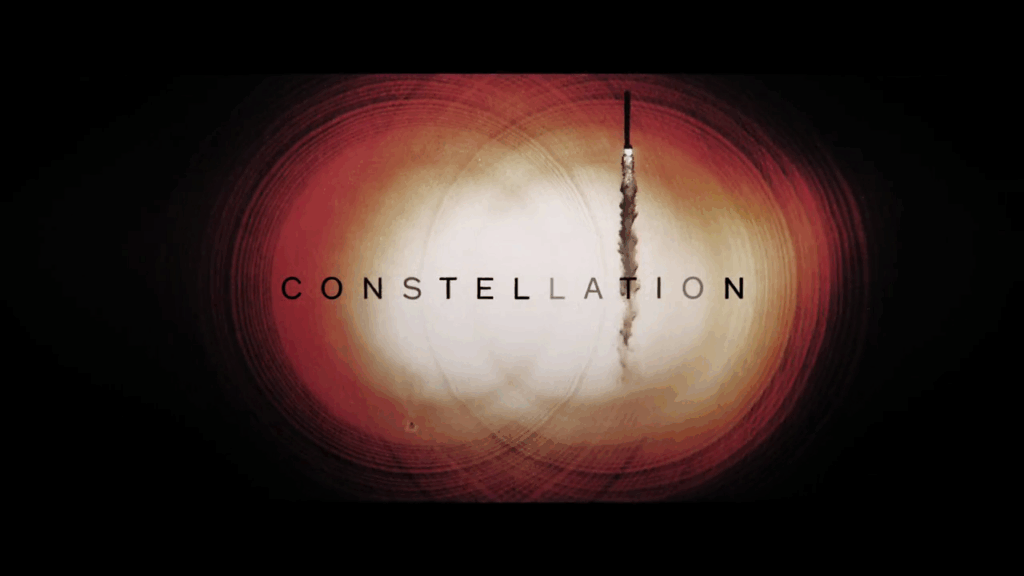
A Review of Apple TV series Constellation (2024)

TLDR: Constellation is one of the best science fiction series I have seen in a while. A must watch!


I recently watched the Apple TV series Constellation. The series is gripping, engages you both visually and conceptually and explores some of the deep fears and facts of the human condition.

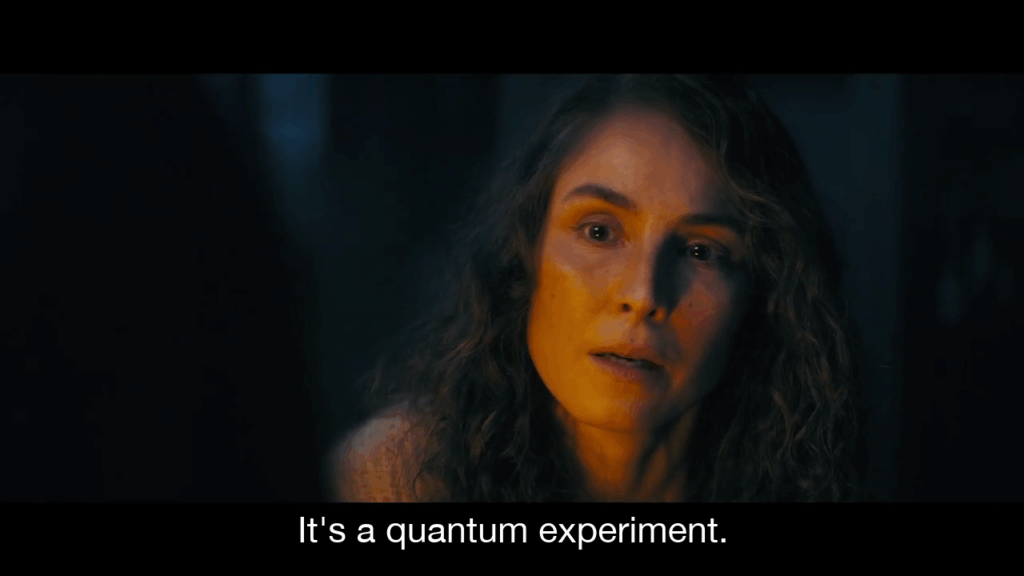
So what is the series about? Well, Jo answers it for us!

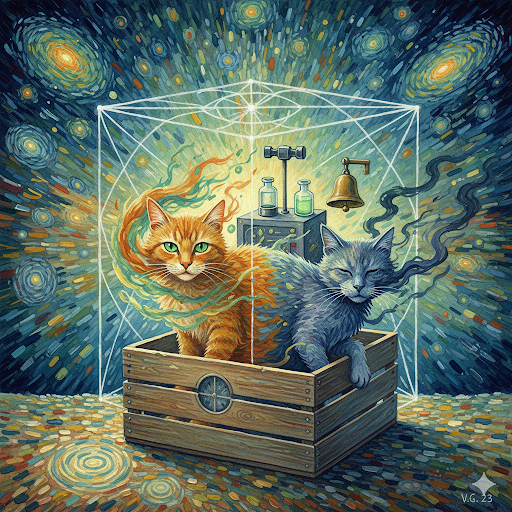
Quantum mechanics, developed at the starting of last century, is one of the most counter-intuitive scientific theory that we humans have created. Our notions of “common sense” and our perception of “reality” around us are challenged and refuted in the realm of the quantum. That being said, during its development several gedankenexperiments were done by the pioneers of quantum mechanics. One of the most iconic gedankenexperiment is that was posited in 1935 by German physicist Erwin Schrödinger, the so called Schrödinger’s Cat

Image generated by Gemini with prompt: Illustration for Schrödinger’s cat, water color, van Gogh style.

The experiment is described as such by Schrödinger

One can contrive even completely burlesque [farcical] cases. A cat is put in a steel chamber along with the following infernal device (which must be secured against direct interference by the cat): in a Geiger counter, there is a tiny amount of radioactive substance, so tiny that in the course of an hour one of the atoms will perhaps decay, but also, with equal probability, that none of them will; if it does happen, the counter tube will discharge and through a relay release a hammer that will shatter a small flask of hydrocyanic acid. If one has left this entire system to itself for an hour, one would tell oneself that the cat is still alive if no atom has decayed in the meantime. Even a single atomic decay would have poisoned it. The psi-function of the entire system would express this by having in it the living and dead cat (pardon the expression) mixed or spread out in equal parts.

It is typical of these cases that an indeterminacy originally restricted to the atomic domain turns into a sensually observable [macroscopic] indeterminacy, which can then be resolved by direct observation. This prevents us from so naïvely accepting a “blurred model” as representative of reality. Per se, it would not embody anything unclear or contradictory. There is a difference between a shaky or out-of-focus photograph and a snapshot of clouds and fog banks. (link)

Stated thus, it questions the very nature of our understanding of reality as seen with our macro senses. How do we understand this? Can the living AND the dead cat exist at the same time? According to the law of excluded middle in our logical system, we assume that proposition is true OR its negation is true. This principle is fundamental in classical logic and asserts that there are no other truth values beyond true or false. So how could the cat exist in both the states: dead AND alive? How do we understand and interpret phenomenon?

There are several interpretations of the cat paradox depending on one’s worldview. The Copenhagen interpretation, one of the more widely accepted interpretations amongst physicists, posits that a measurement results on only one state. This interpretation does not provide an “explanation” for the state of the cat while the box is closed. When the box is not opened, the wave function description of the system consists of a superposition of the states “decayed nucleus/dead cat” and “undecayed nucleus/living cat”. An observer can only assert a statement about the cat only when the box is opened. Thus we can say that the state of the system remains indeterminate, superposition of possible states. The very act of observation collapses the wave function to one of the possible states. Thus observing a system makes the realisation of states possible.

Another way to look at this is the so called many worlds interpretation  (MWI) posited by Hugh Everett in 1957. In this interpretation it is posited that there is a universal wave function and in contrast to the Copenhagen interpretation there is no collapse of the wave function. This implies that all states whose superposition creates the wave function are physically realised, but in different “worlds”. What does this mean? The many-worlds interpretation implies that there are many parallel, non-interacting worlds. MWI views time as a many-branched tree, wherein every possible quantum outcome is realized. MWI’s main conclusion is that the universe is composed of a quantum superposition of an uncountable or undefinable amount or number of increasingly divergent, non-communicating parallel universes or quantum worlds. Sometimes dubbed Everett worlds, each is an internally consistent and actualized alternative history or timeline.

So given the MWI framework how do we interpret Schrödinger’s cat paradox?

In the many-worlds interpretation, both alive and dead states of the cat persist after the box is opened, but are decoherent from each other. In other words, when the box is opened, the observer and the possibly-dead cat split into an observer looking at a box with a dead cat and an observer looking at a box with a live cat. But since the dead and alive states are decoherent, there is no communication or interaction between them.

When opening the box, the observer becomes entangled with the cat, so “observer states” corresponding to the cat’s being alive AND dead are formed; each observer state is entangled, or linked, with the cat so that the observation of the cat’s state and the cat’s state correspond with each other. Quantum decoherence ensures that the different outcomes have no interaction with each other. Decoherence is generally considered to prevent simultaneous observation of multiple states. (emphasis added)

Thus every observation event, creates as many worlds as there are states in the superposition. And within each world the events follow as they should. In one world the cat is dead in the other it is not.

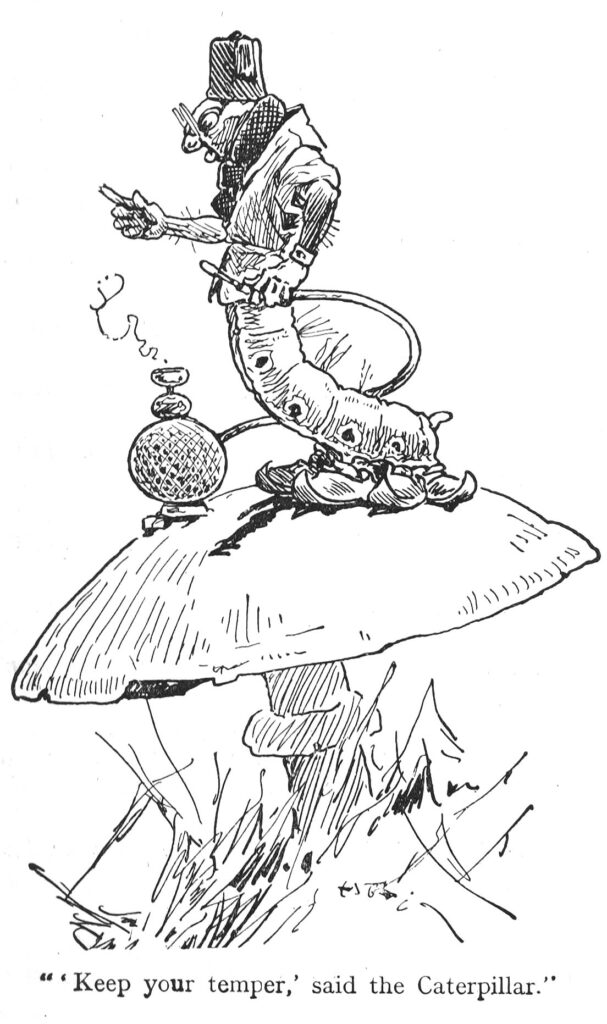
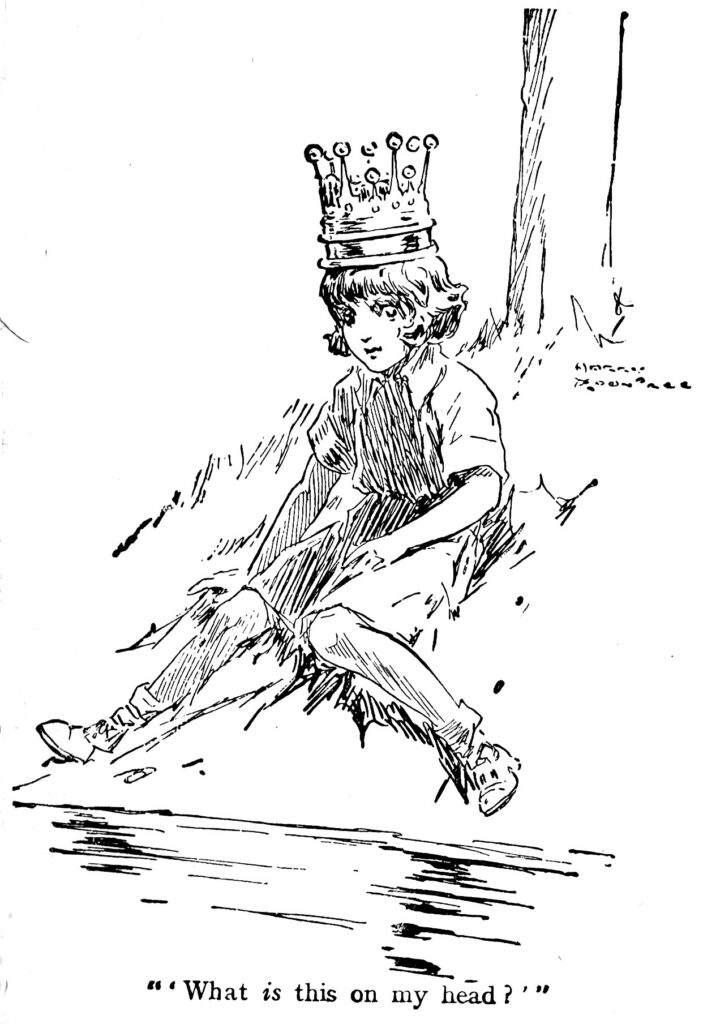
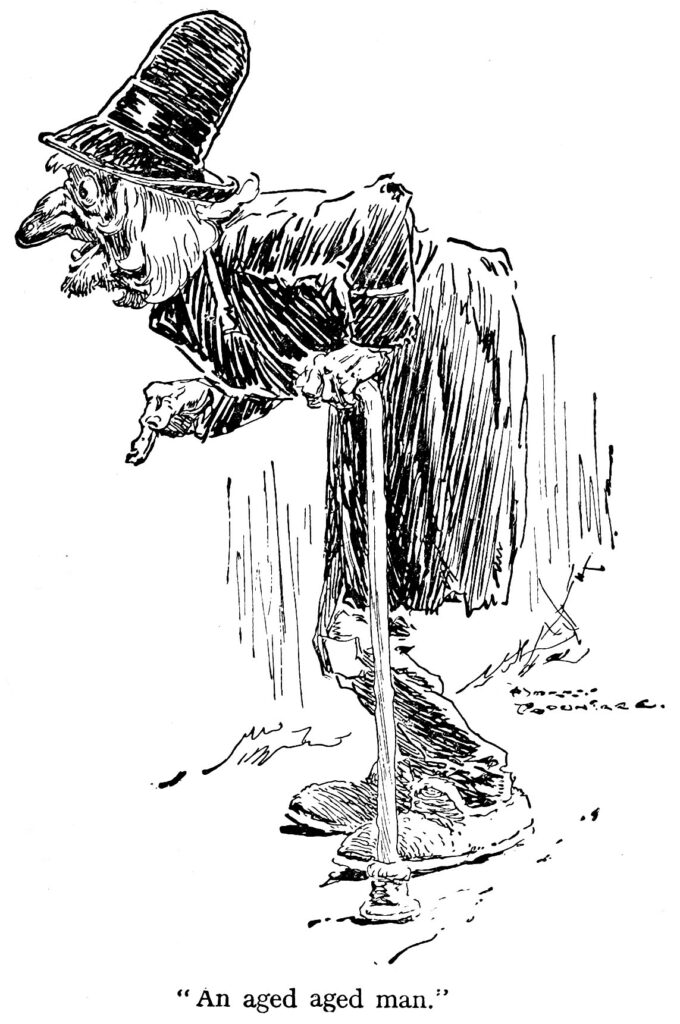
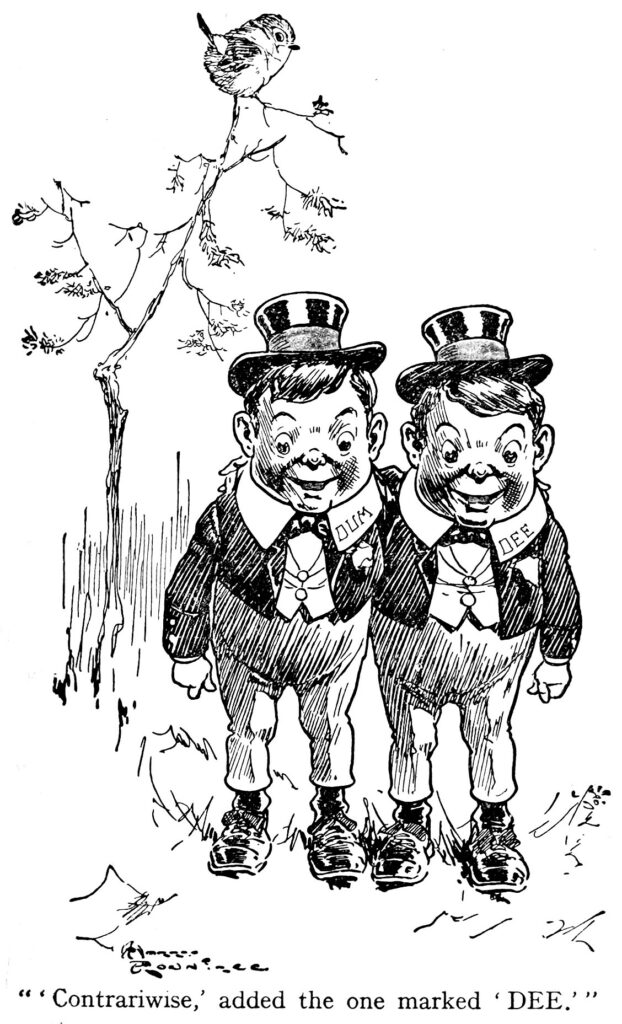
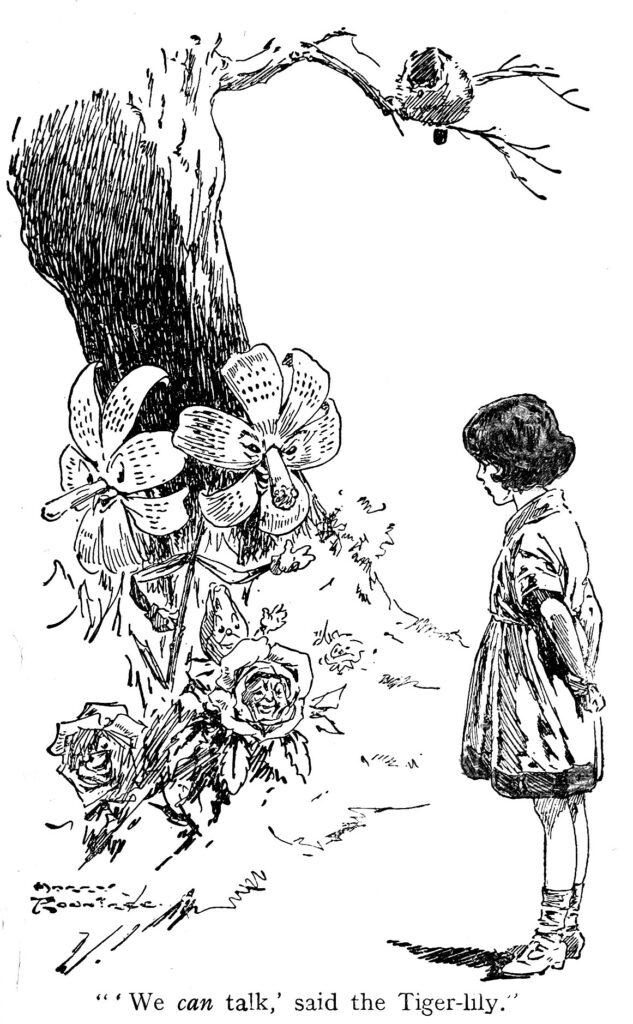
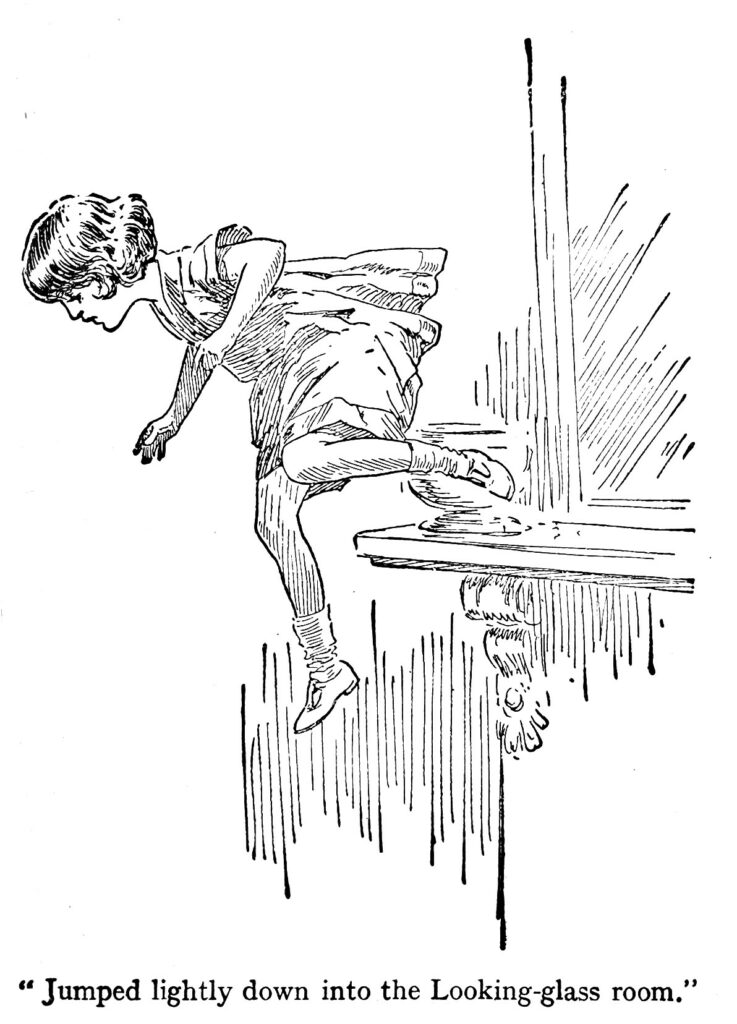
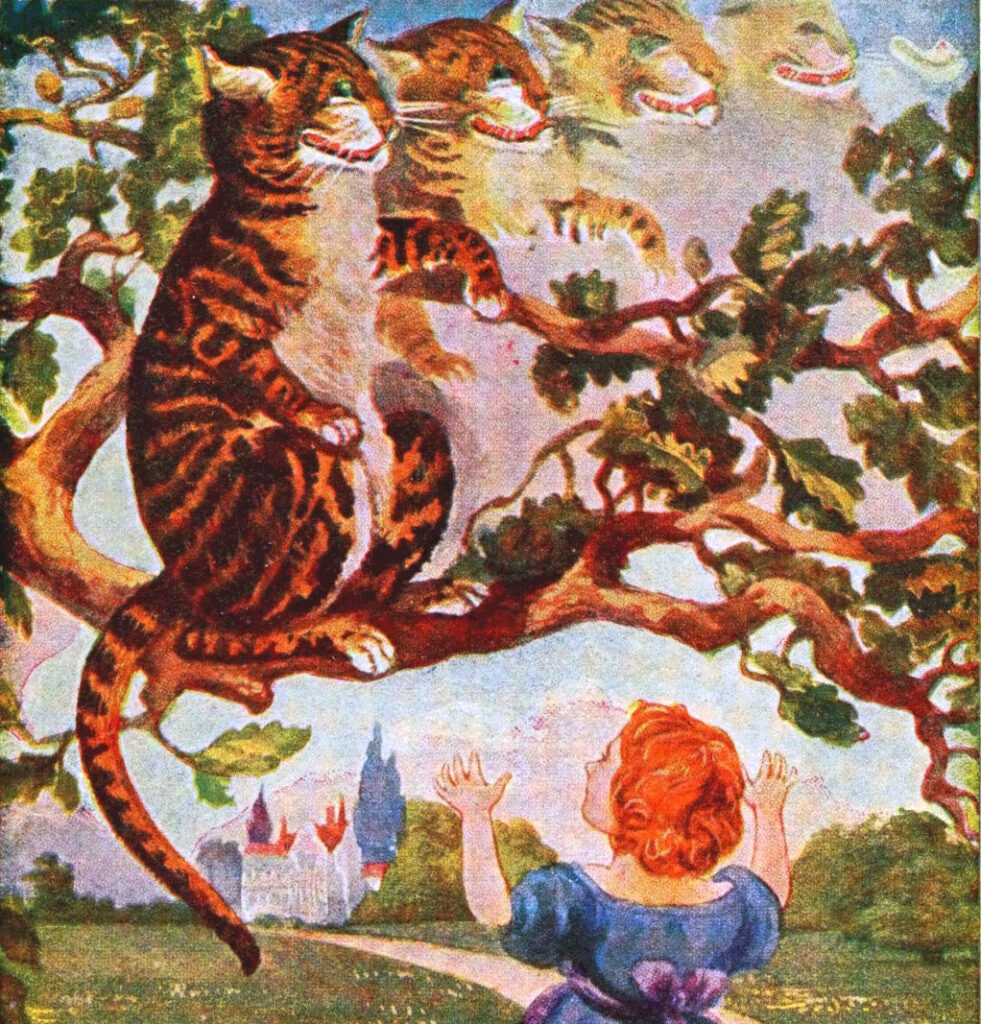
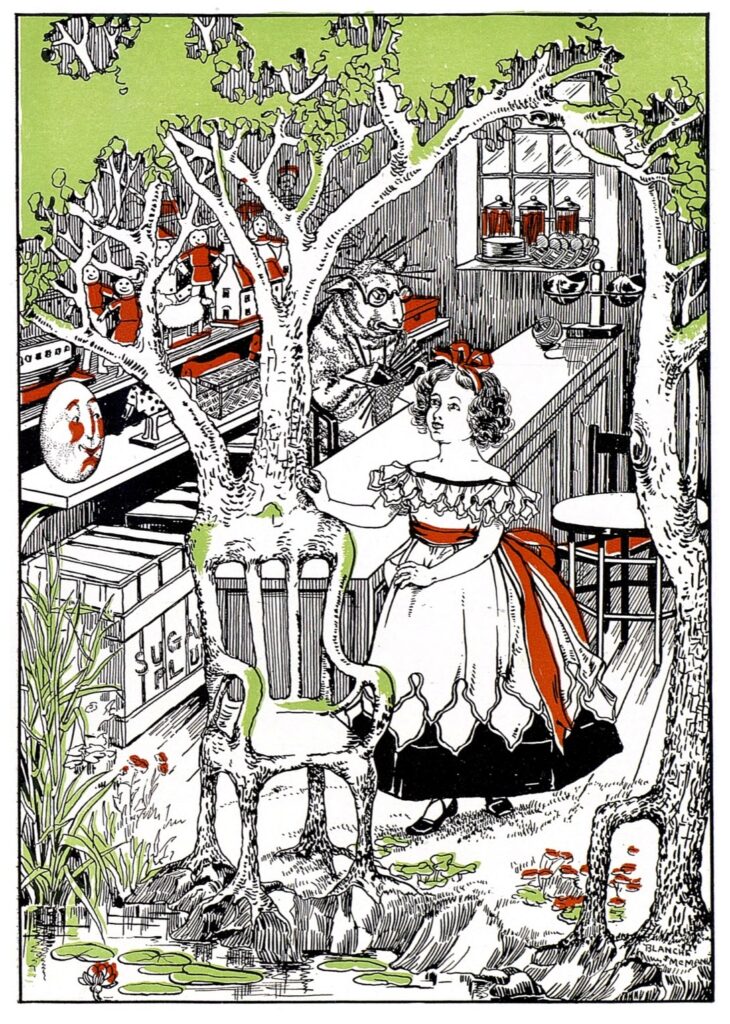
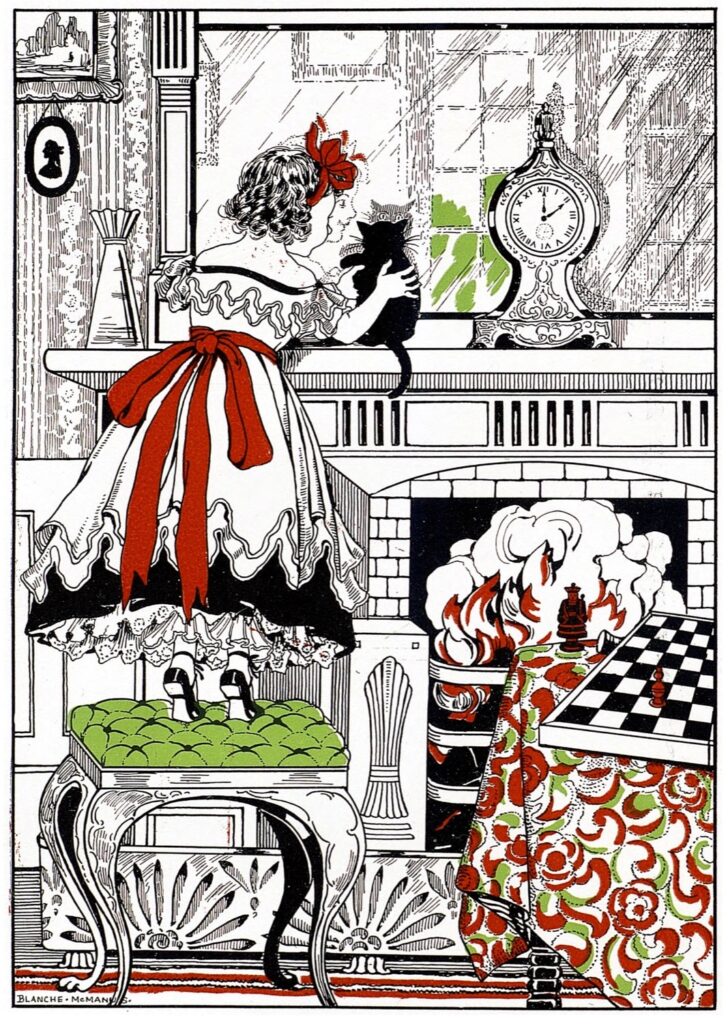
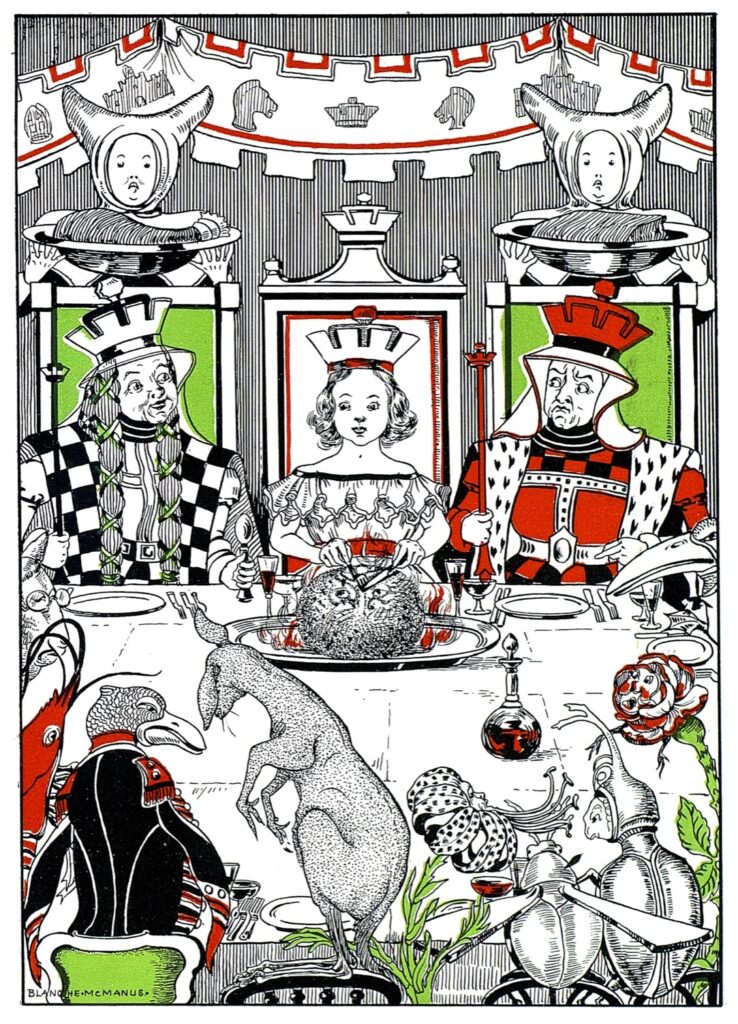
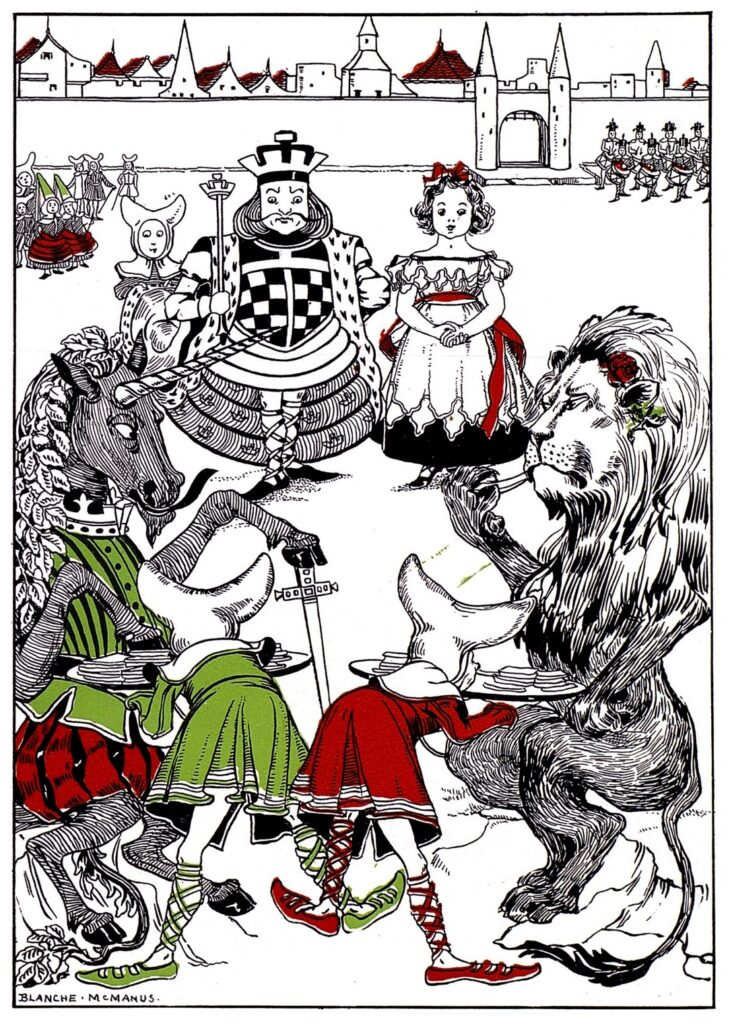
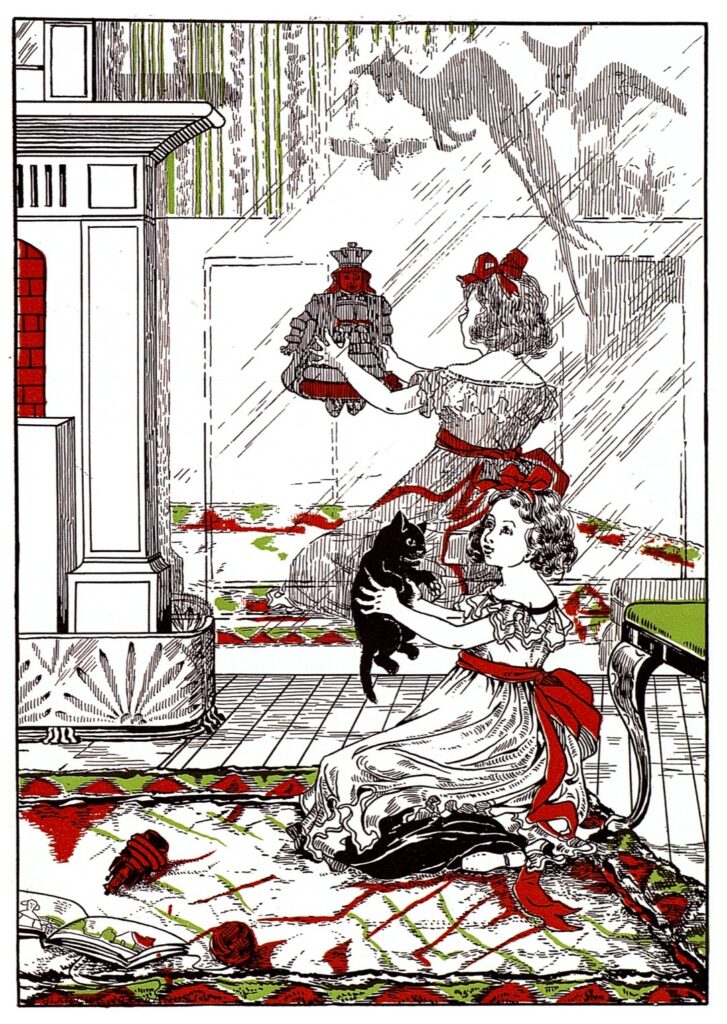
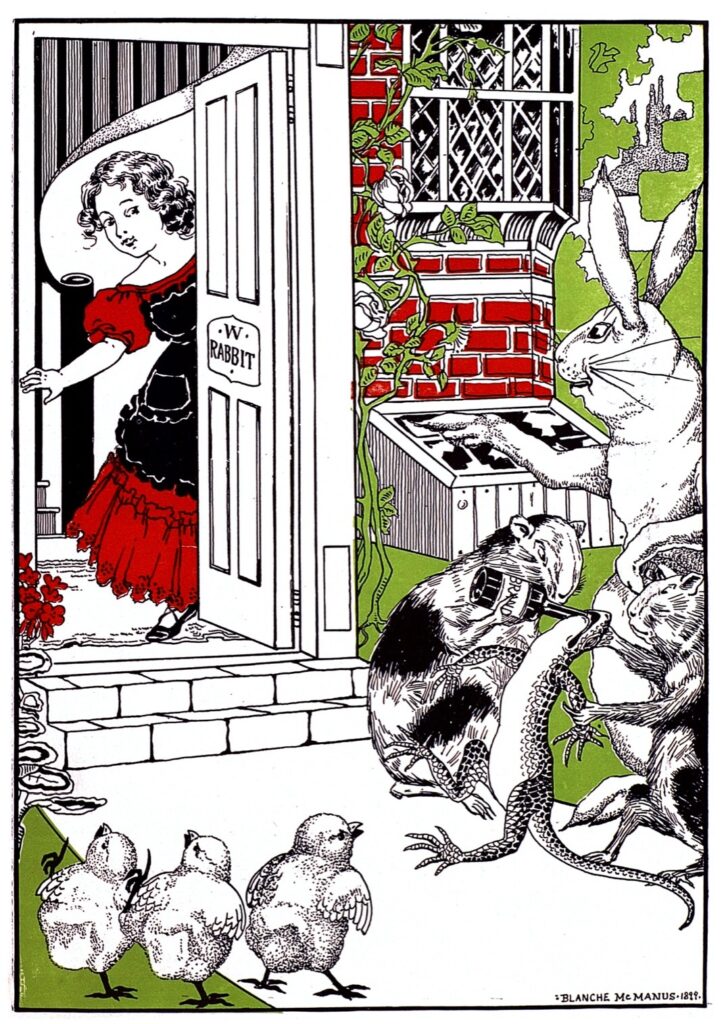
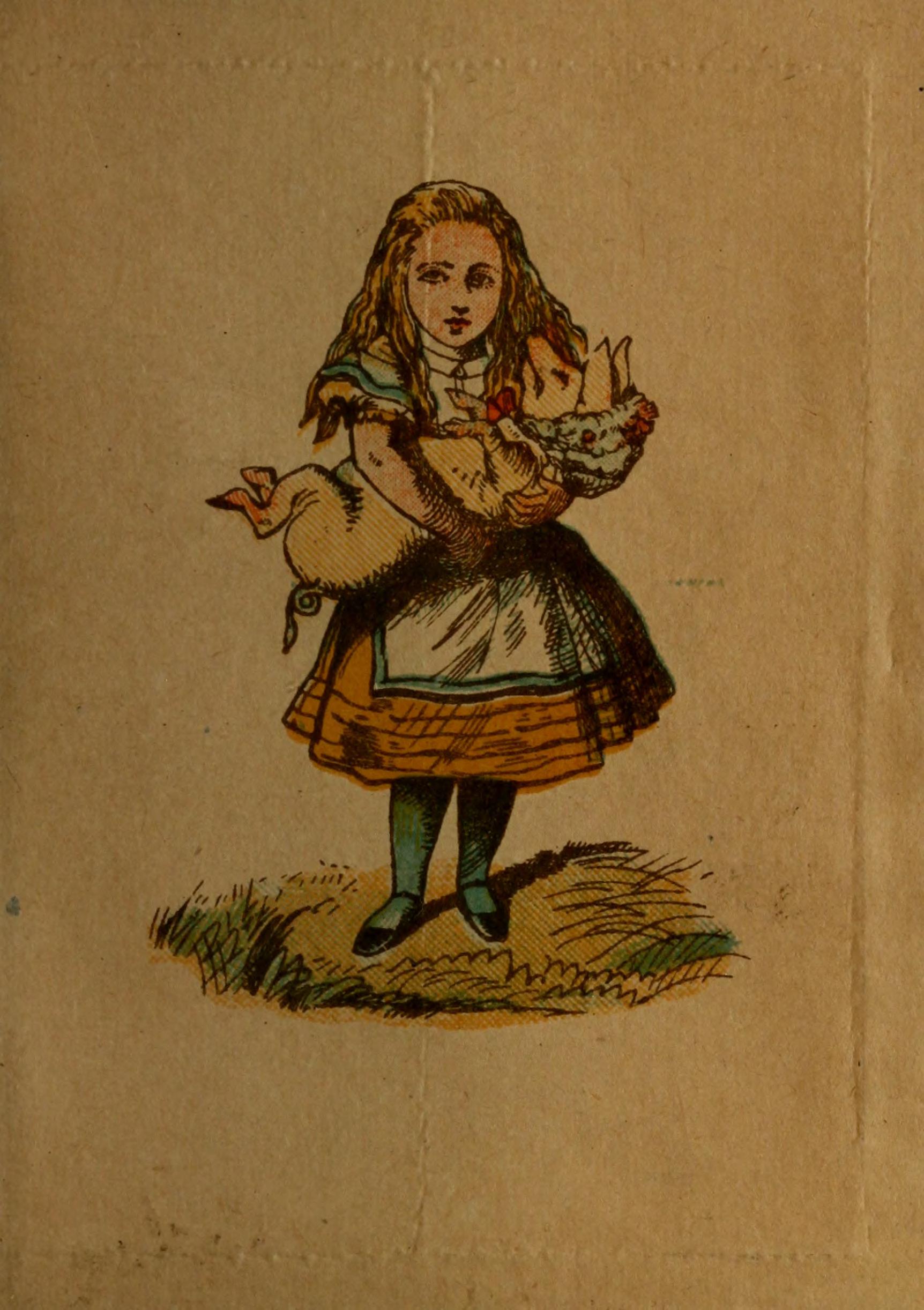
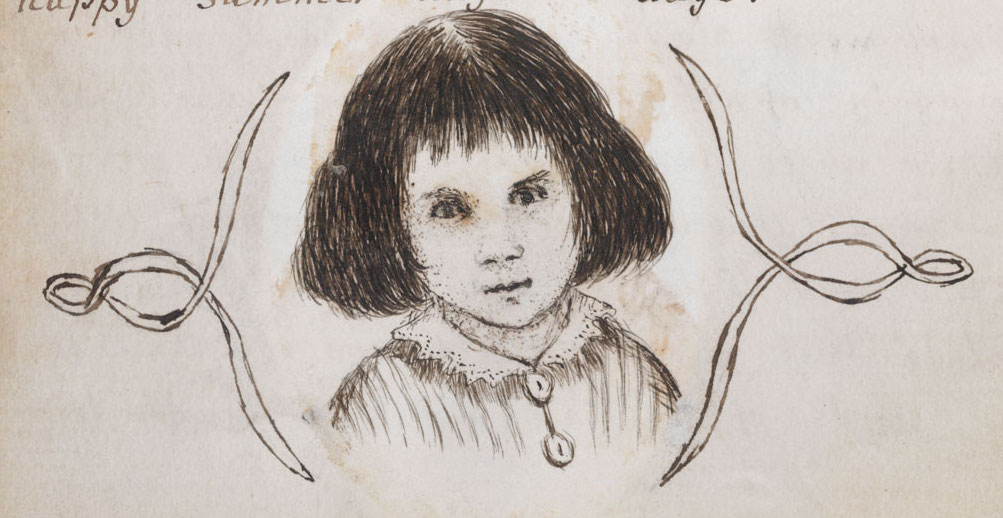
Illustration for Alice in Wonderland by Blanche McManus

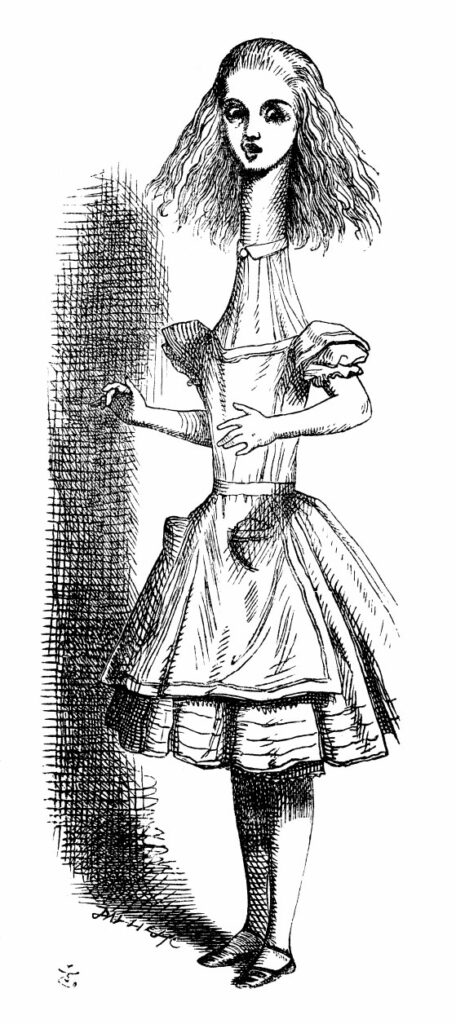
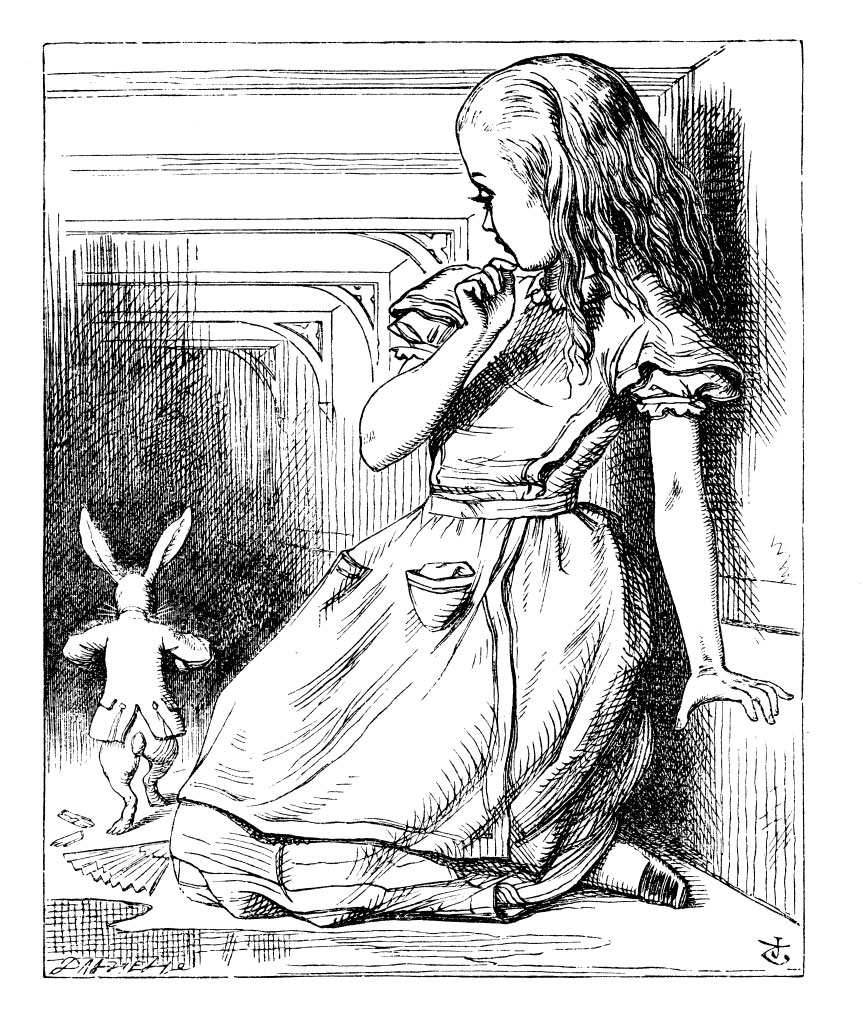
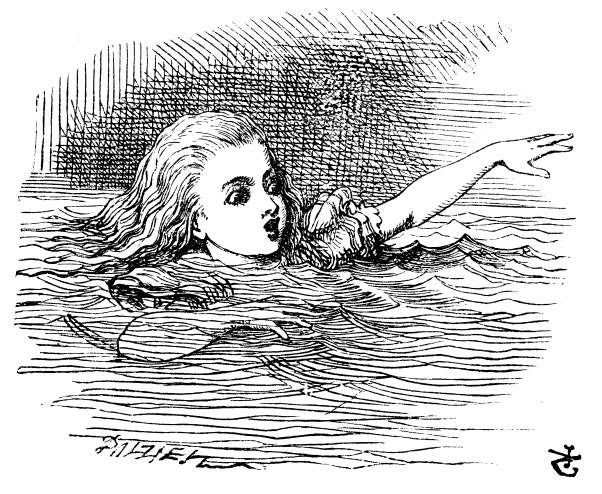
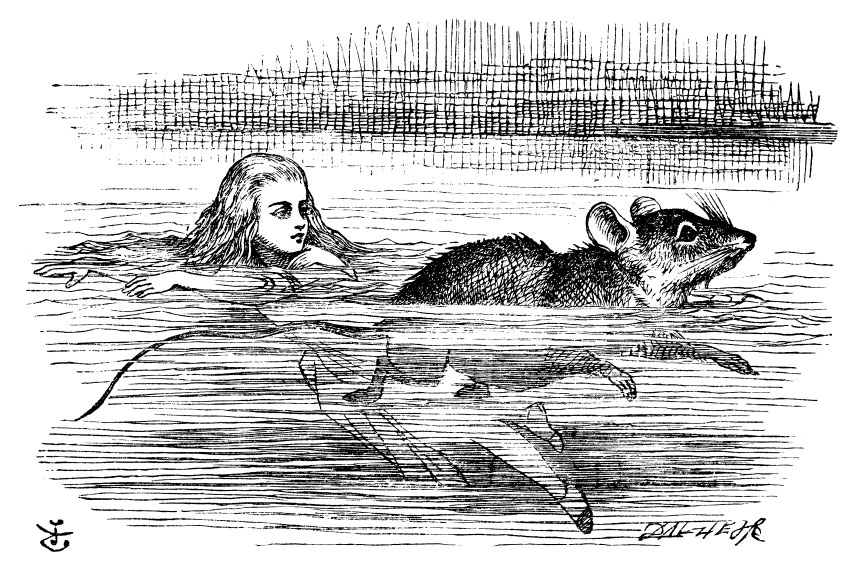
Now what would happen if these two worlds, which are split by a certain observation, somehow interacted? There is no “common sense” way to understand or interpret this. It screws your way of thinking, there is no “coherent” way to think about this, it is all “de-coherent”. More you think about it more it becomes perplexing. Curioser and curioser….

And this is exactly the idea that is explored in Constellation series!

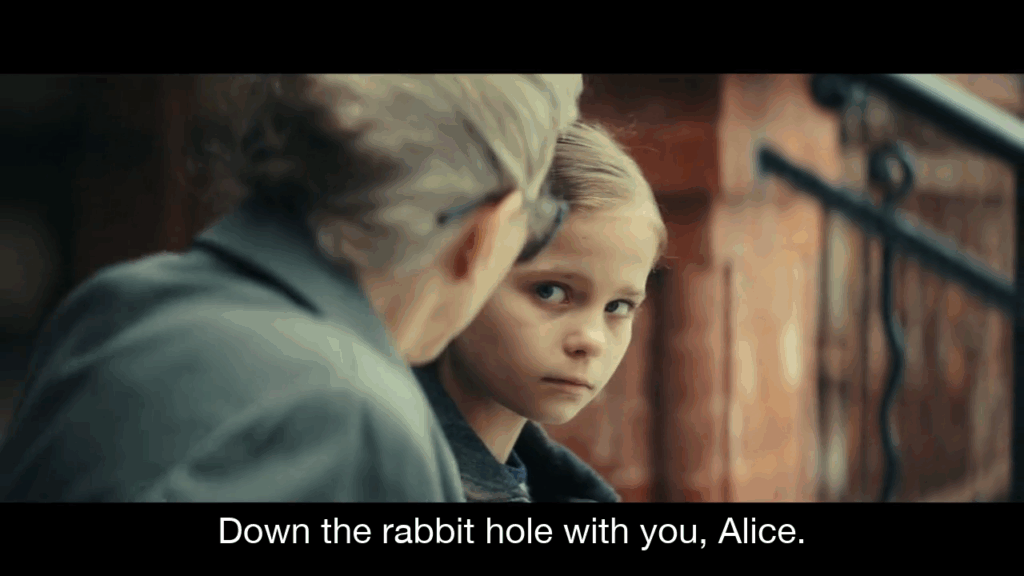
All is going well abroad the International Space Station (ISS), where cosmonauts from US, Russia and Europe are placed. Swedish ESO cosmonaut  Johanna “Jo” Ericsson (played by Noomi Rapace ) is talking to her daughter Alice (played by Davina Coleman and Rosie Coleman) from the space station. At the same time Paul Lancaster (played by William Catlett) of the NASA astronauts is conducting an experiment to find out about a new state of matter which they think should exist in zero gravity. This is the Cold Atomic Laboratory (CAL).

This is where the story begins. The operation of the CAL is the event which blurs the timelines between the two worlds and allow communication and juxtaposition of the persons and ideas across the worlds which is not supposed to happen in the MWI.


The performance of this experiment gives the predicted result, but causes things to go haywire. There is a collision of the ISS with an unknown object which causes several life-support systems to go out of order. The cosmonauts have to perform an emergency evacuation.

In all this chaos, the Paul is critically injured and eventually succumbs to his injuries. Now for the emergency evacuation, the remaining operational module can only fit three cosmonauts. So a decision is made Jo will remain on the ISS, repair the Soyuz 1 module and return to Earth later, while three other astronauts return to Earth. Jo being alone on the ISS suffers hallucinations (or real visions?) and is on emergency power. These hallucinations  (visions?) set the tone for the rest of the series. This is some top-class space-horror. I am not giving out the spoilers..

When Jo returns to Earth she feels somethings are different than what she remembered before being up on the ISS. She has been on the ISS for some time (few months). There are strong elements of jamais vu in her experience. For example, Jo remembers her daughter Alice could talk in Swedish, but currently she finds that Alice cannot speak Swedish. Then there are elements of conspiracy theories and Soviet state secrets very seamlessly added to plot. Little things like this take their toll and Jo has a mental breakdown.

Along with Jo, Alice is also finding things disturbing. She also has visions of another Alice in another world, where instead of Paul her mother is dead in the ISS accident. Apart from these two, Bud/Henry Caldera (played by Johnathan Banks) who has designed the CAL experiment also has visions. Thus Jo, Alice, Bud, and Paul are entangled by the event of operating CAL and connections (or cracks?) appear in the divergent worlds between them.

How is this resolved? Do people who are part of these multi-world realities realise that they are in parallel worlds with their counterparts in another world? Well to find out do watch the series!

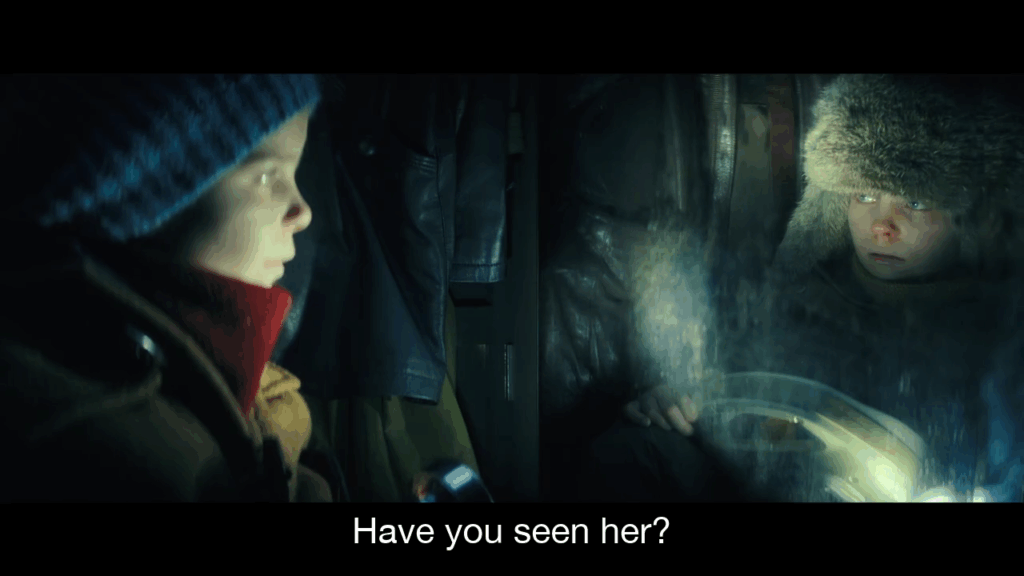
PS: A special appreciation for the role of two Alices played very very ably by the twins Davina Coleman and Rosie Coleman. The sheer sense of helplessness, fear and anxiety portrayed by them when they are trying to find “their mother” is  exceptionally brilliant.

Illustrations for Alice in Wonderland – Part 5 – Blanche McManus

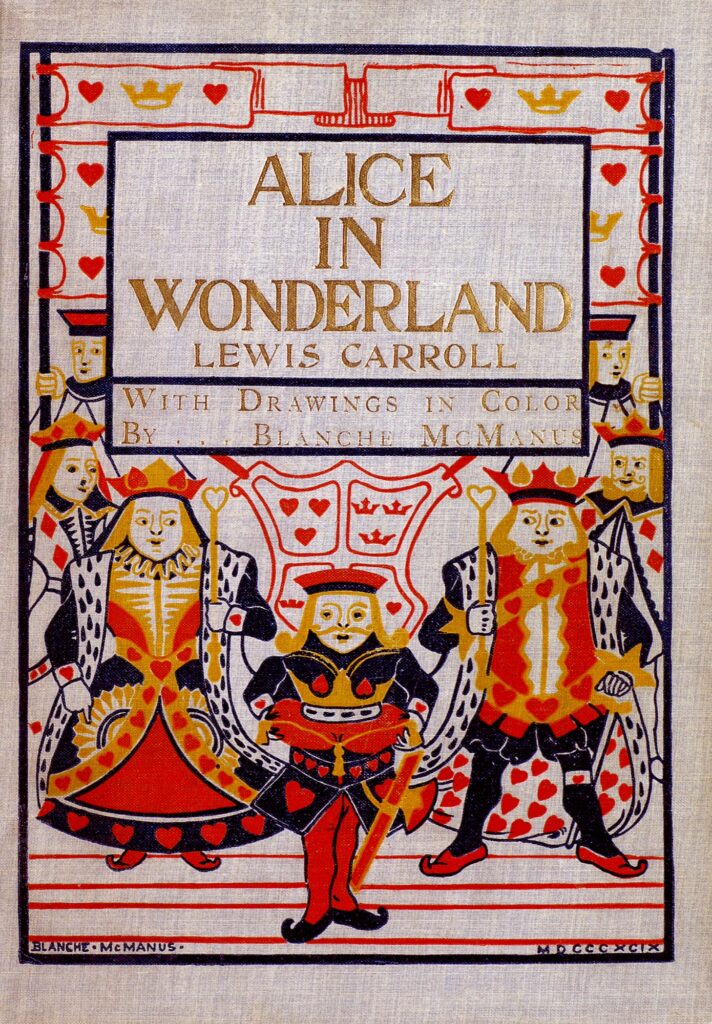
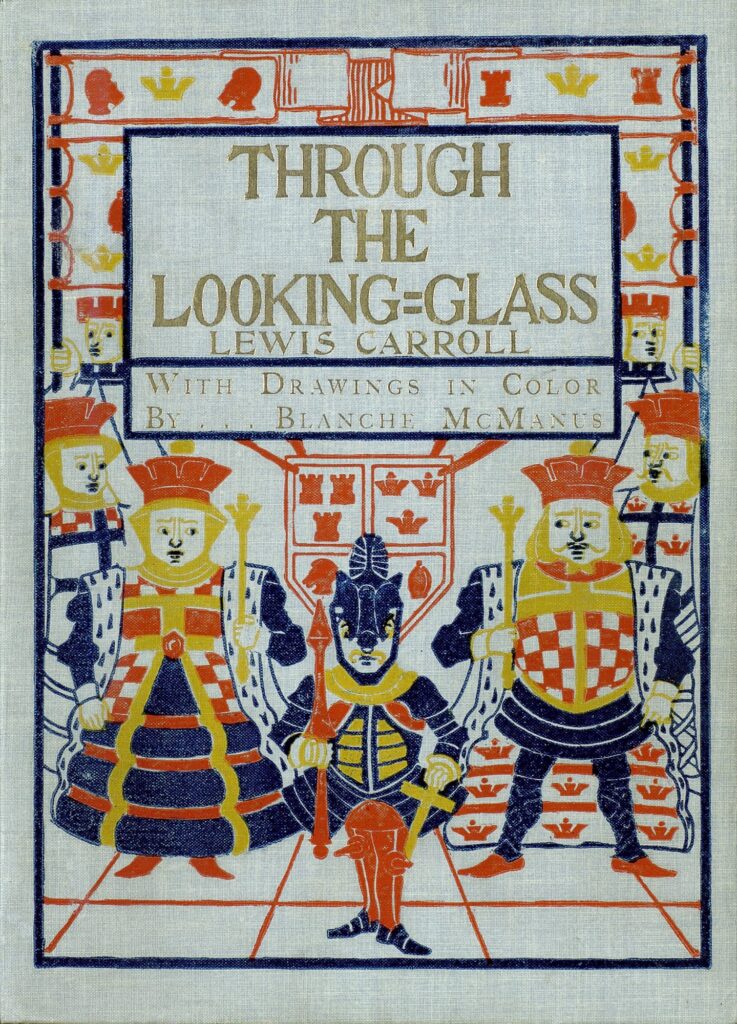
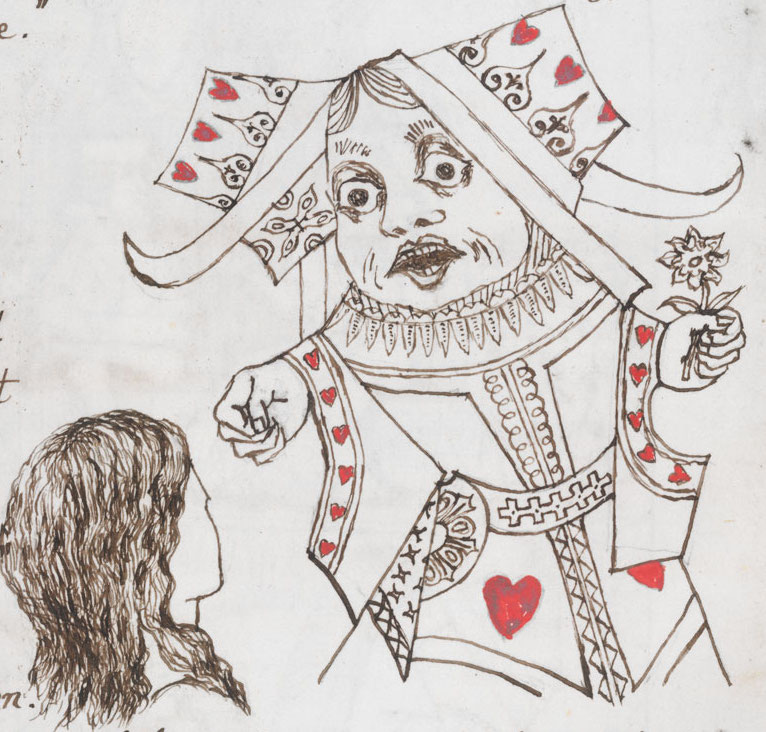
Blanche McManus (1869–1935) was an American writer and artist. She and her husband, wrote a series of illustrated travel books, many of which included information about automobiles which were new at the time. [wiki] She also illustrated both Alice in Wonderland and Through the Looking Glass. In this post we see her illustrations for the two books publishing in 1899. This was the first non-Tenniel illustrated version of the tale [1]. The illustrations are in three colours: red, black and green. There is another set of line drawings by Blanche which I will add later. And another set in which an unknown artist made full colour paintings from the line drawings.

The scans of books are available at University of Florida’s Digital Collections

Alice in Wonderland

Through the Looking Glass

I have also uploaded the cleaned images to Wikimedia commons in hi-res, search there if you want hi-res images.


(All images in the Public Domain)

Illustrations for Alice in Wonderland – Part 4 – Brinsley Le Fanu

The present post is from a rather peculiar version of Alice’s Adventures translated to Esperanto. The book was published in 1910 by the British Esperanto Association and the translation to Esperanto was done by E. L. Kearney. The illustrations about 10 are by Brinsley Le Fanu (by kind permission of the publisher of Stead’s Prose Classics). So perhaps there is another version with more illustrations by Le Fanu, but I was not able to locate it as such.

All images released under Public Domain CC0.

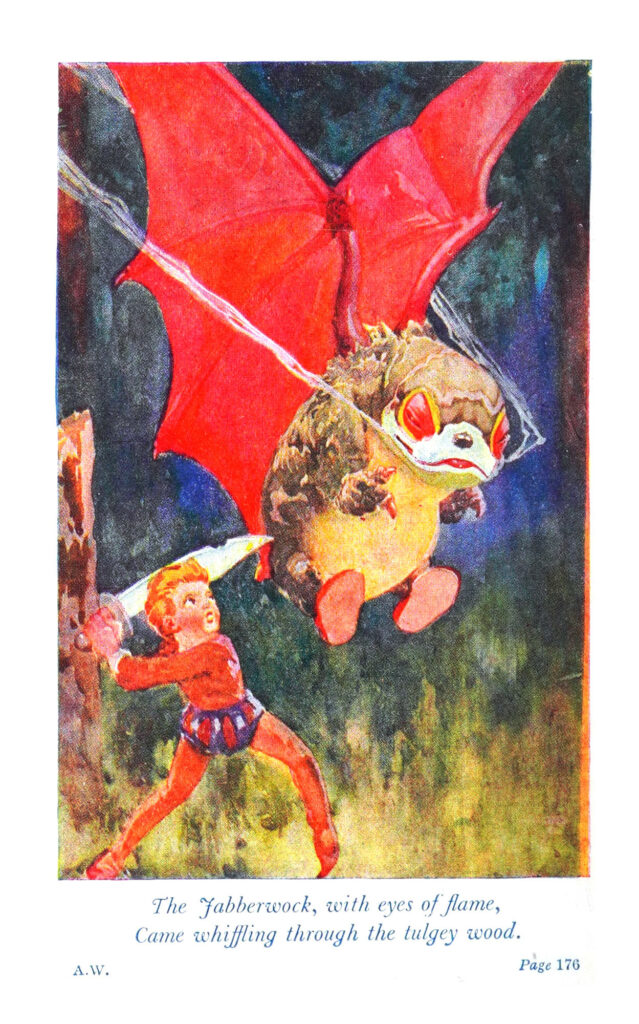
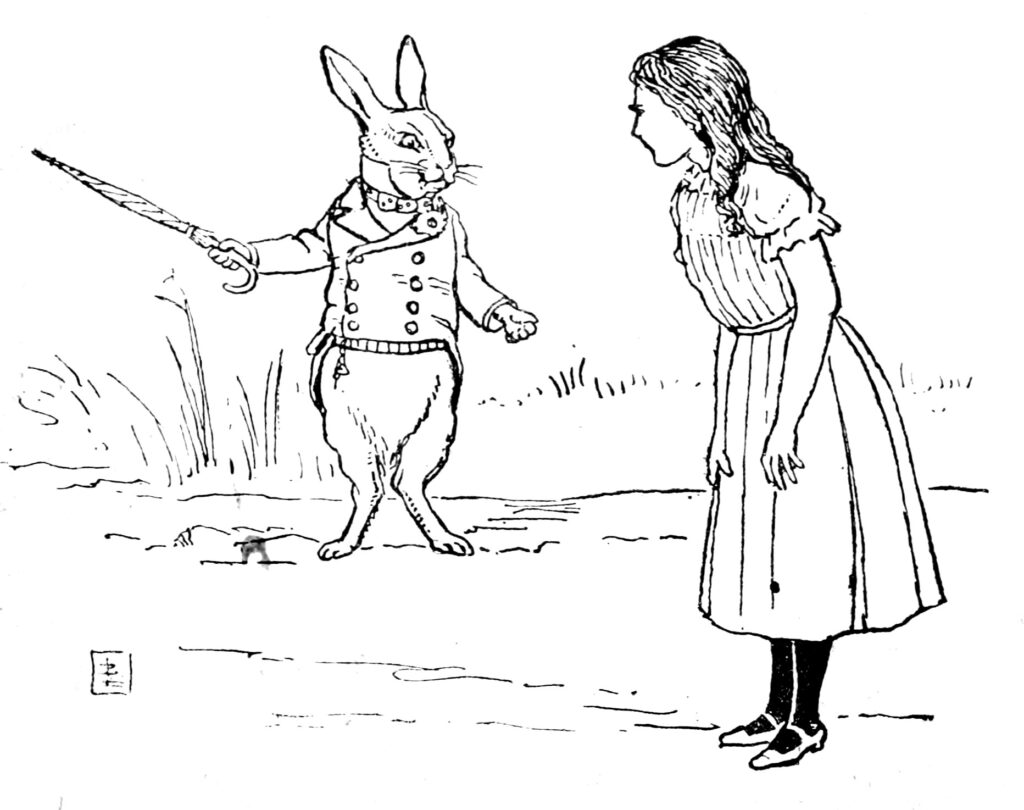
From the title page, Alice and the March Hare
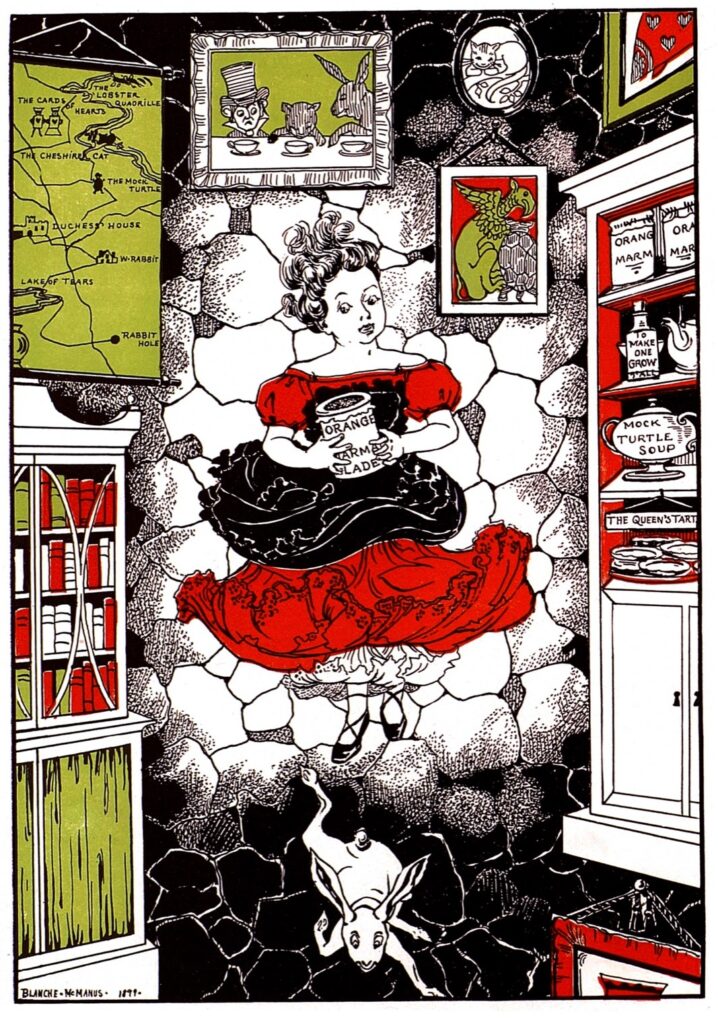
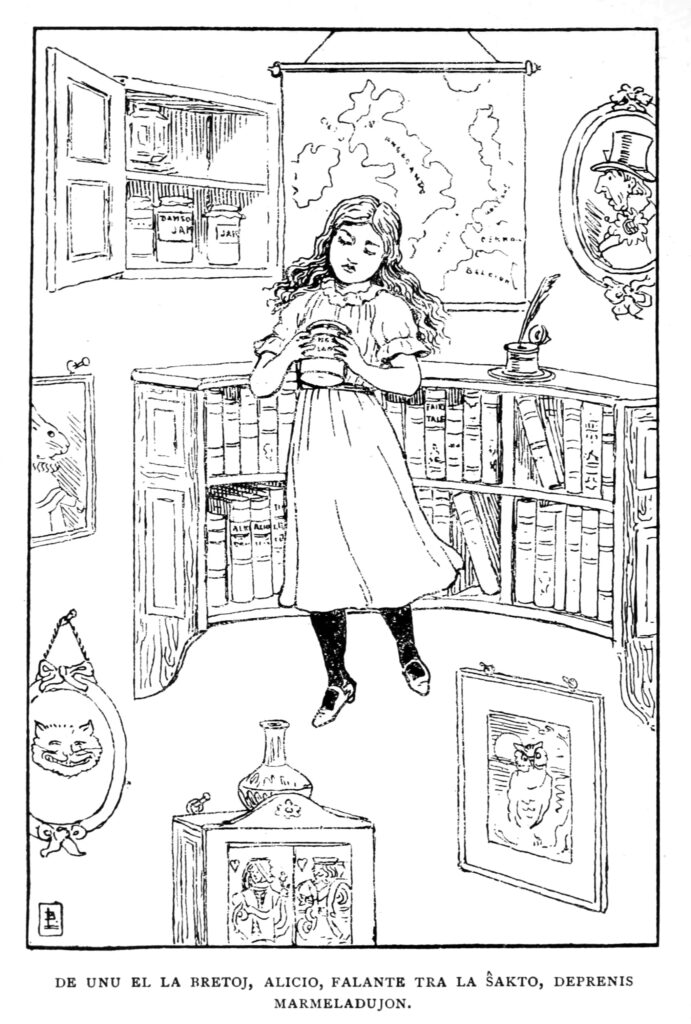
“De unu el la bretoj, Alicio, falante tra la ŝakto, deprenis marmeladujon.” (From one of the shelves, Alice, while falling through the sack, took a jar of marmalade.)
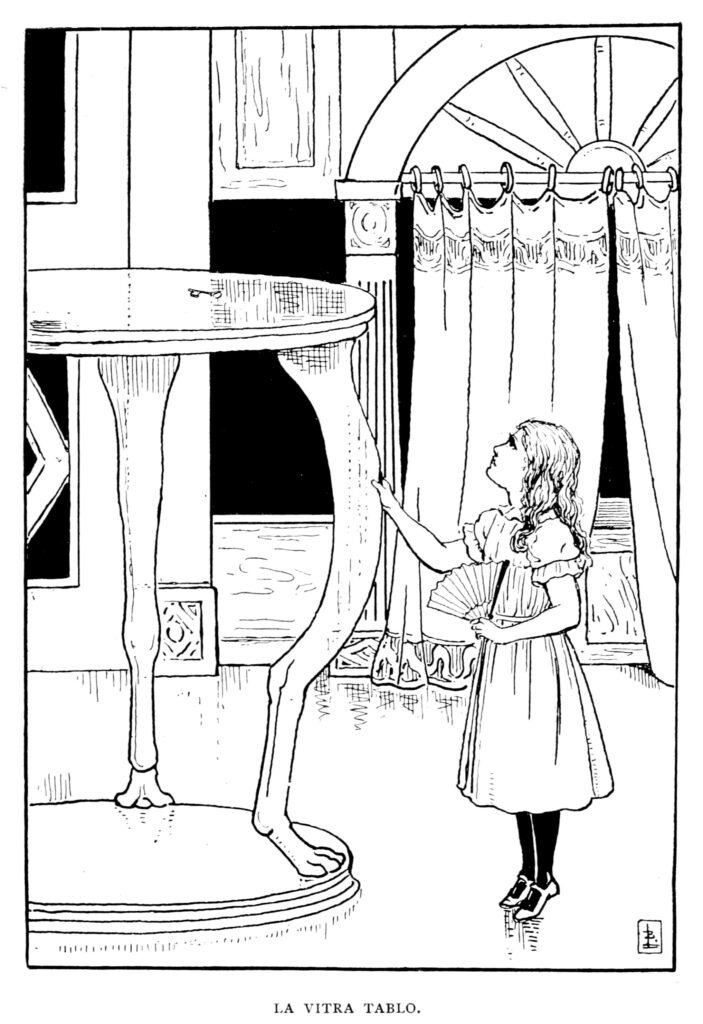
La vitra tablo. (The glass table.)
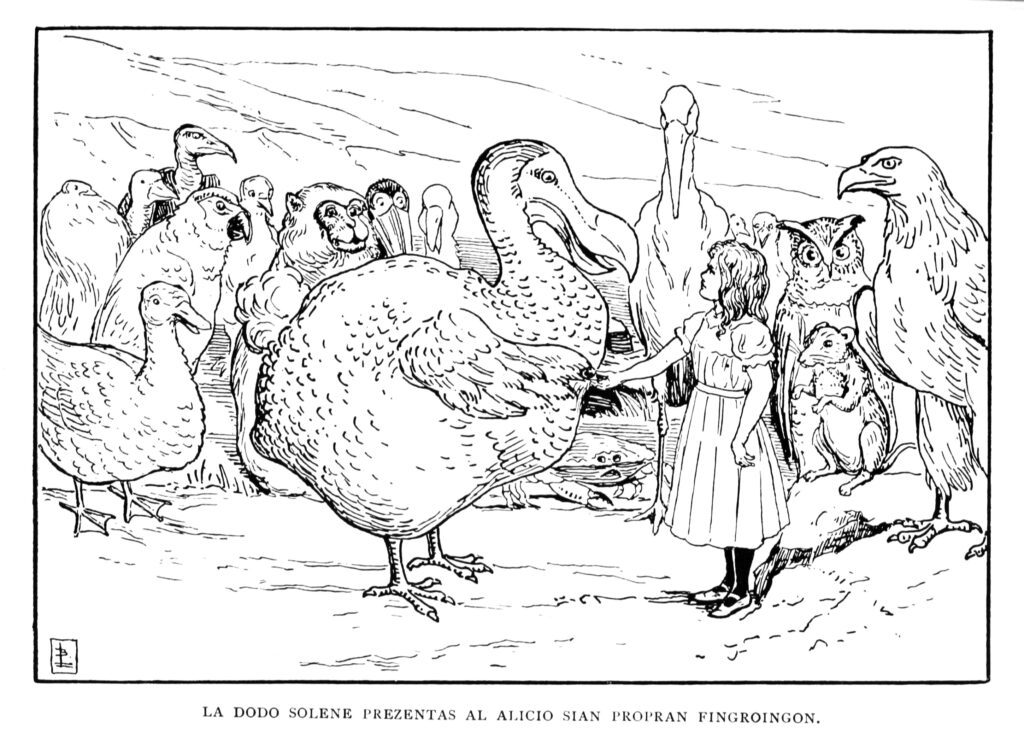
La Dodo Solene prezentas al Alicio sian propran fingroingon. (The Dodo solemnly presents to Alice its own finger ring.)
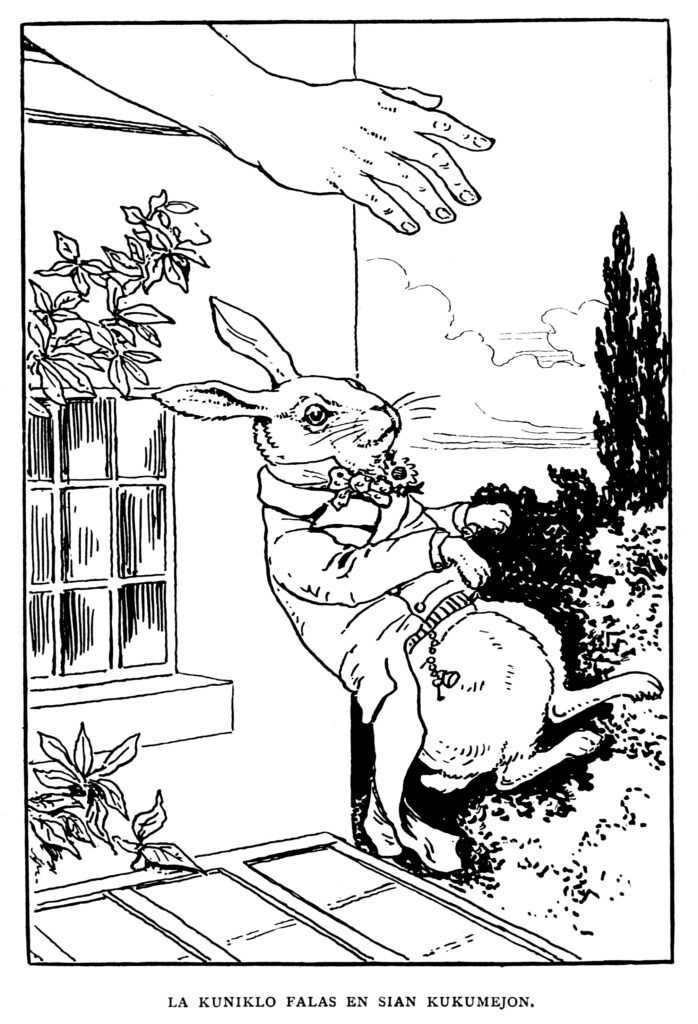
La kuniklo falas en sian kukumejon. (The rabbit falls into its biscuit box.)
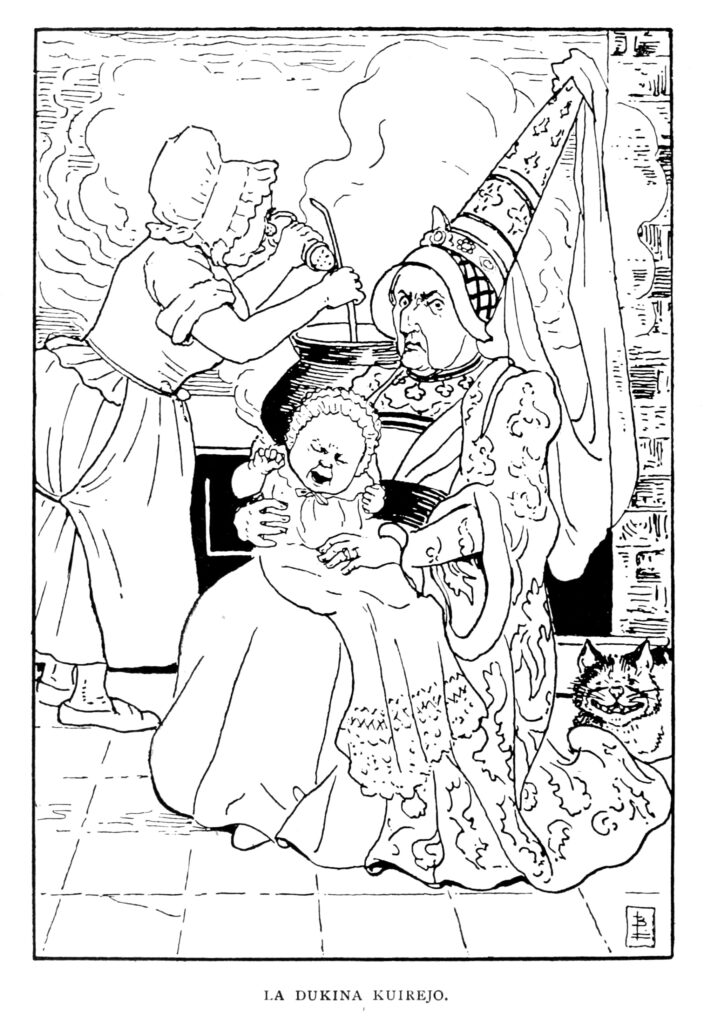
La dukina kuirejo. (The duchess’s kitchen.)
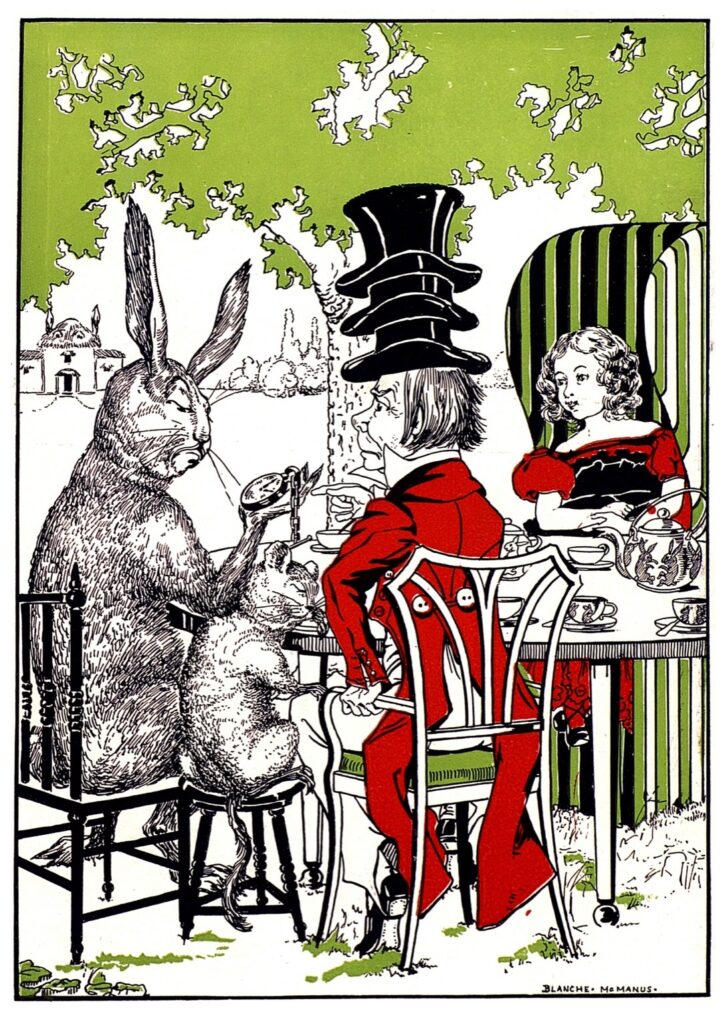
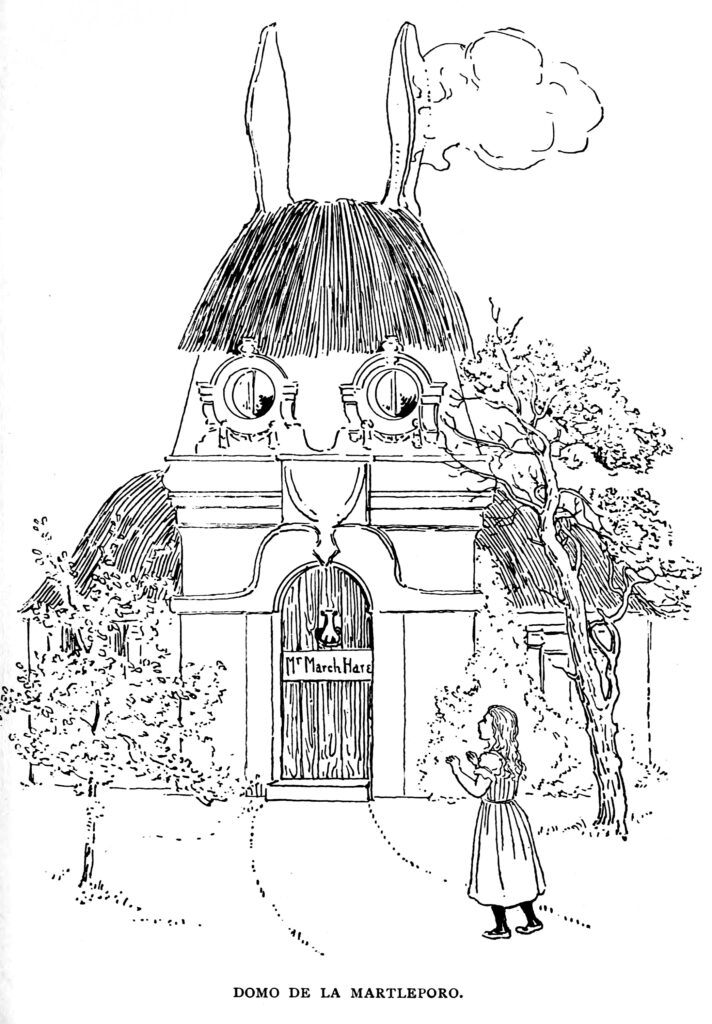
Domo de la martleporo. (“House of the March Hare.”)
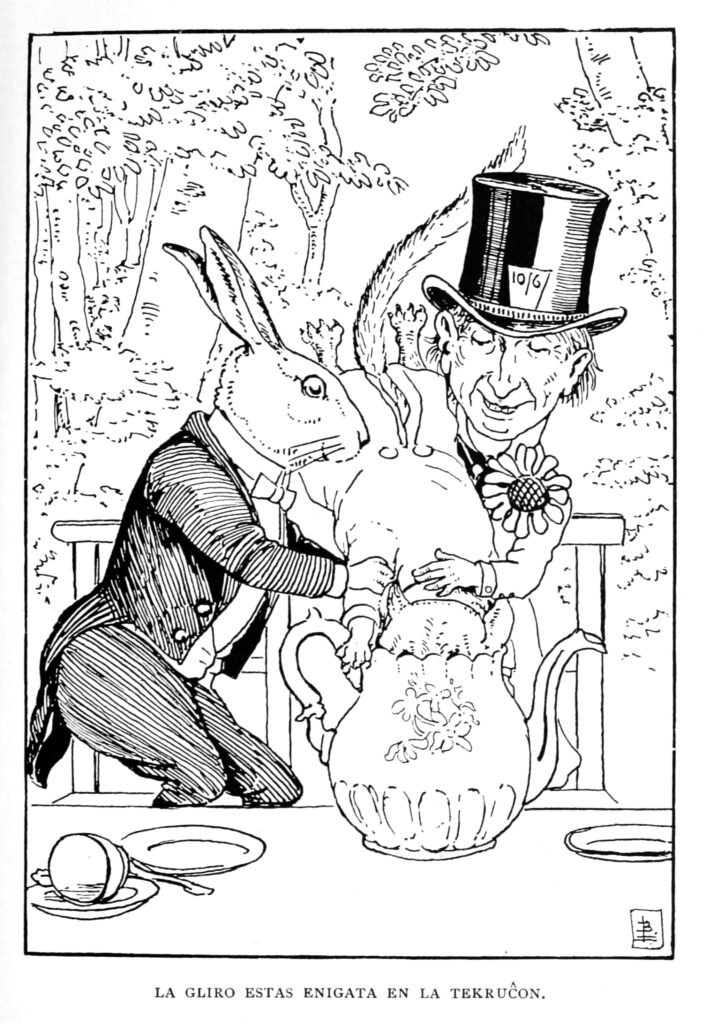
La gliro estas enigata en la tekrucon. (“The dormouse is embedded in the teakettle.”)
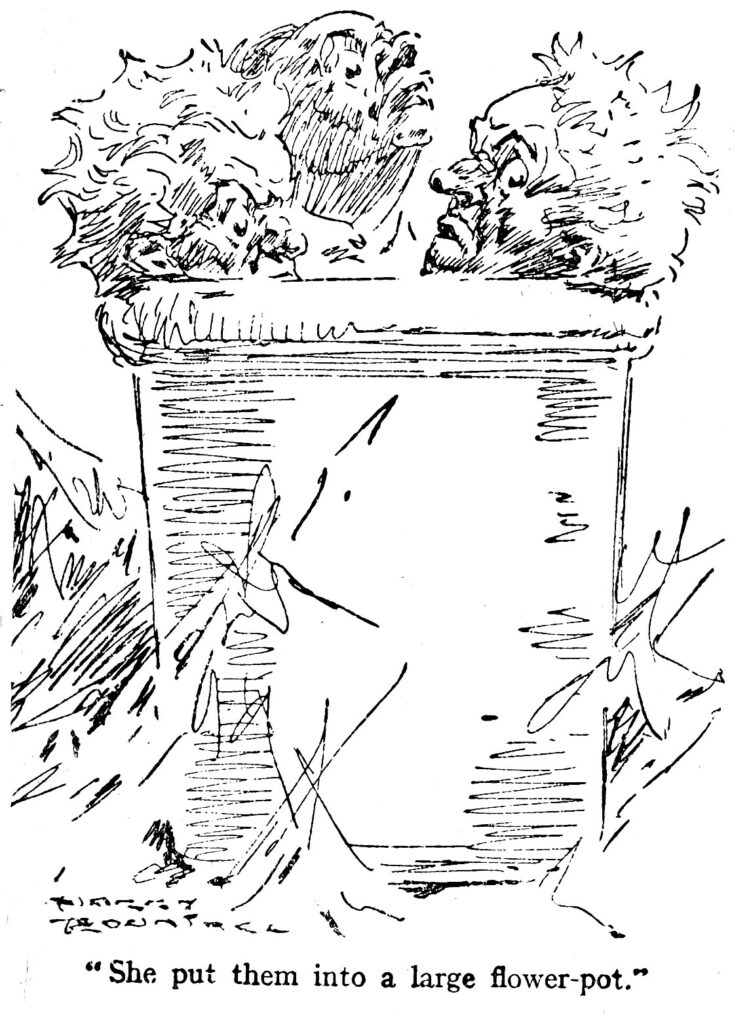
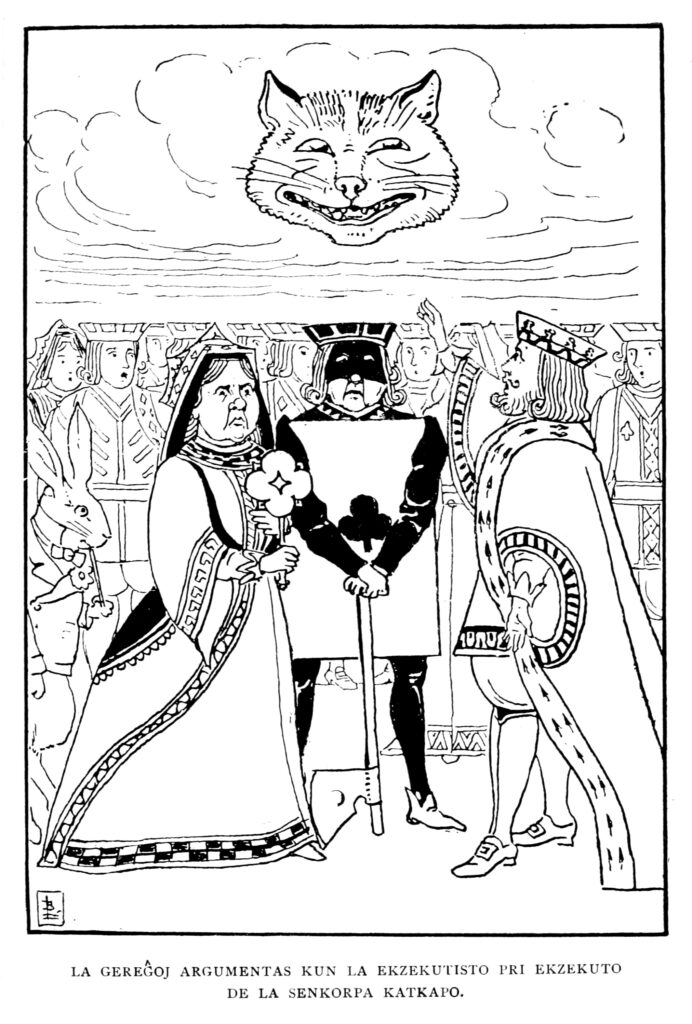
La gereêoj argumentas kun la ekzektisto pri ekzekuto de la senkorpa katkapo. (“They argue with the executioner about the execution of the headless cat.”)
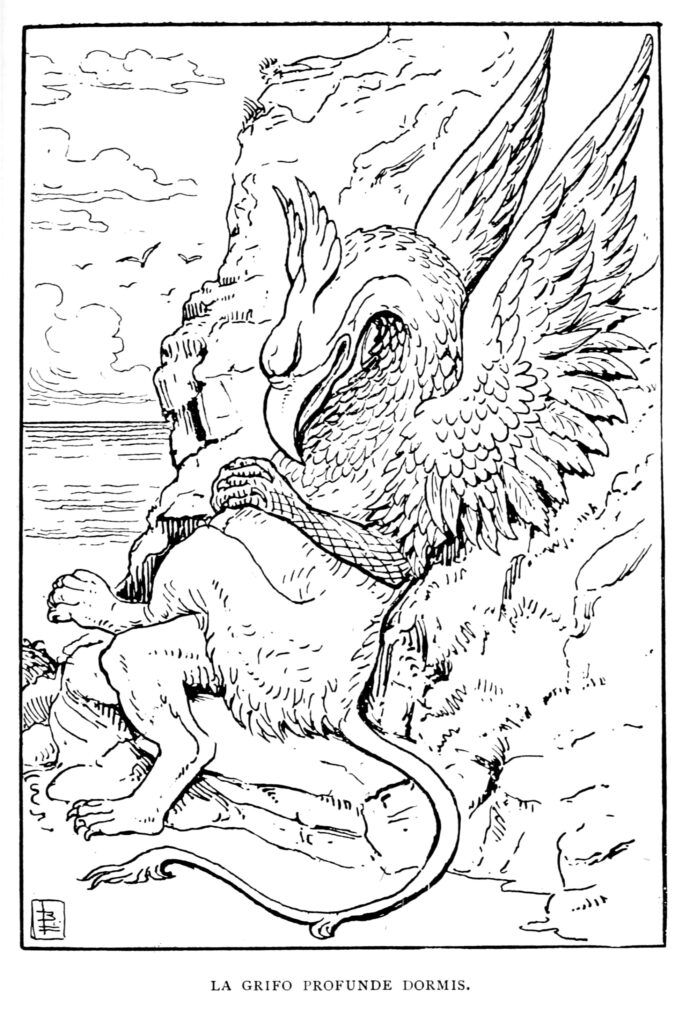
La grifo profunde dormis. (“The griffin was deeply asleep.”)
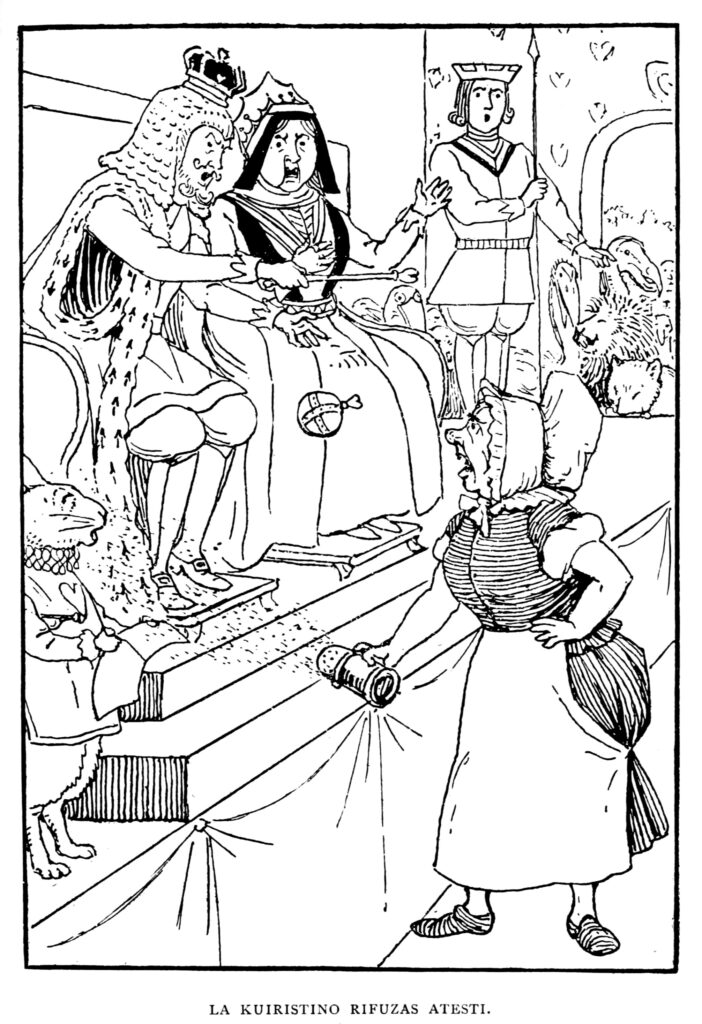
La kuiristino rifuzas atesti. (“The cook refuses to testify.”)

Illustrations for Alice in Wonderland – Part 3 – Peter Newell

Peter Newell was a prolific American illustrator and author. The books with his illustrations for Alice’s Adventures in Wonderland and Through The Looking Glass were published circa 1901. These are paintings rather than line drawings. The books were printed in black and white/grayscale so are the illustrations. But there must be a set of fully colour versions of these paintings. Some of them you can see here and there on the interwebs, but a complete collection I could not find. If you know of colour versions of these paintings please let me know.


Alice’s Adventures in Wonderland

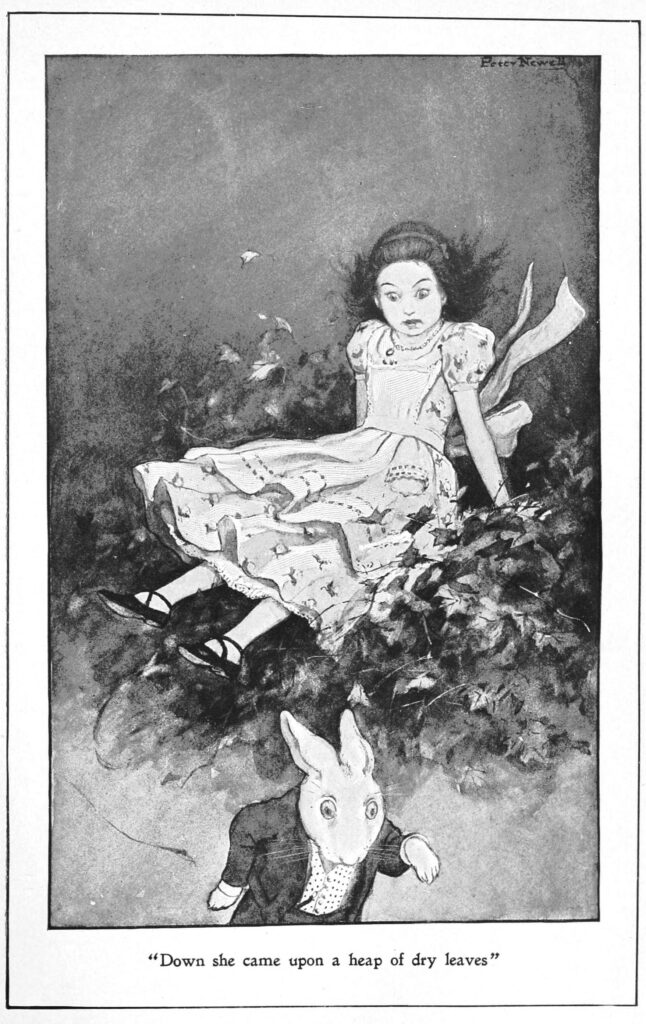
Down she came upon a heap of dry leaves.


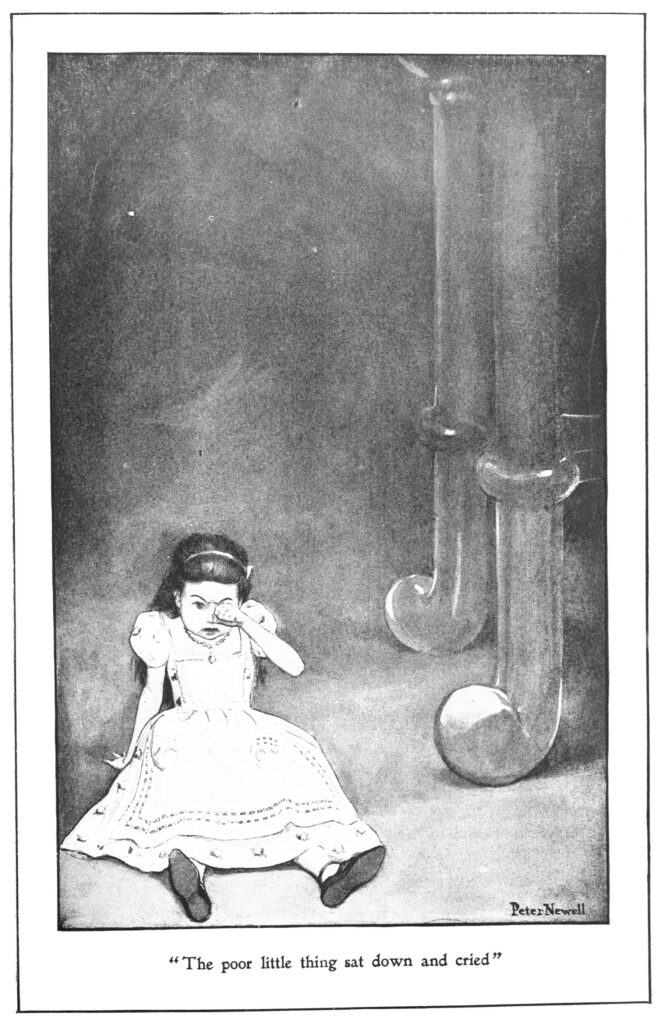
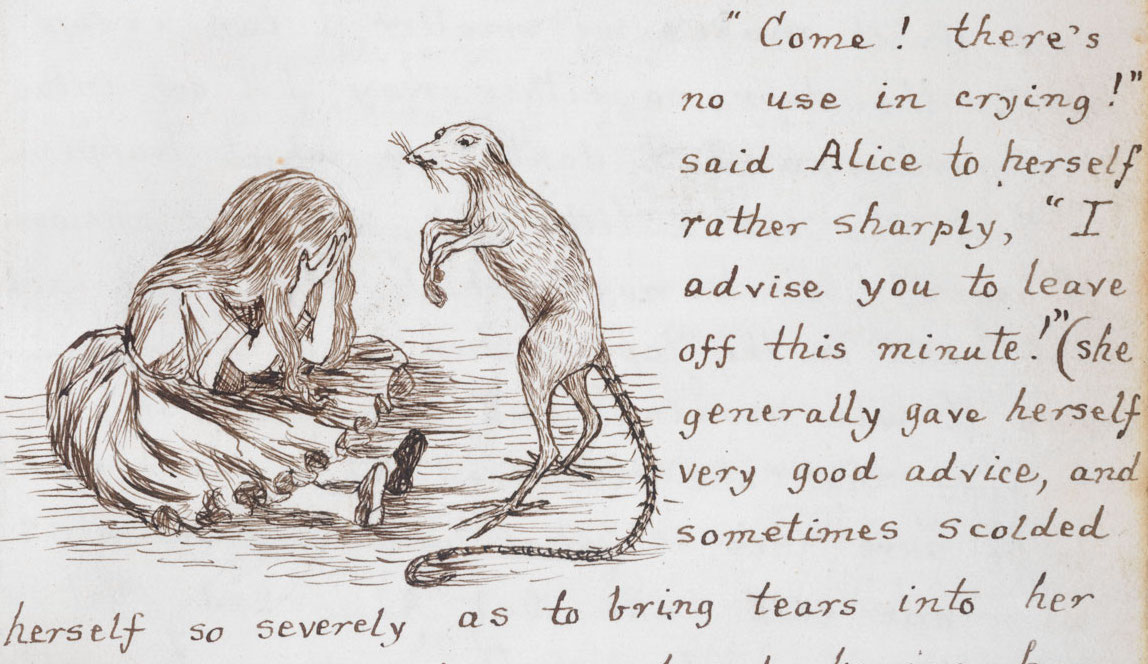
The poor little thing sat down and cried.

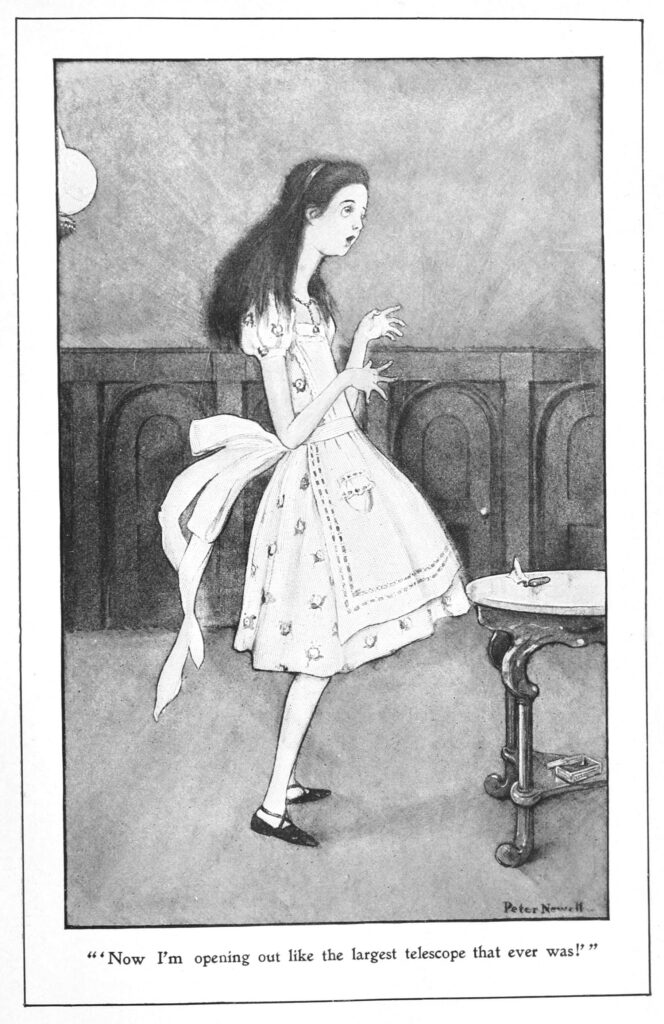
“Now I’m opening out like the largest telescope that ever was!”


The Rabbit started violently.


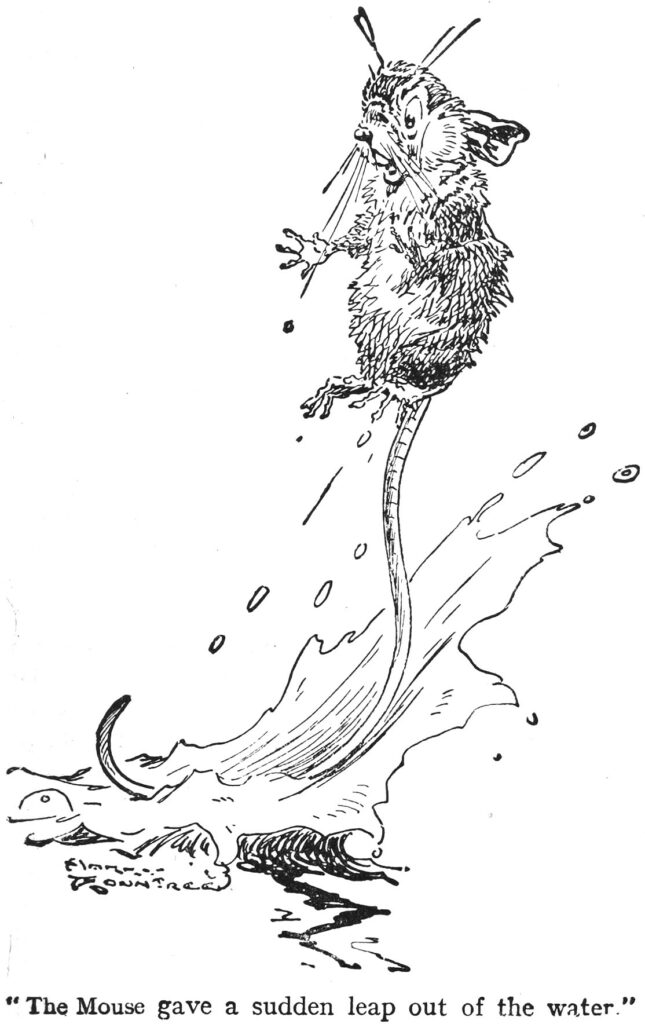
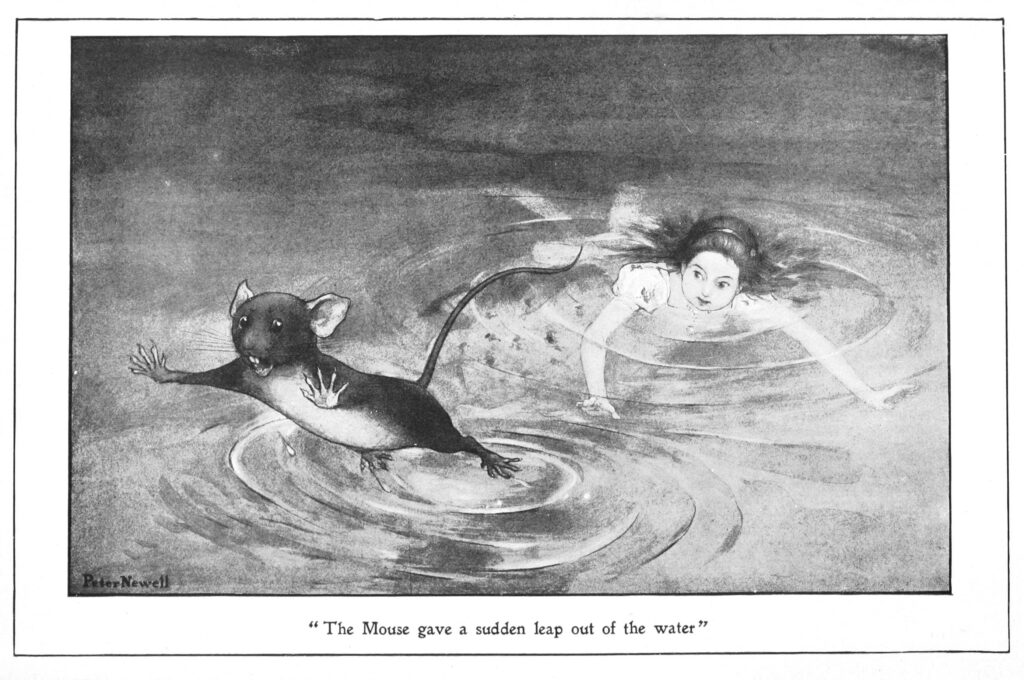
The Mouse gave a sudden leap out of the water.

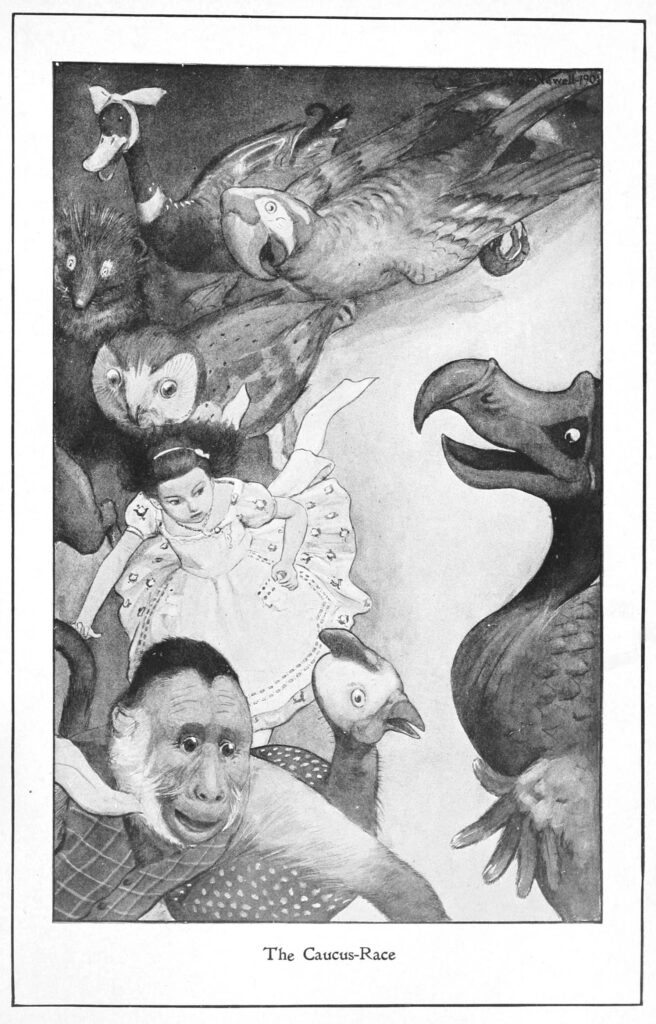
The Caucus-Race.


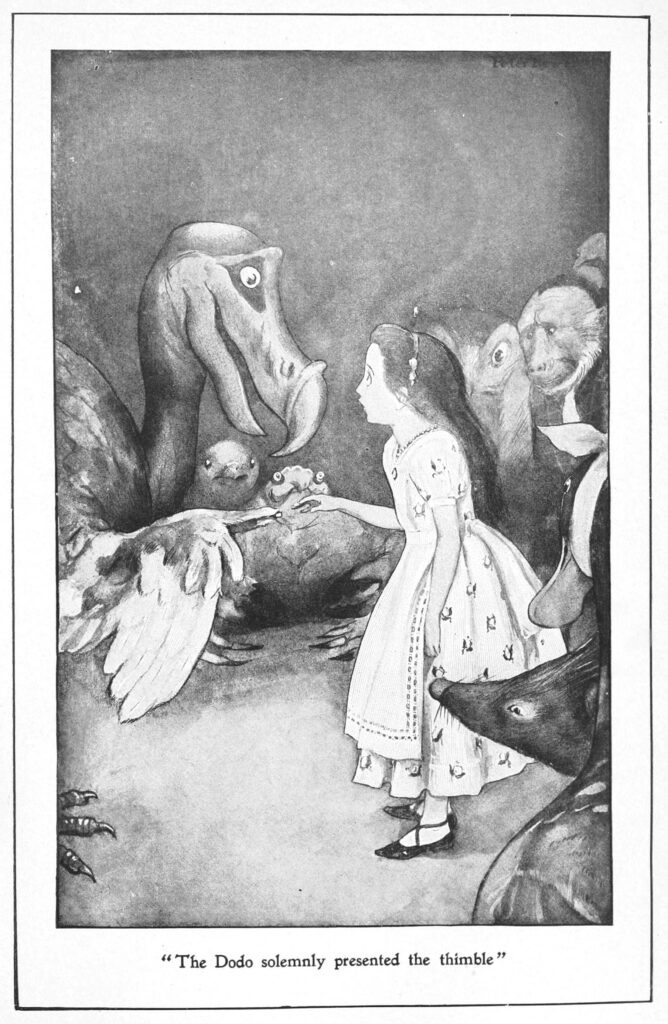
The Dod solemnly presented the thimble.

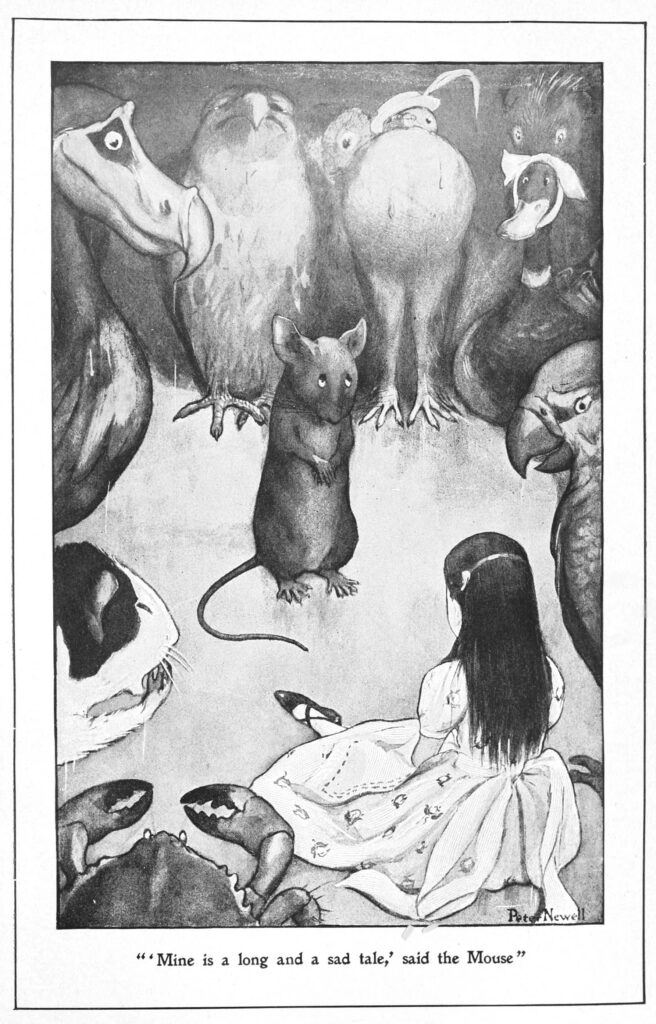
“Mine is a long and a sad tale,” said the Mouse.

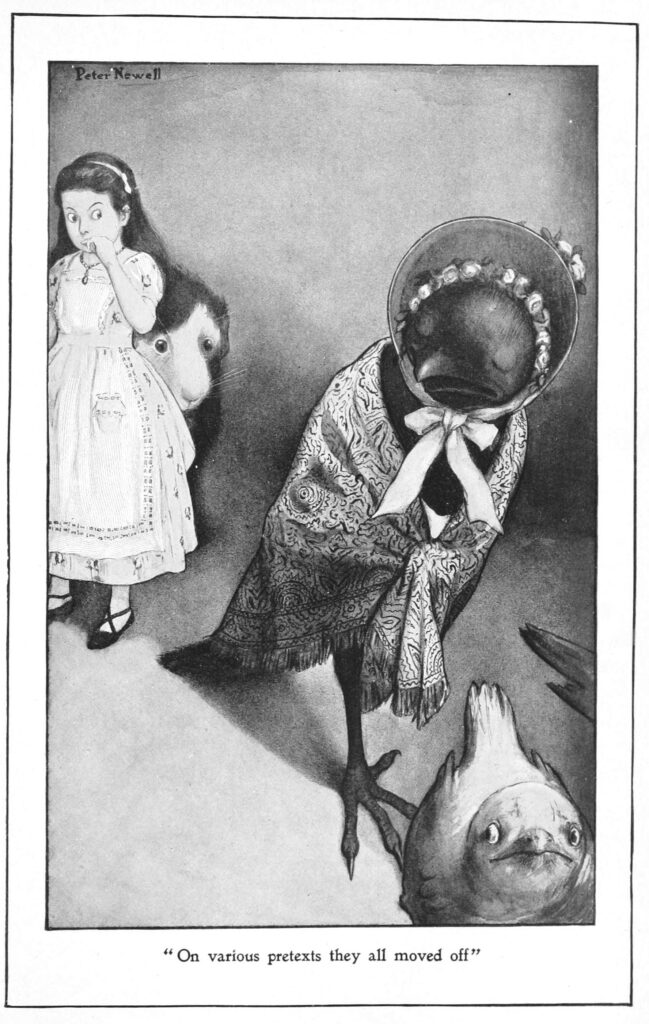
On various pretexts they all moved off.

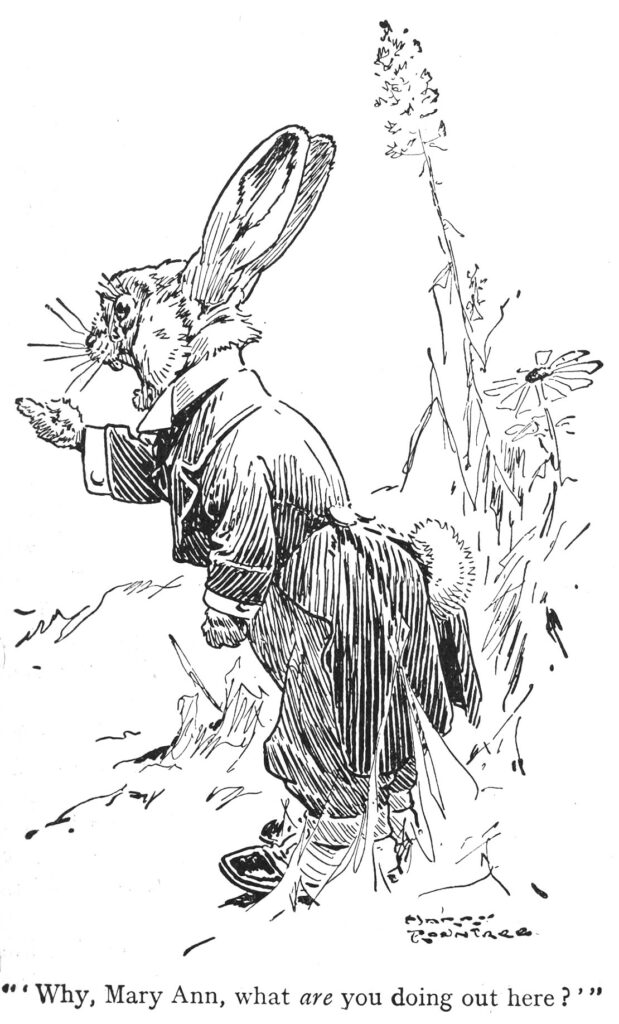
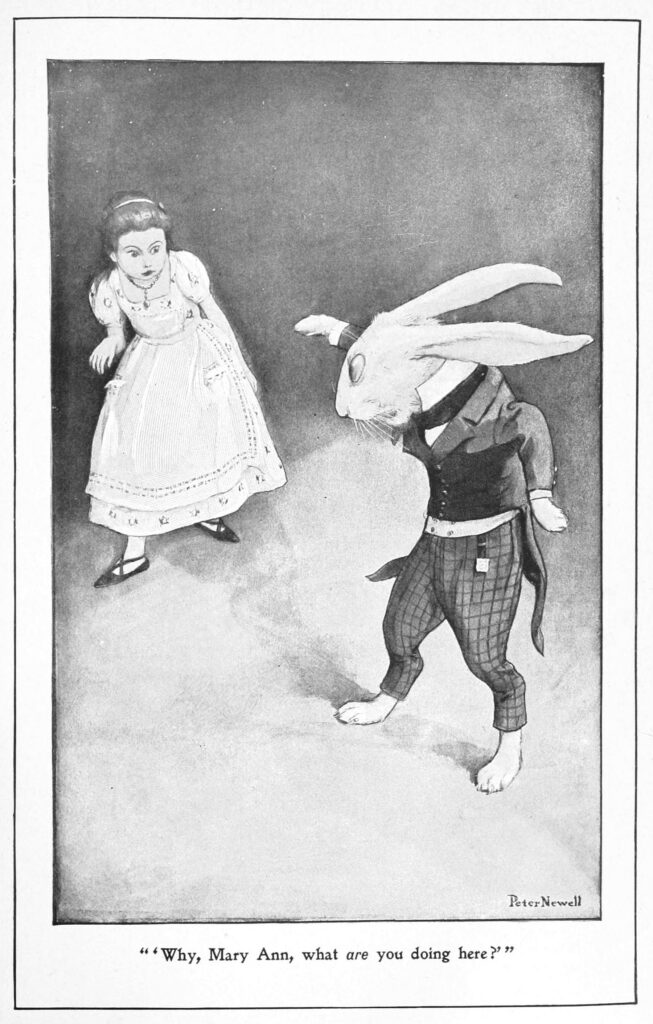
“Why, Mary Ann, what are you doing here?”

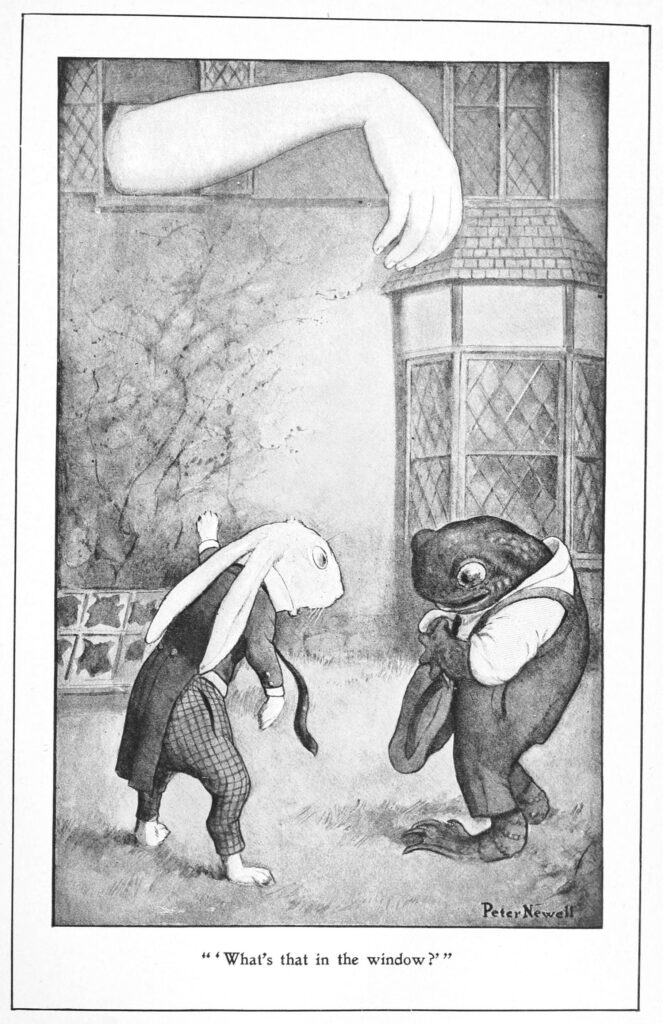
“What’s that in the window?”

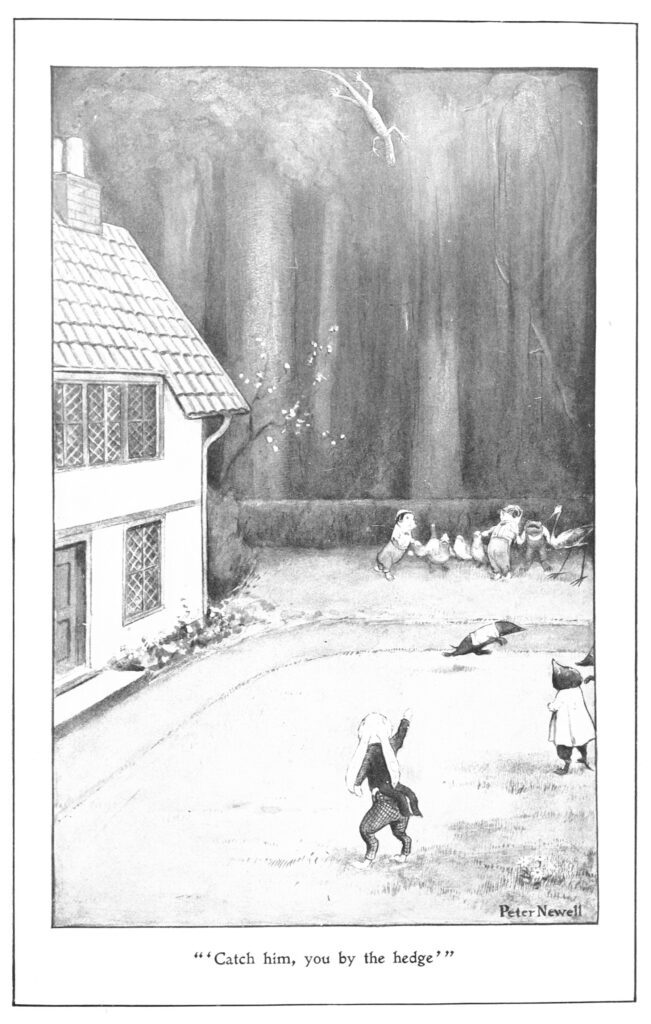
“Catch him, you by the hedge.”

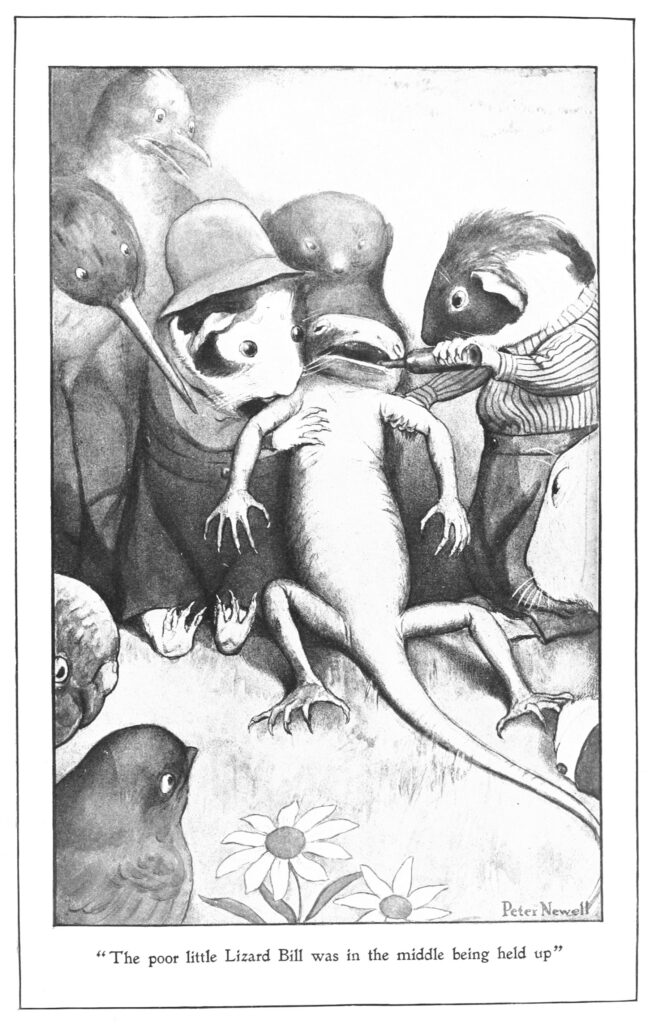
The poor little Lizard Bill was in the middle being held up.

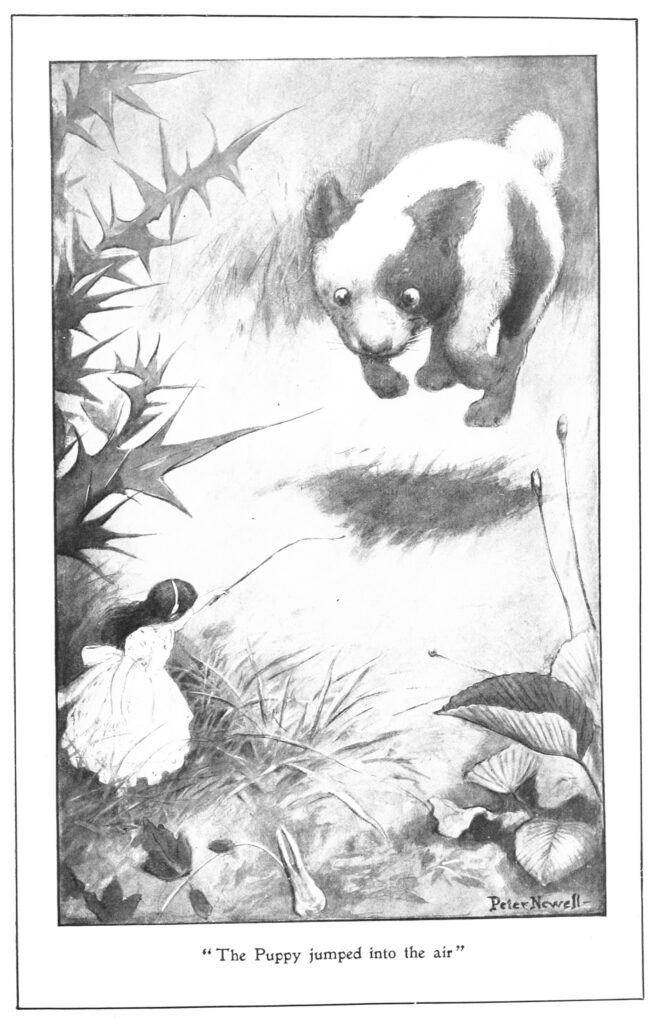
The Puppy jumped into the air.


T

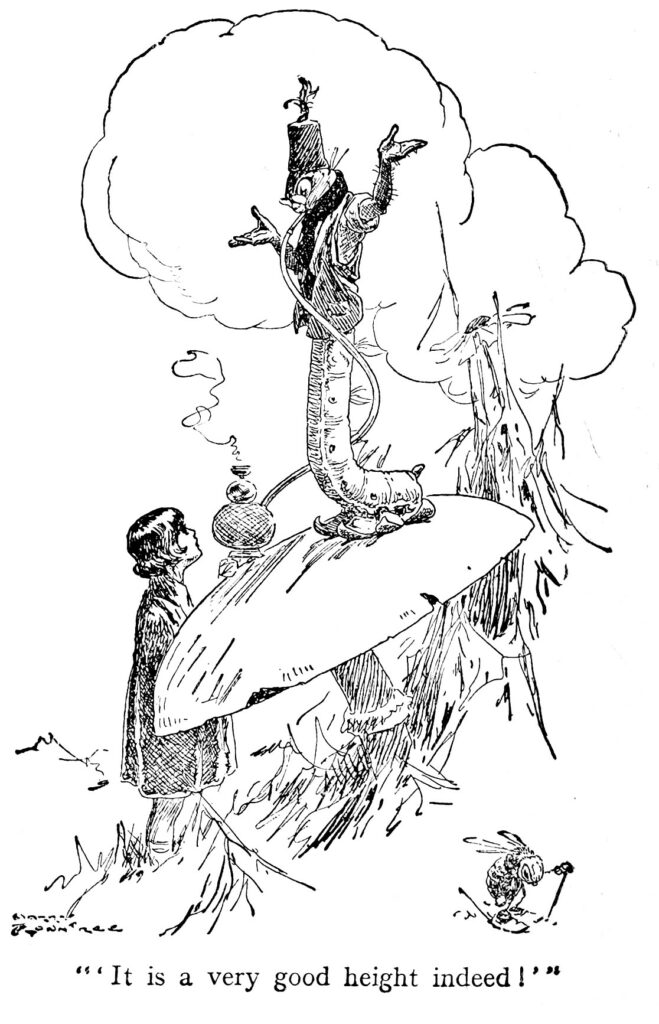
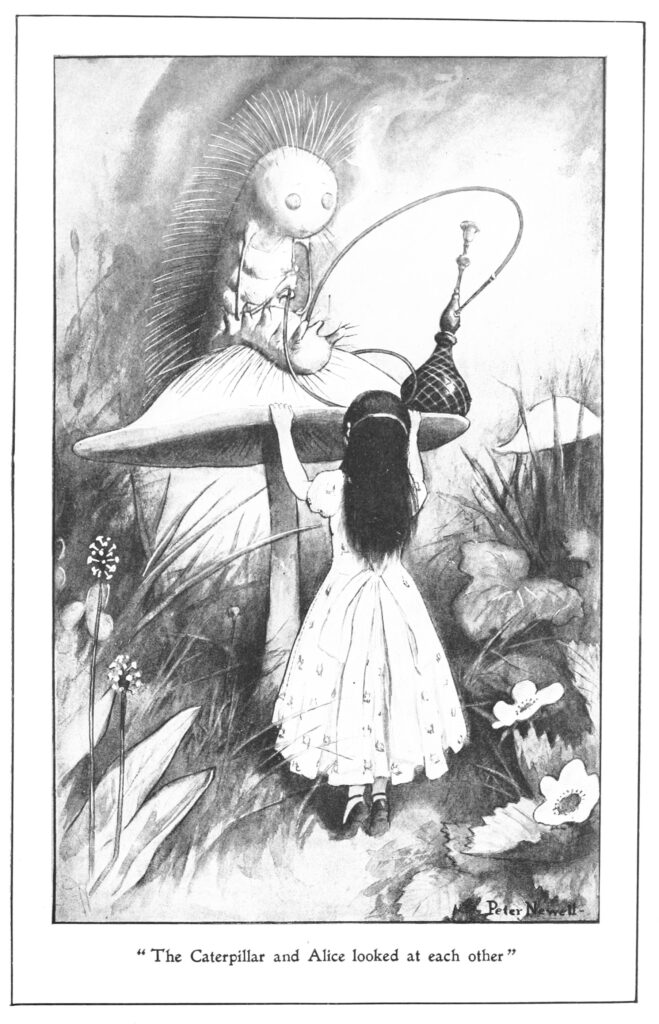
The Caterpillar and Alice looked at each other.

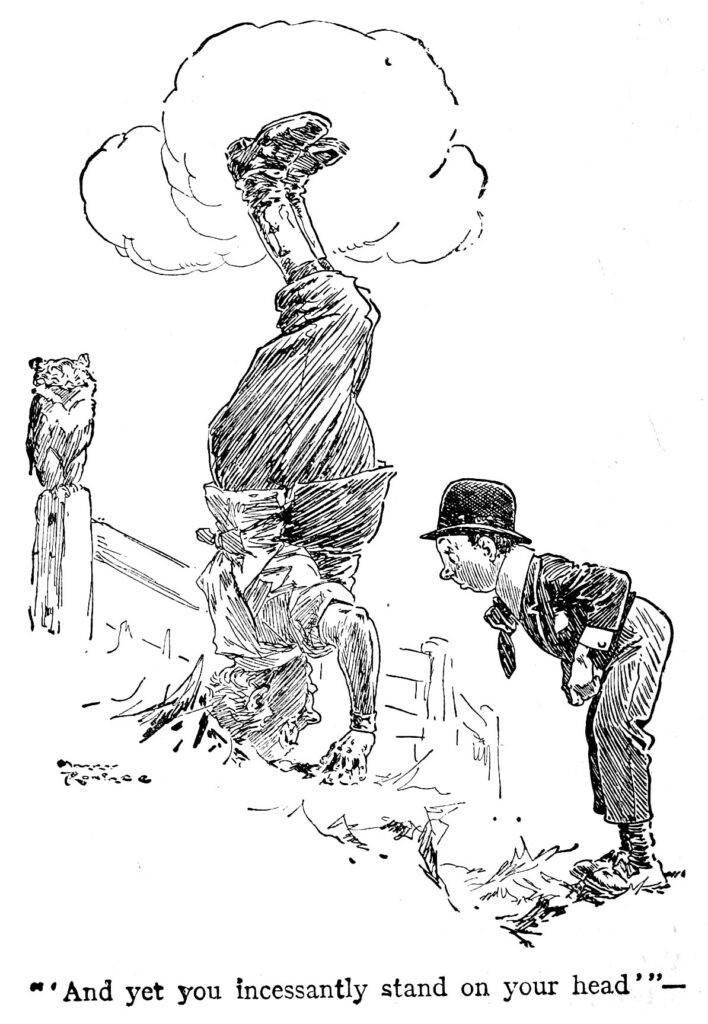
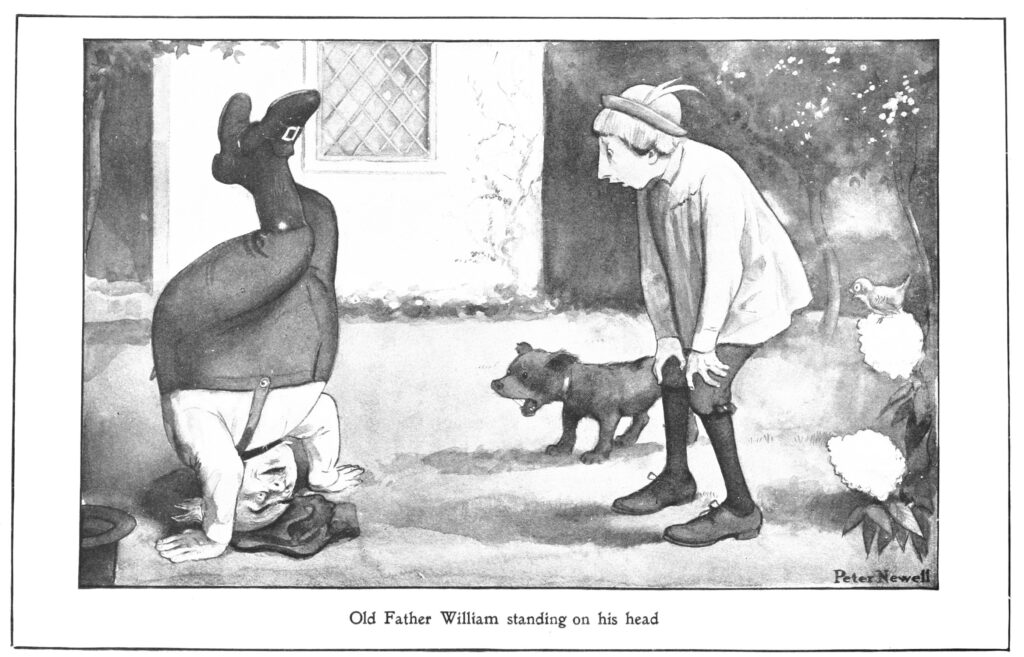
Old Father William standing on his head.


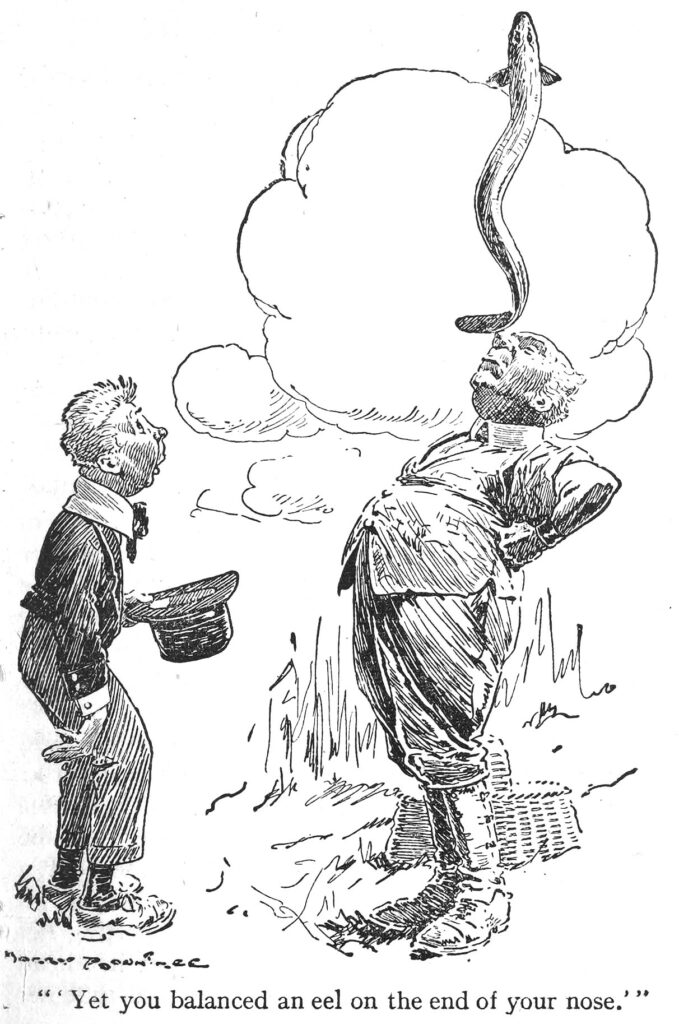
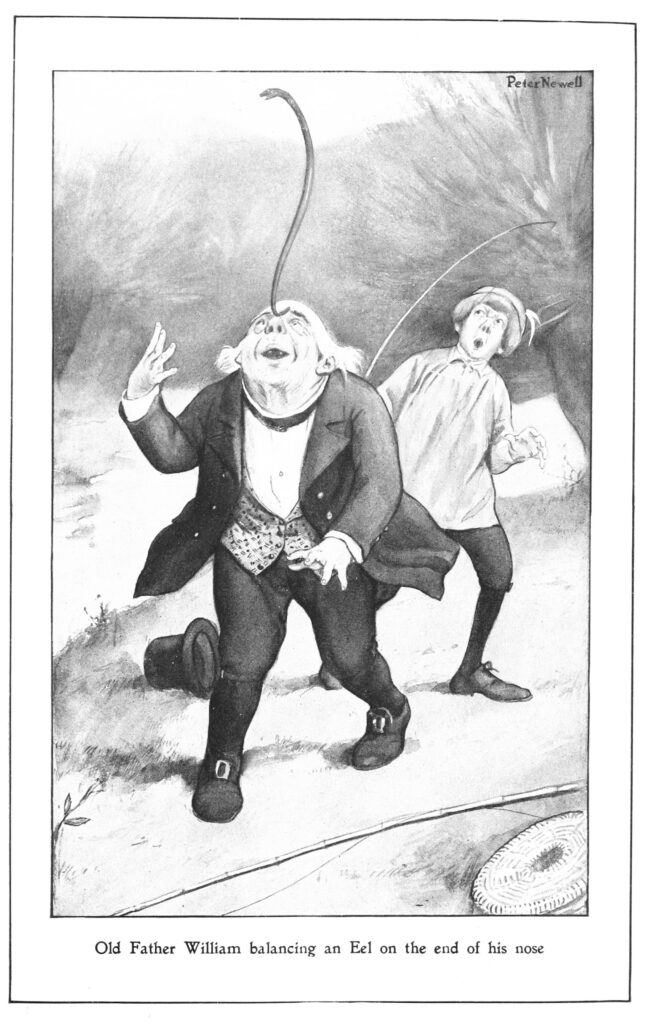
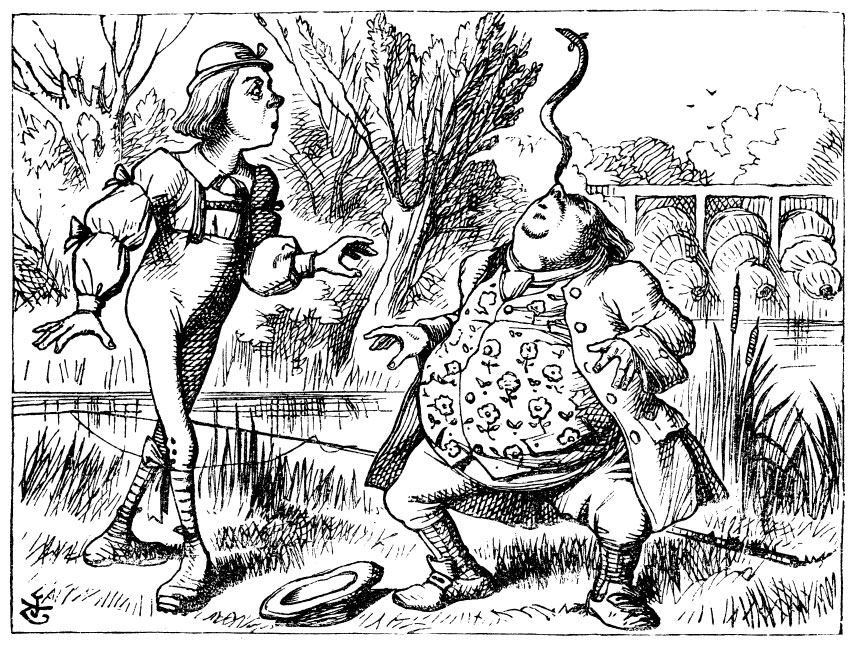
Old Father William balancing an Eel on the end of his nose.

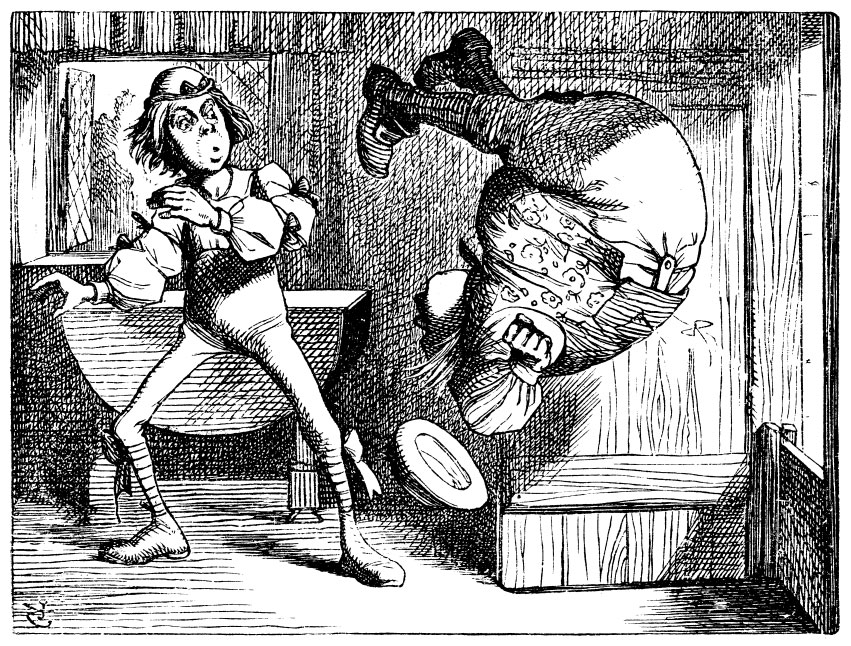
Old Father William turning a back somersault in at the door.

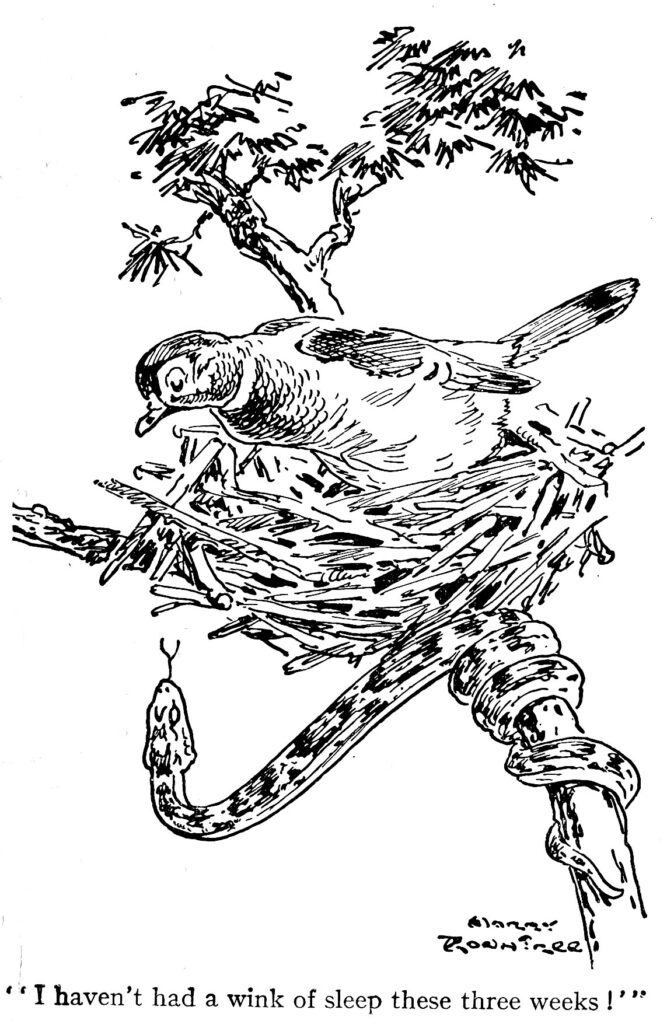
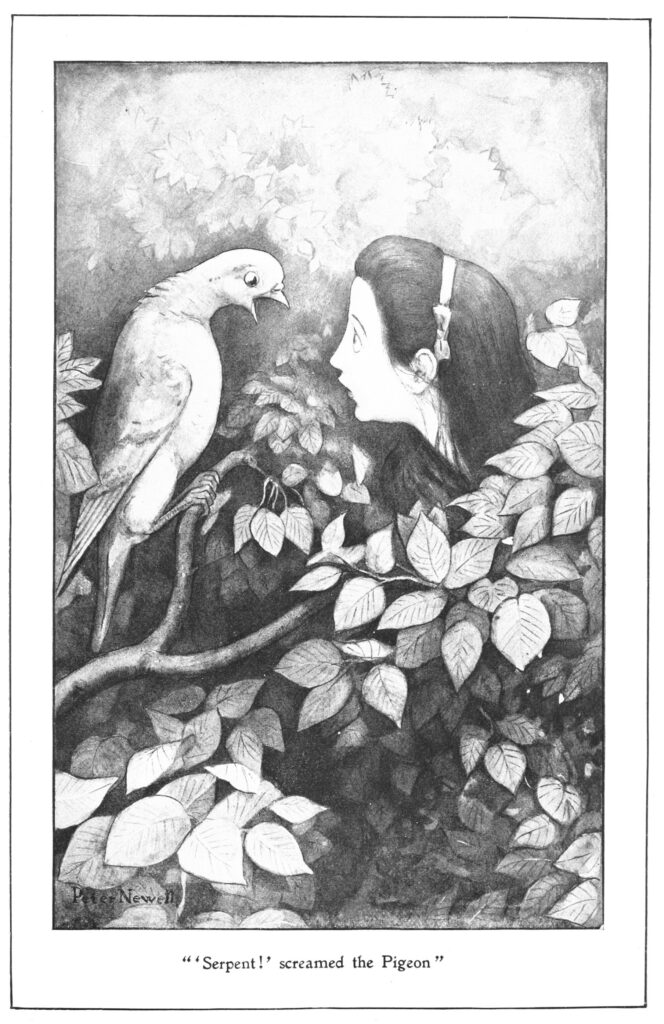
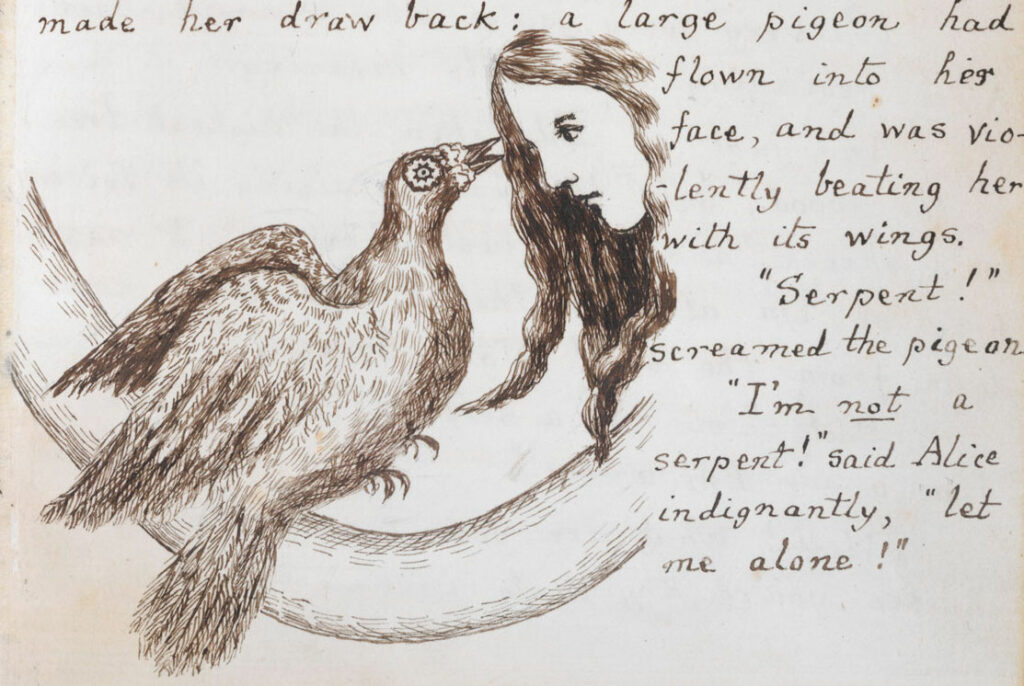
“Serpent!” screamed the Pigeon.

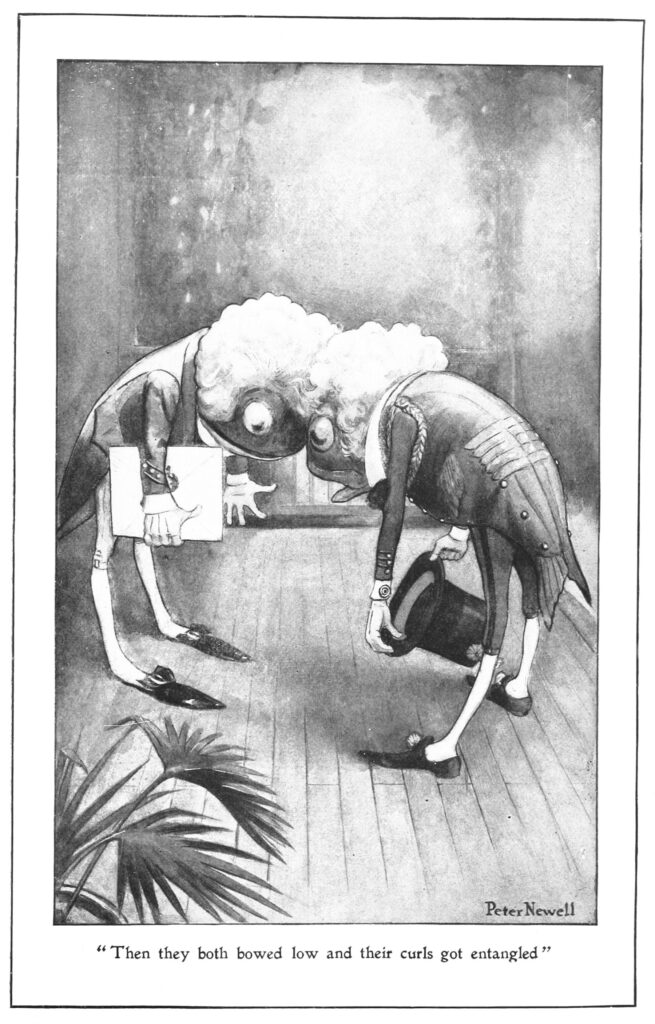
Then they both bowed low and their curls got entangled.


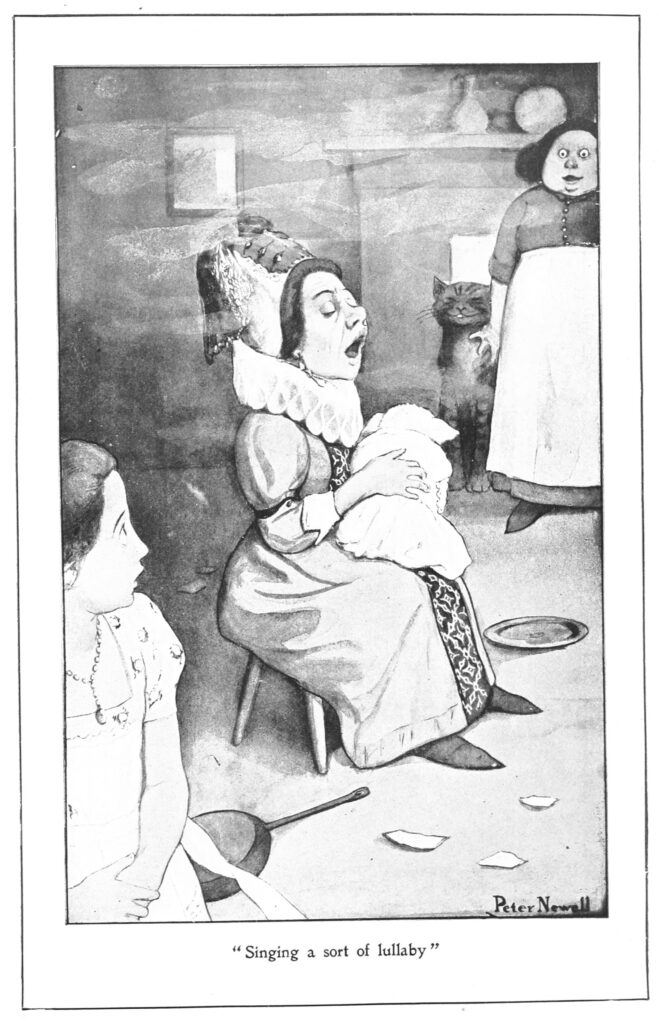
Singing a sort of lullaby.


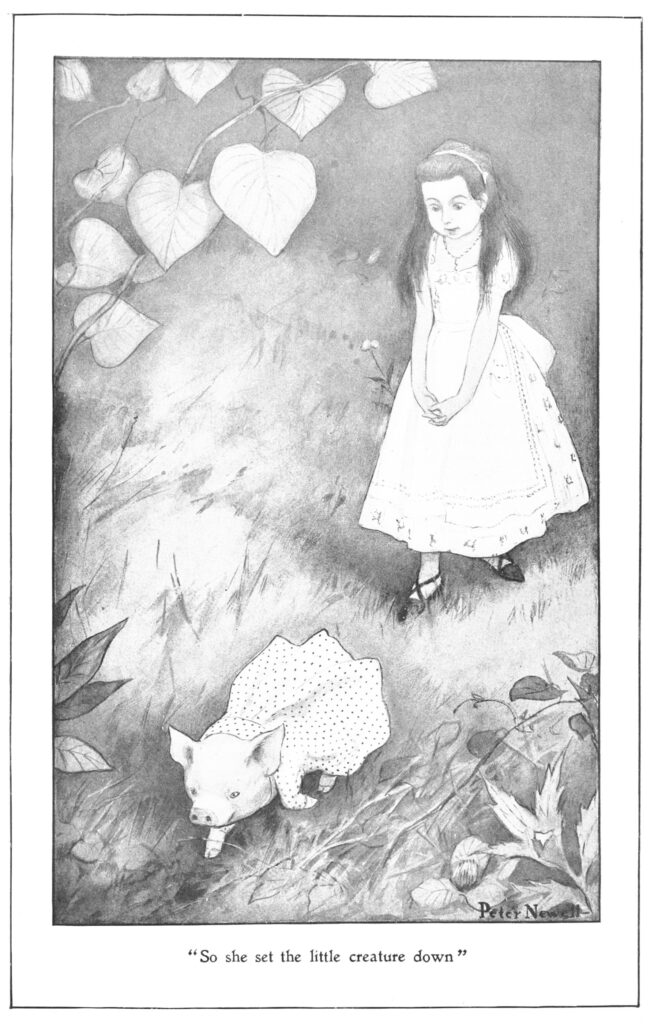
Sp she set the little creature down.

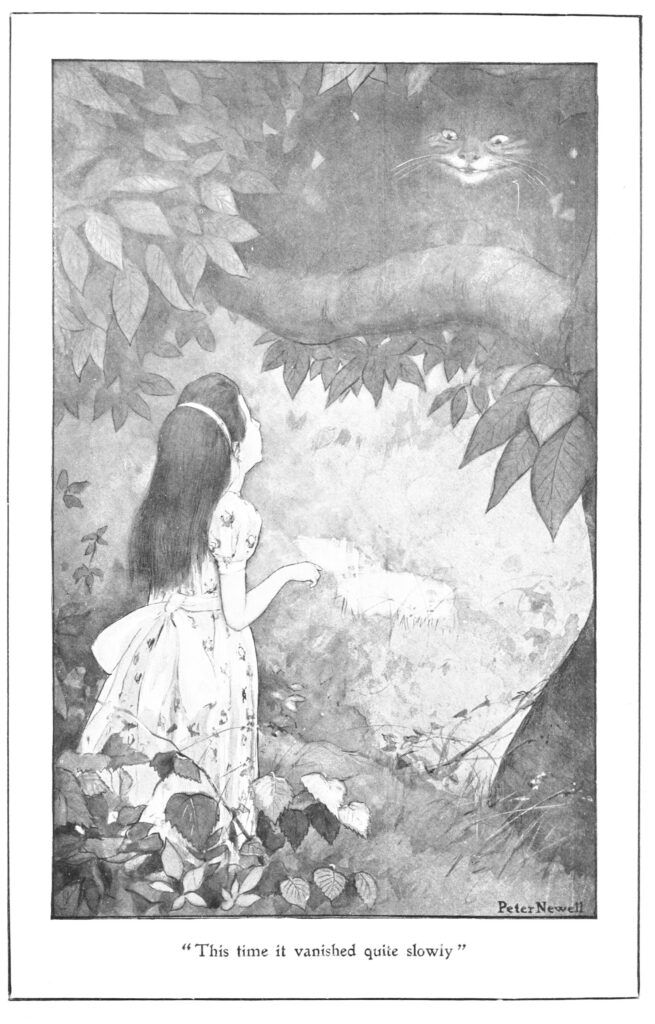
This time it vanished quite slowly.

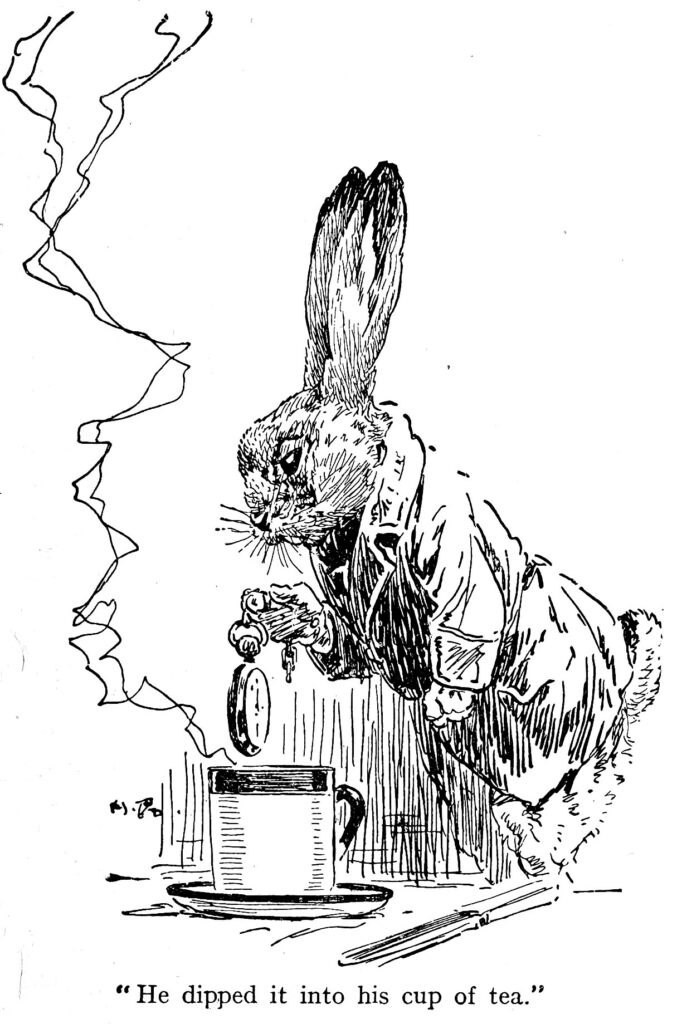
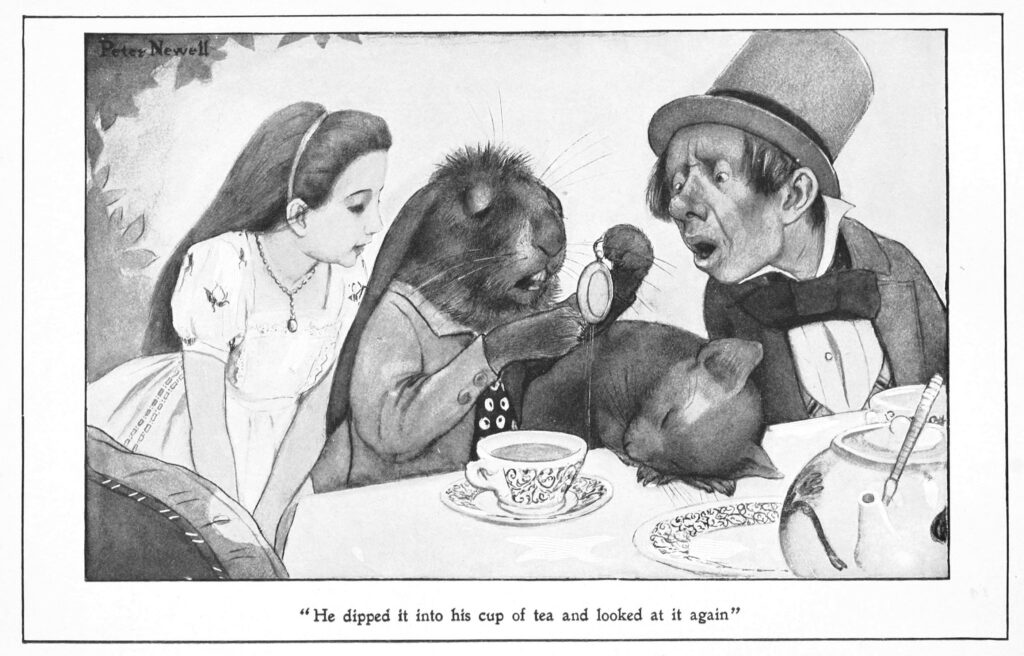
He dipped it into his cup of tea and looked at it again.

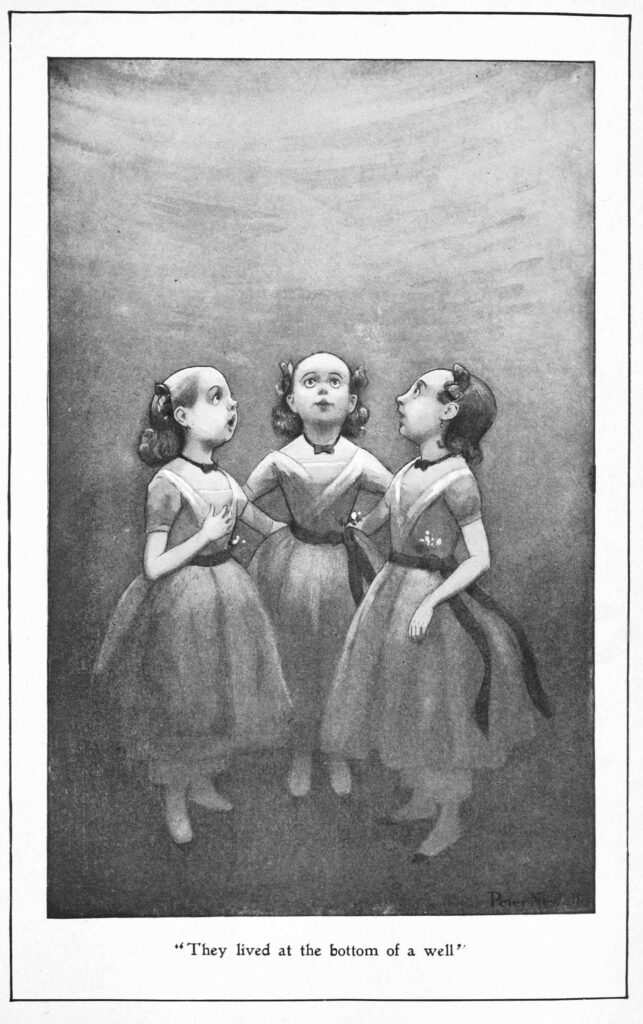
They lived at the bottom of a well.


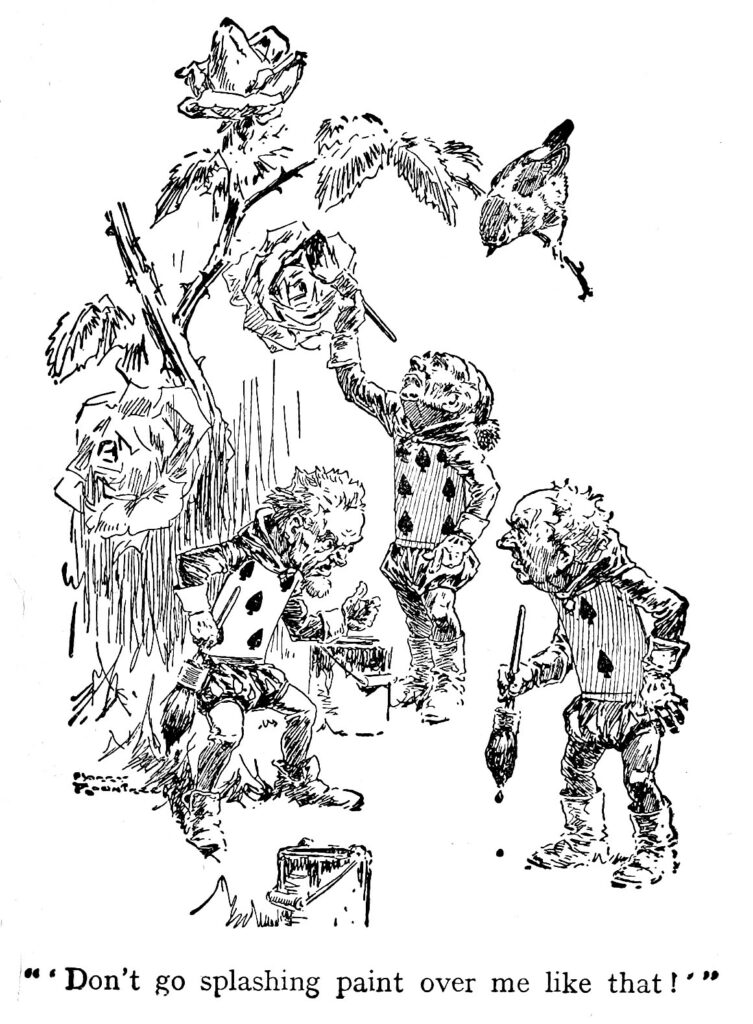
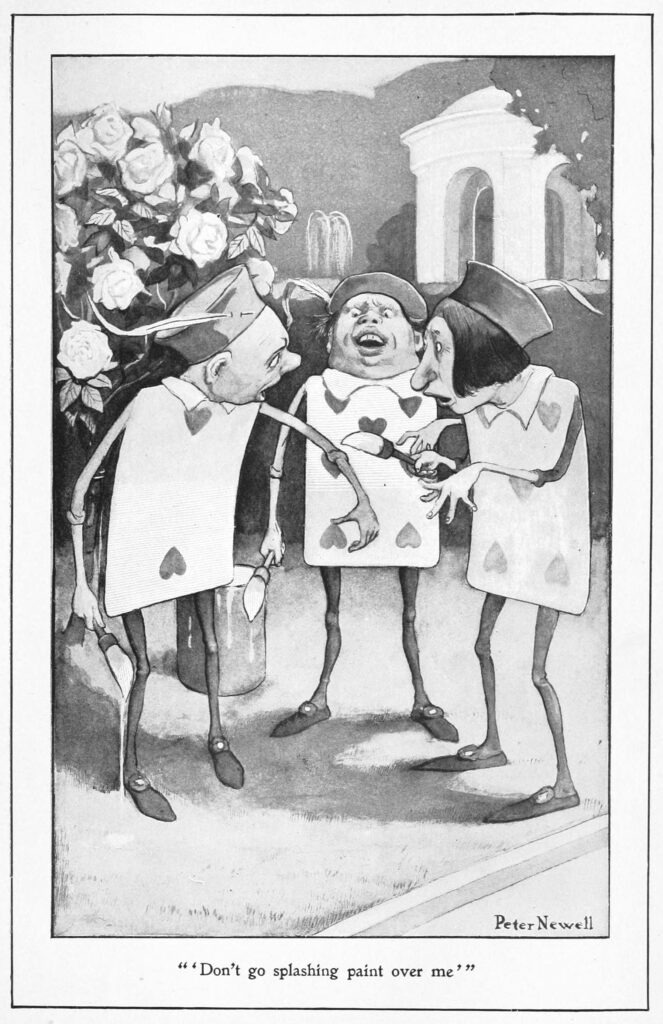
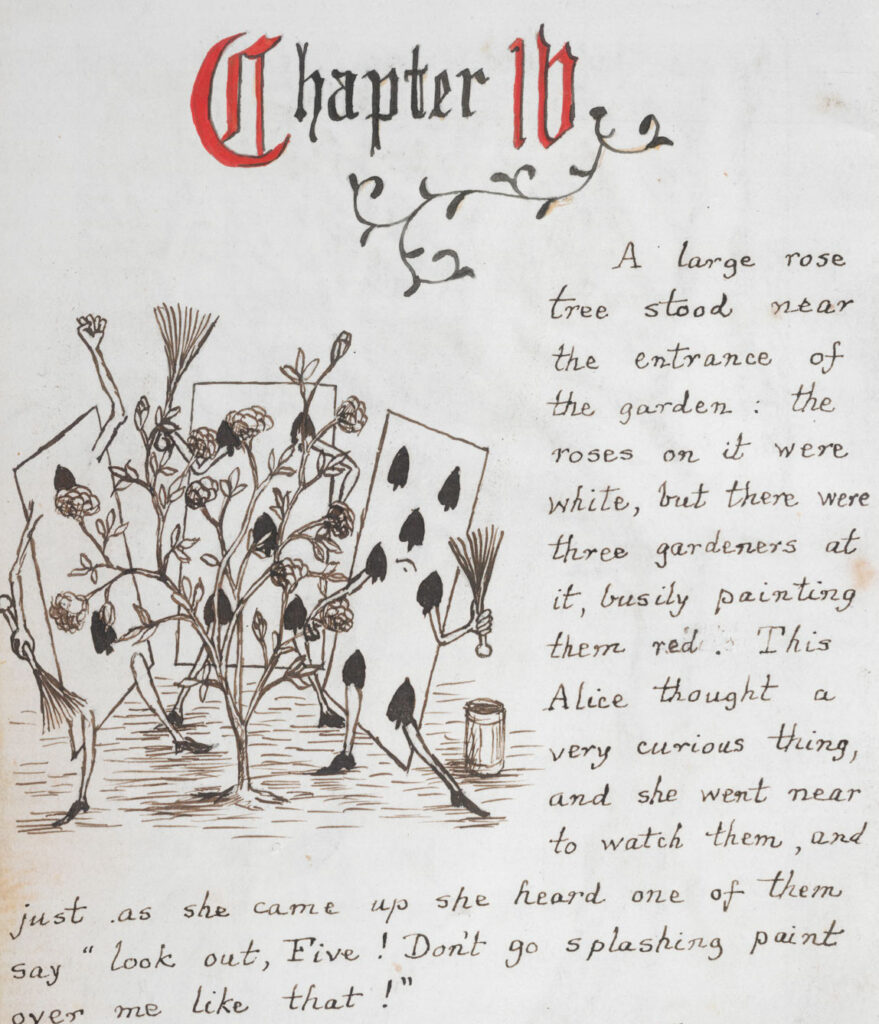
Don’t go splashing paint over me.


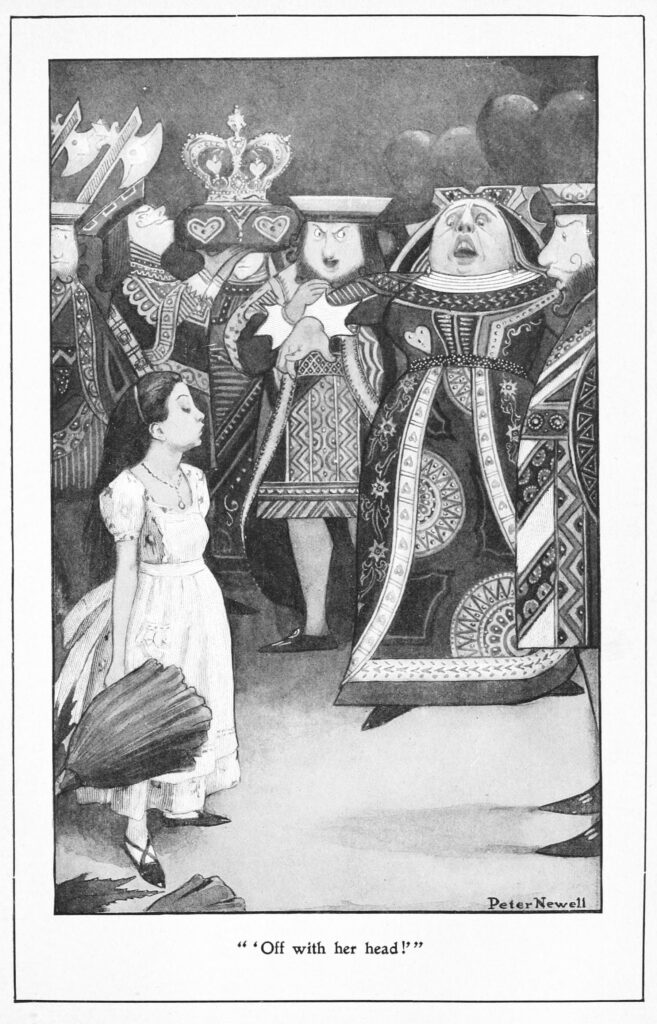
“Off with her head!”

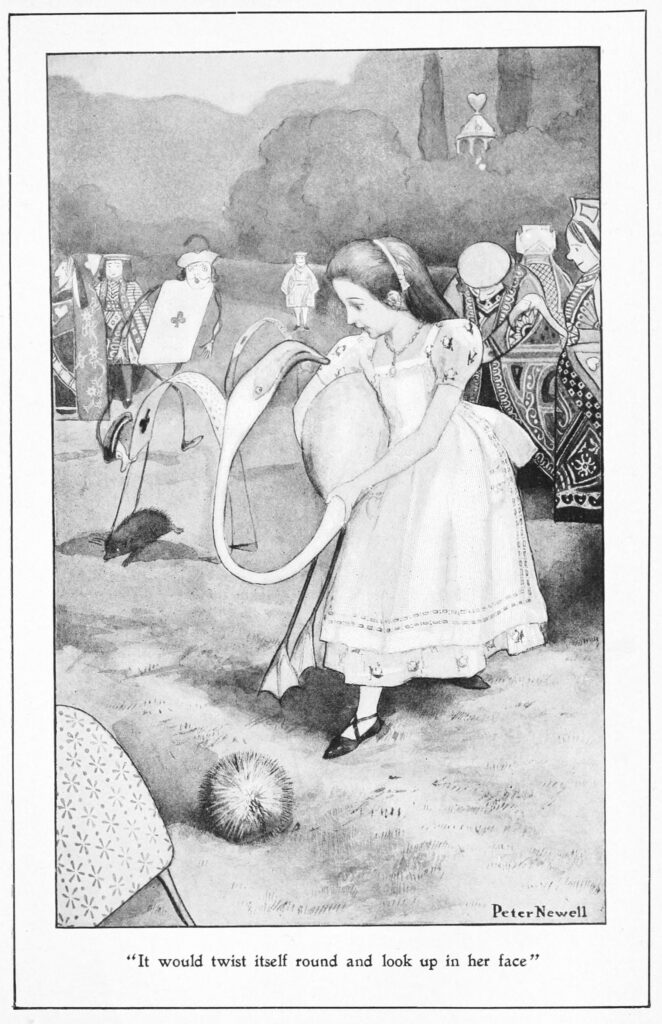
It would twist itself round and look up in her face.

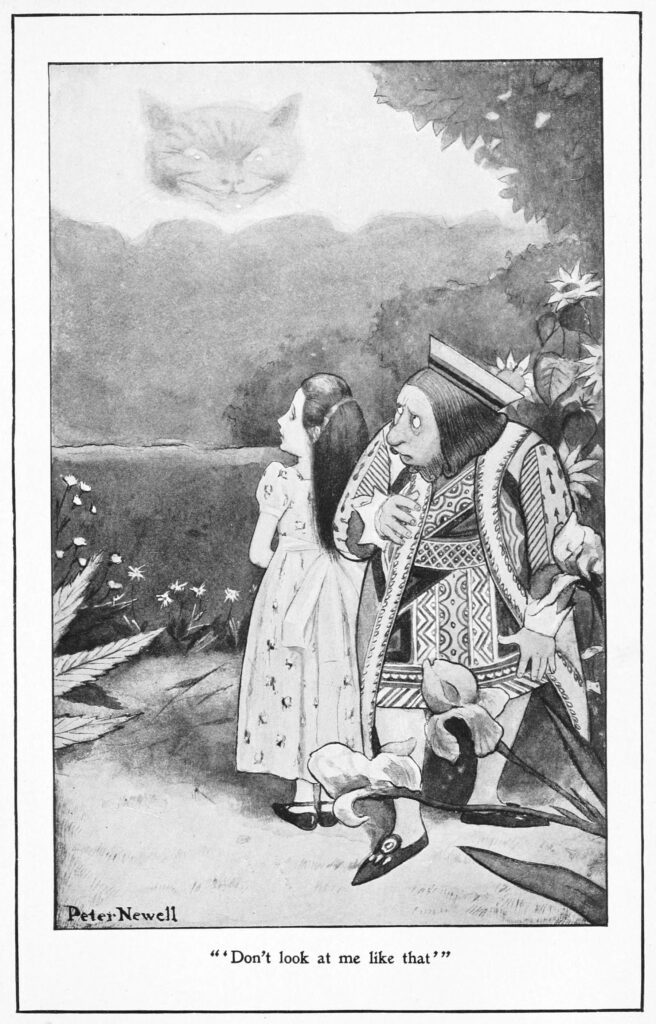
“Don’t look at me like that.”

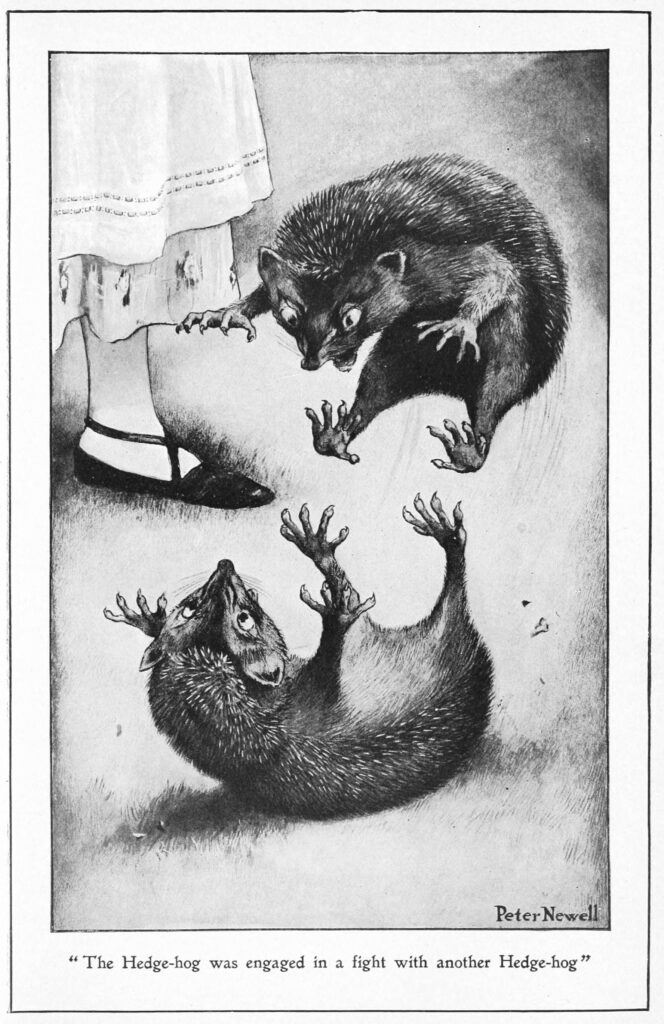
The Hedge-hog was engaged in a fight with another Hedge-hog.


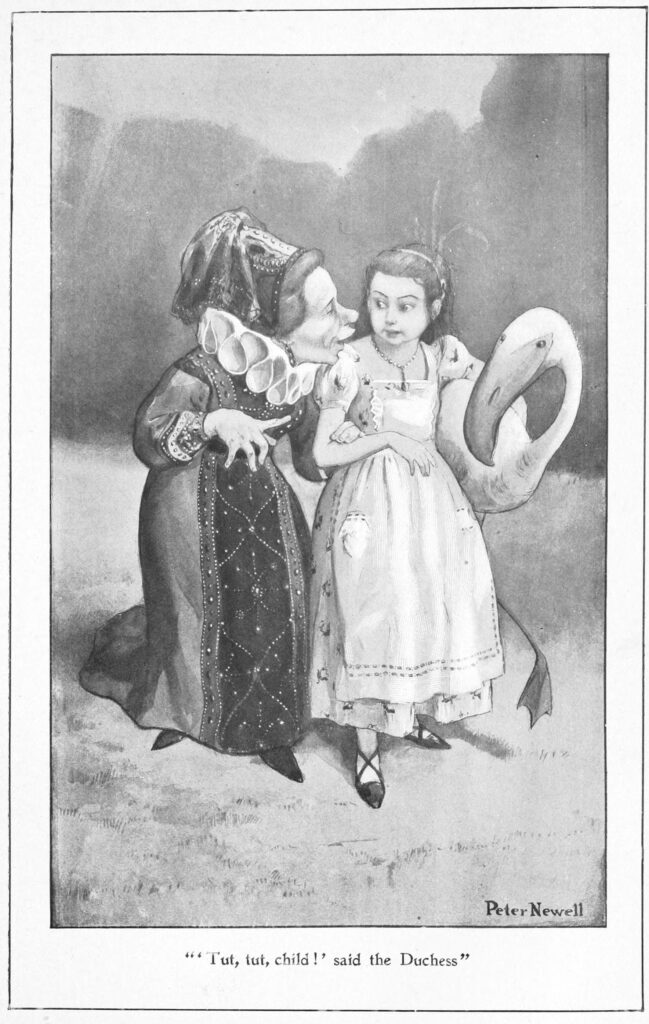
“Tut, tut, child!” said the Duchess.


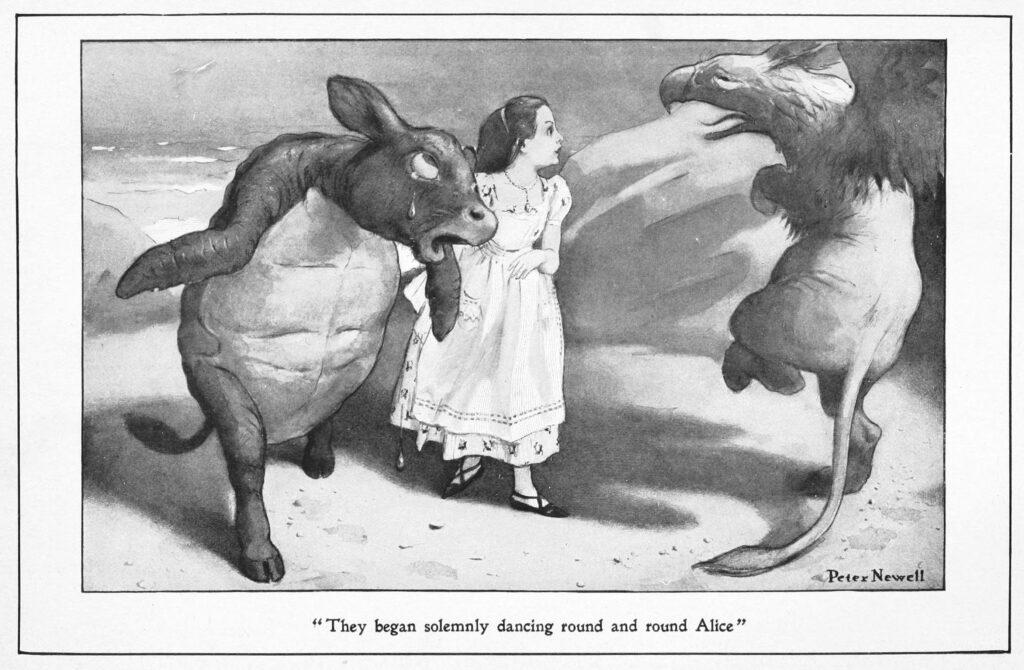
They began solemnly dancing round and round Alice.

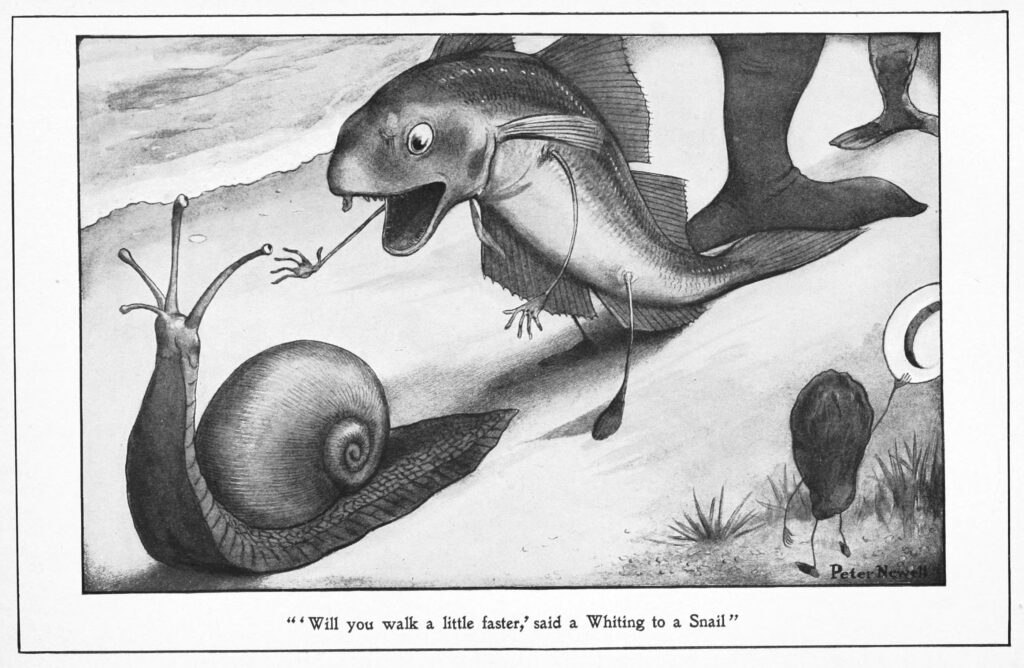
“Will you walk a little faster,” said a Whitling to a Snail.

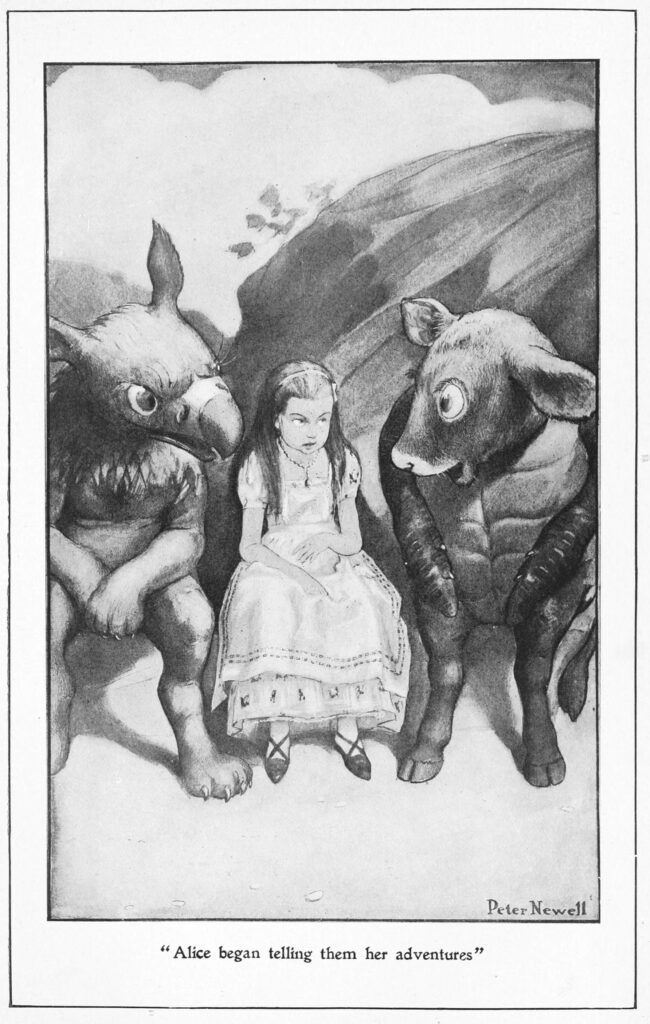
Alice began telling them her adventures.

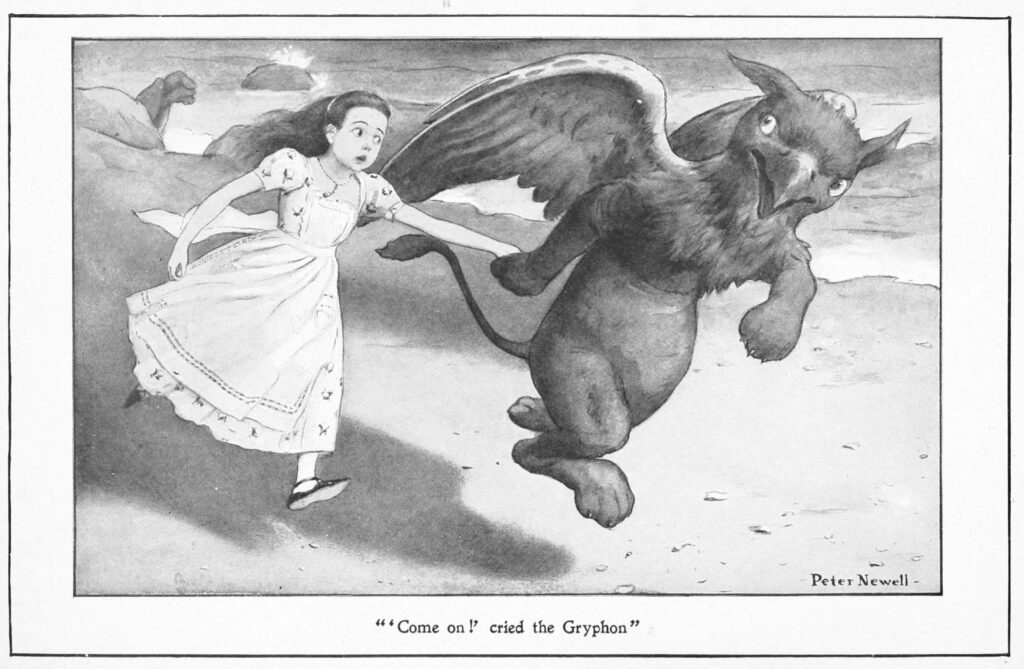
“Come on!” cried the Gryphon.

Illustrations for Alice in Wonderland – Part 2 – John Tenniel

John Tenniel

John Tenniel’s illustrations are by far the most popular drawings for Alice. Over the years from their first publication in for Wonderland (1865) and Looking Glass (1871), these illustrations have had a life of their own.The original illustrations are line drawings, closely following Lewis Carroll’s illustrations in spirit and sometimes in framing also. Tenniel’s illustrations have had a very strong impact on all the later illustrations by other artists as well. His depictions of certain characters, at least for me, is intimately tied with the words of Lewis Carroll. I cannot imagine the story without reference to his illustrations.

Tenniel’s monogram of his stylised initials are part of all the illustrations.


Several later renditions of these were coloured or supplemented by full colour plates by other artists. We will make a separate post for these modified colour illustrations later. In this post we will see only the original illustrations as they appear in the 1865 edition a total of 42 including the front piece.


Over the years I have used several of these images in my presentation and work.

All images in public domain unless mentioned otherwise.

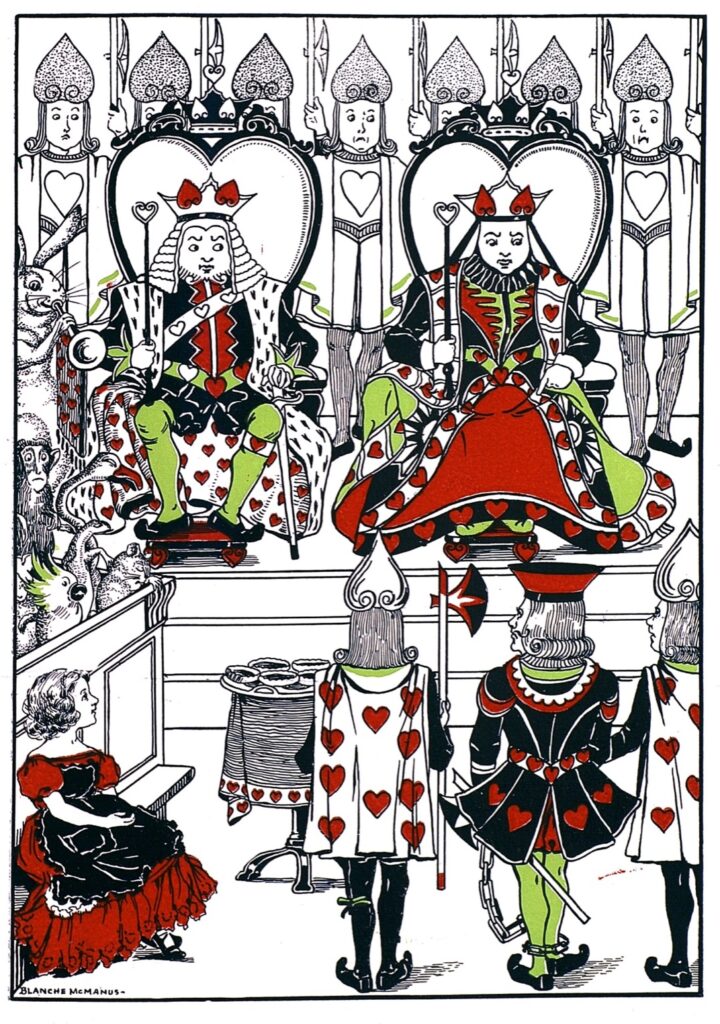
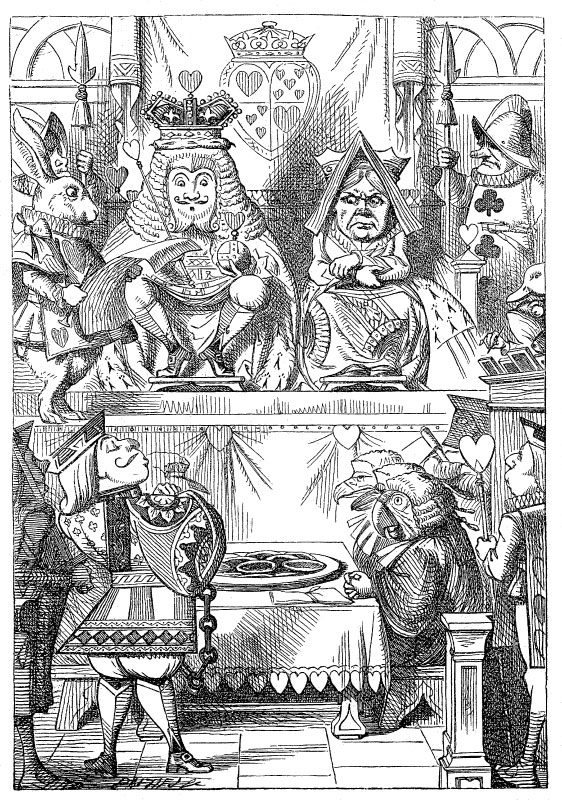
Front piece: the court of the king and queen of hearts.

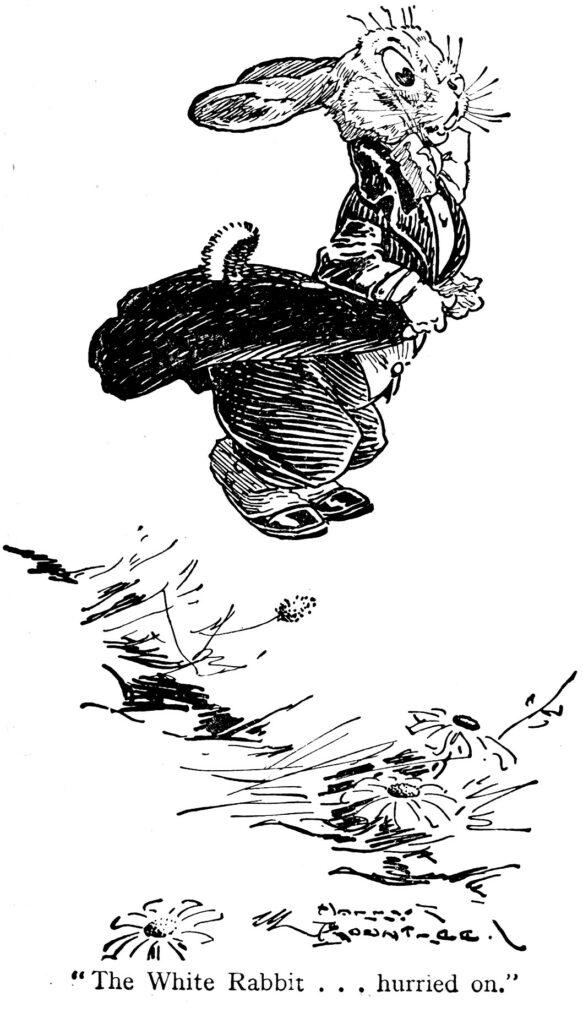
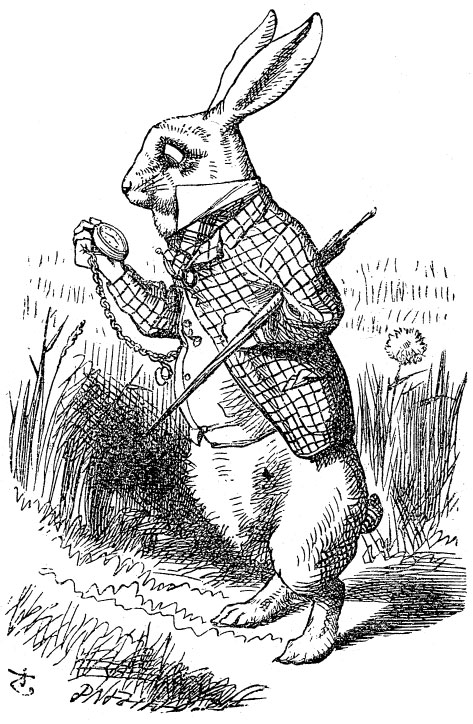
The White rabbit.

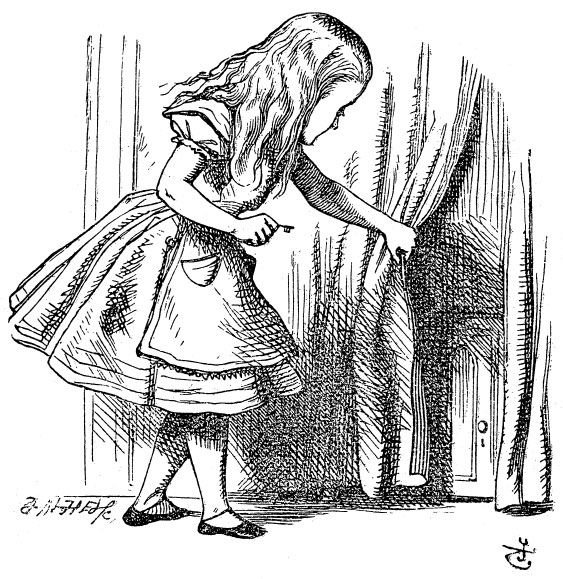
Alice finds the little door.

Drink me! said the label on the bottle.

Alice becomes enlarged.

The white rabbit runs away.

Alice in pool of tears.


The mouse swims away.

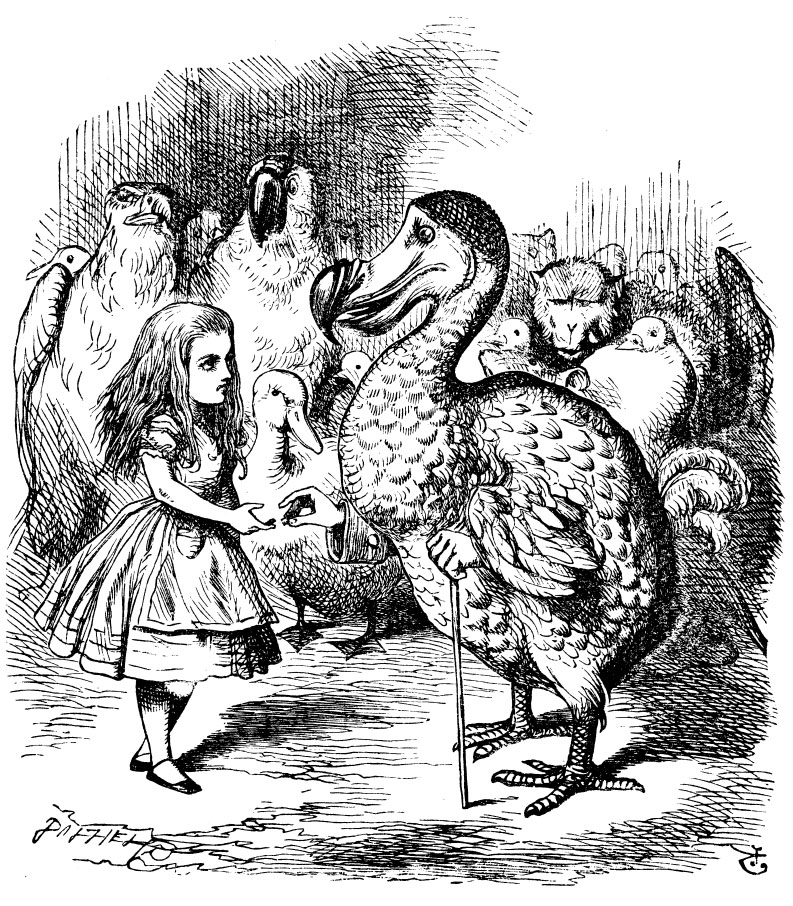
The Dodo presents Alice a thimble.

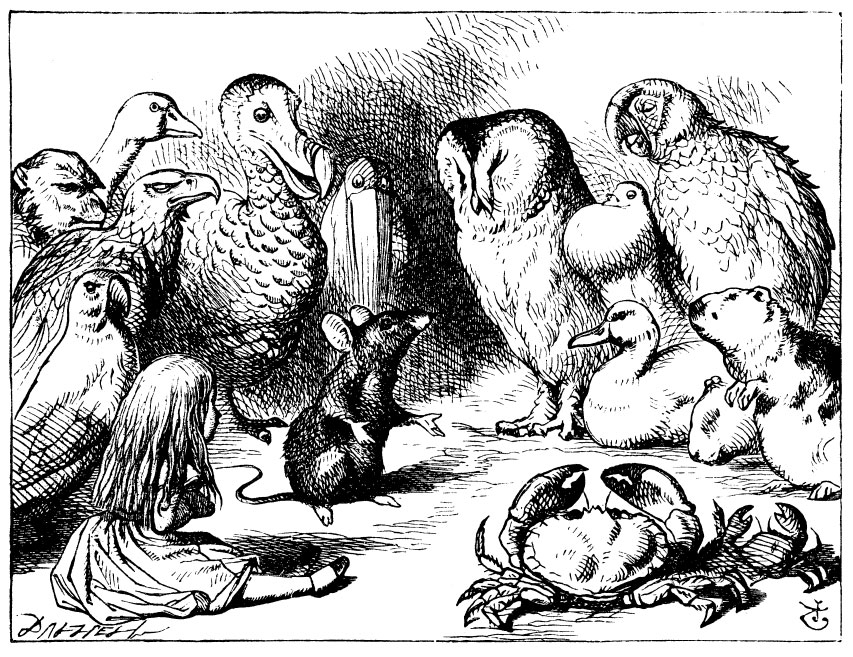
The mouse’s long and sad tale.

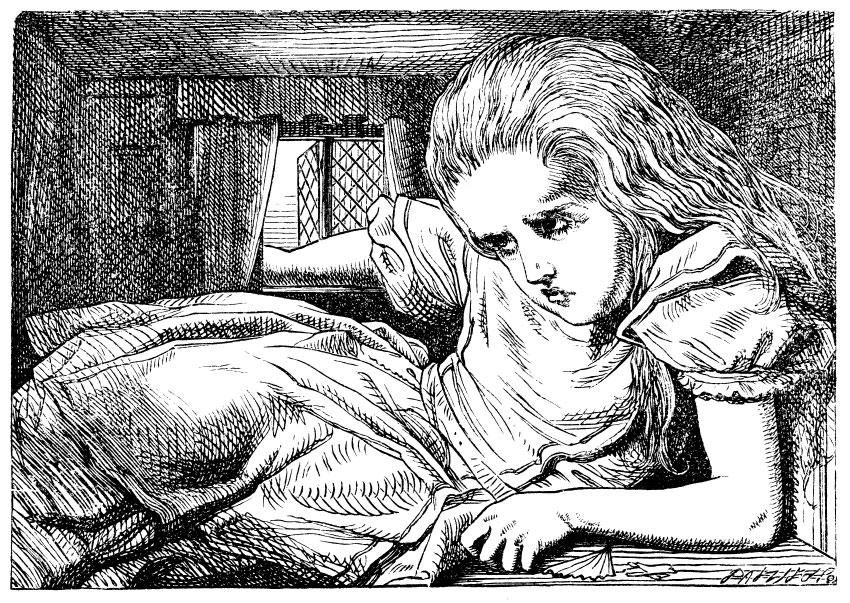
Alice went on growing and growing till she filled the room.

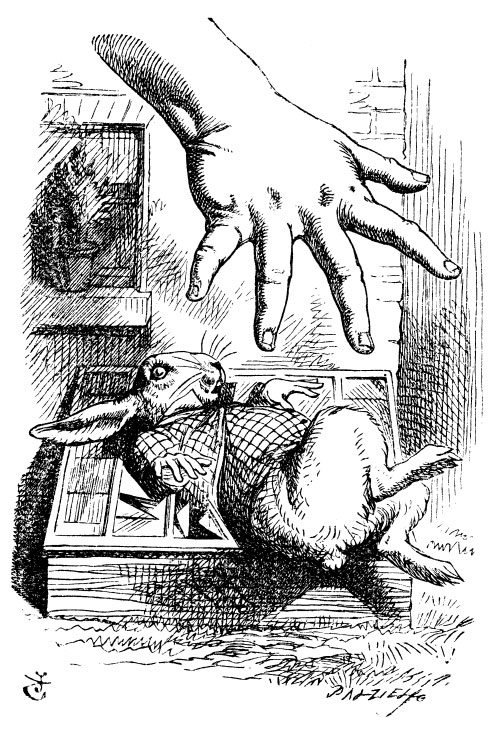
Alice tries to snatch the rabbit from the window.

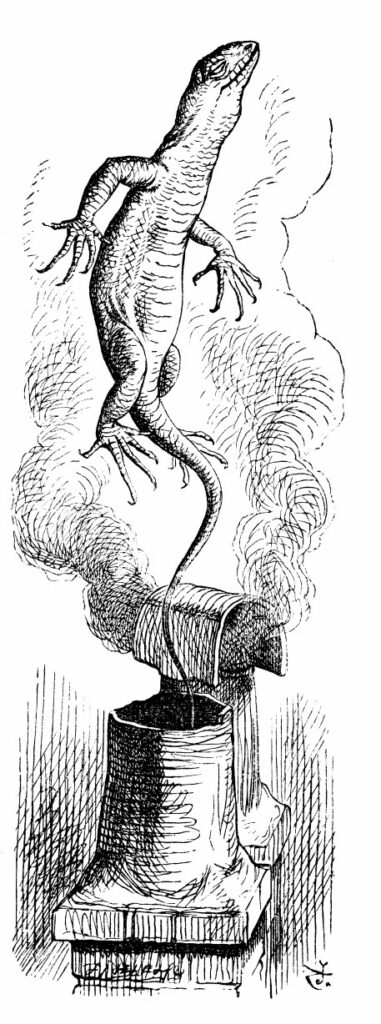
Alice kicks Bill the green lizard from the chimney.

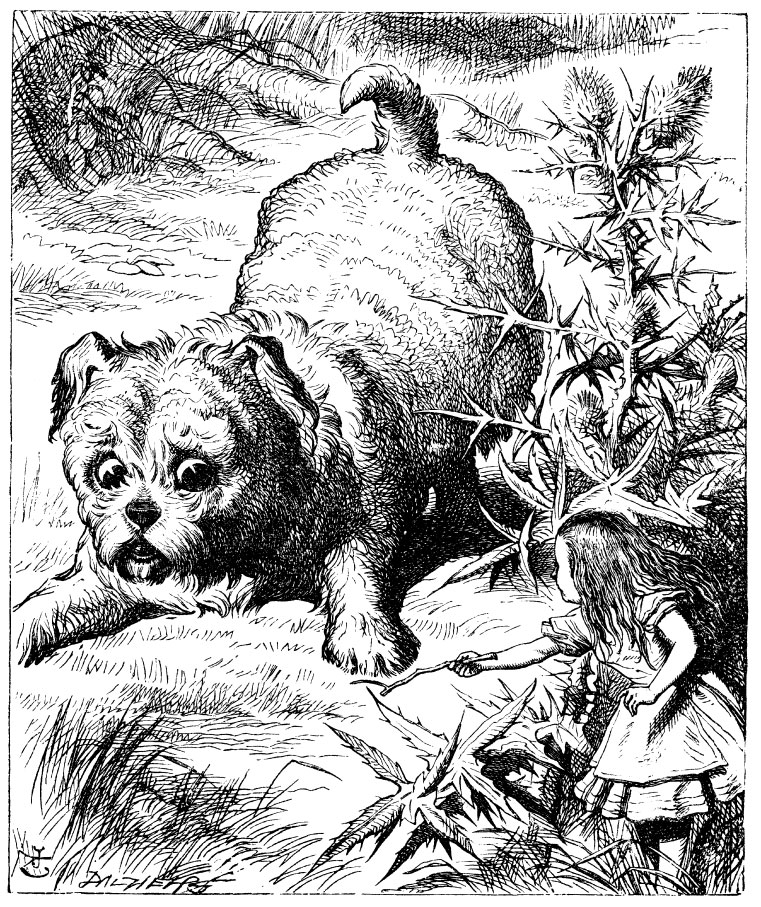
Alice throws a stick to the giant puppy to fetch.


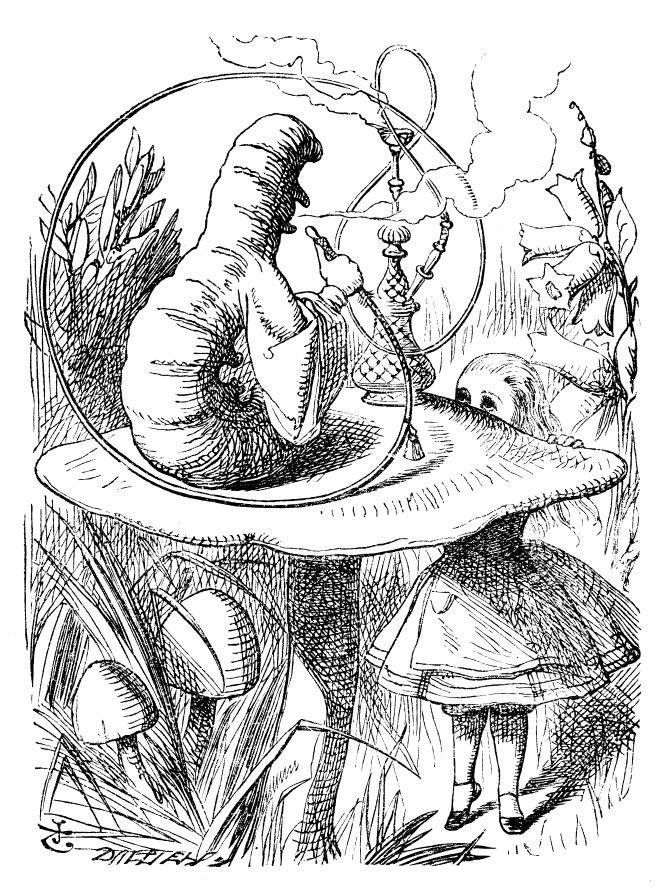
Alice meets the caterpillar.

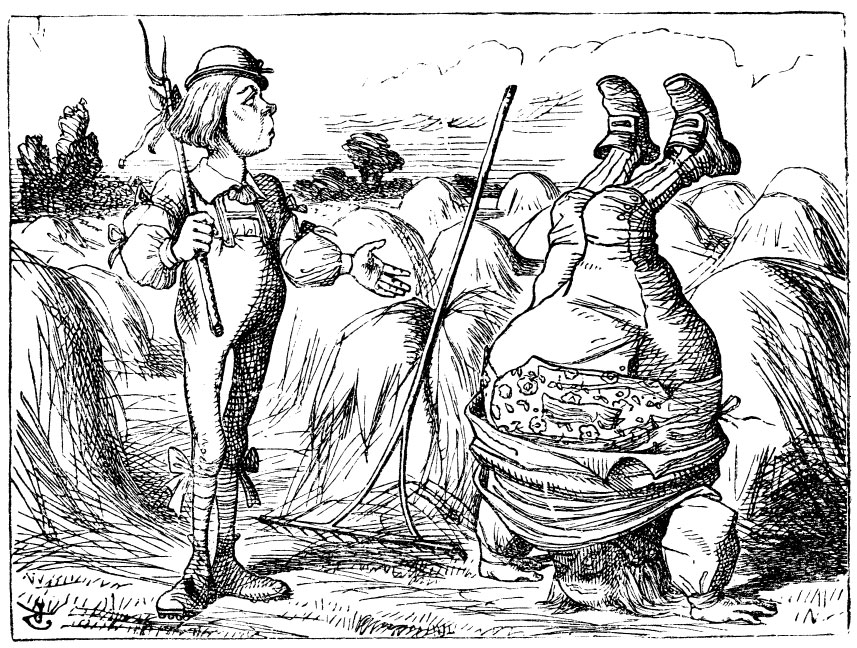
Old Father William stands on his head.

Old Father William does a back-somersault.

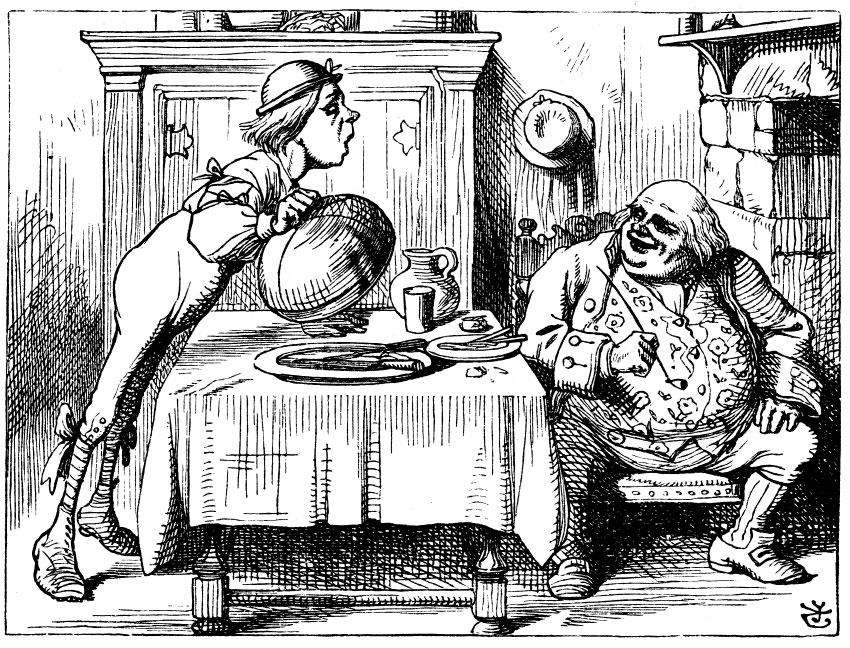
Old Father William finishes the goose, with the bones and the beak.

Old Father William balances an eel on his nose.

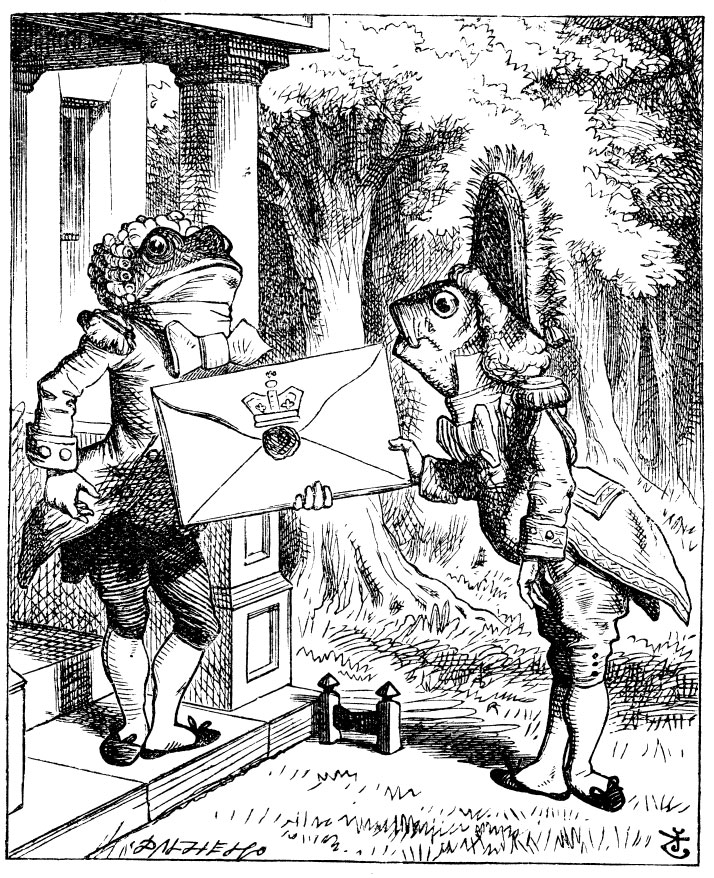
The fish-footman delivers the invitation from the Queen to play croquet.

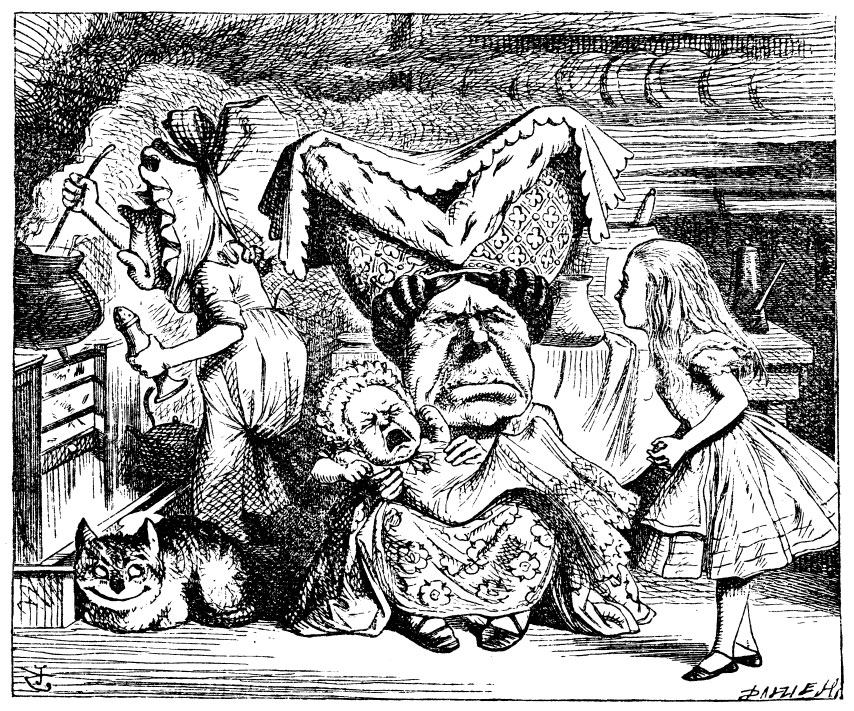
Alice meets Duchess and the crying baby.

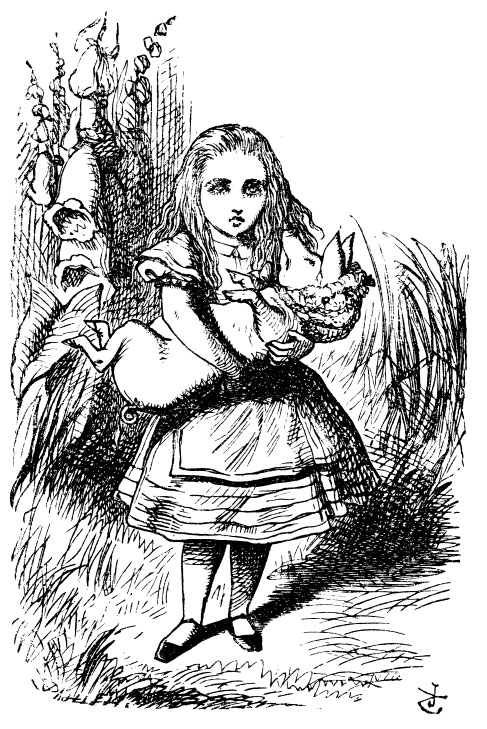
The baby turns to a pig!

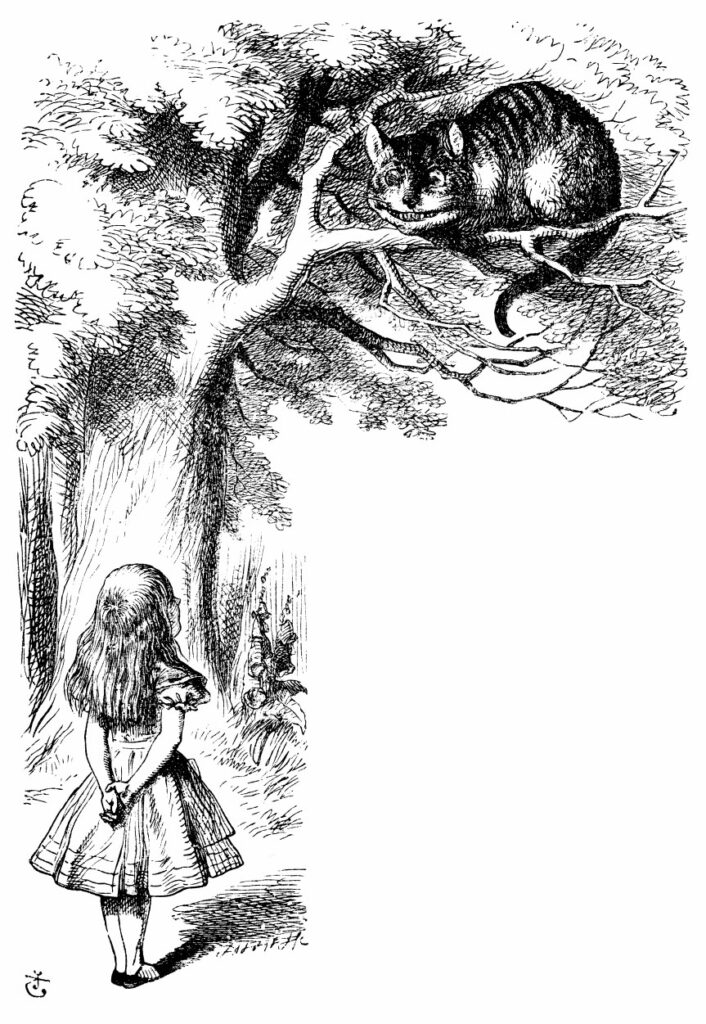
Alice meets the Cheshire cat.


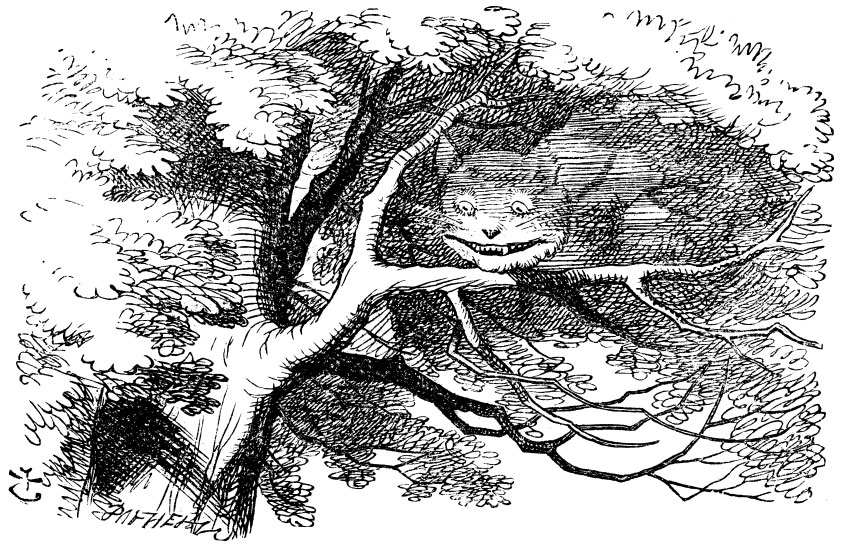
Cheshire cat fades away. “ Well! I’ve often seen a cat without a grin,” thought Alice, “ but a grin without acat! It’s the most curious thing I ever saw in all my life.

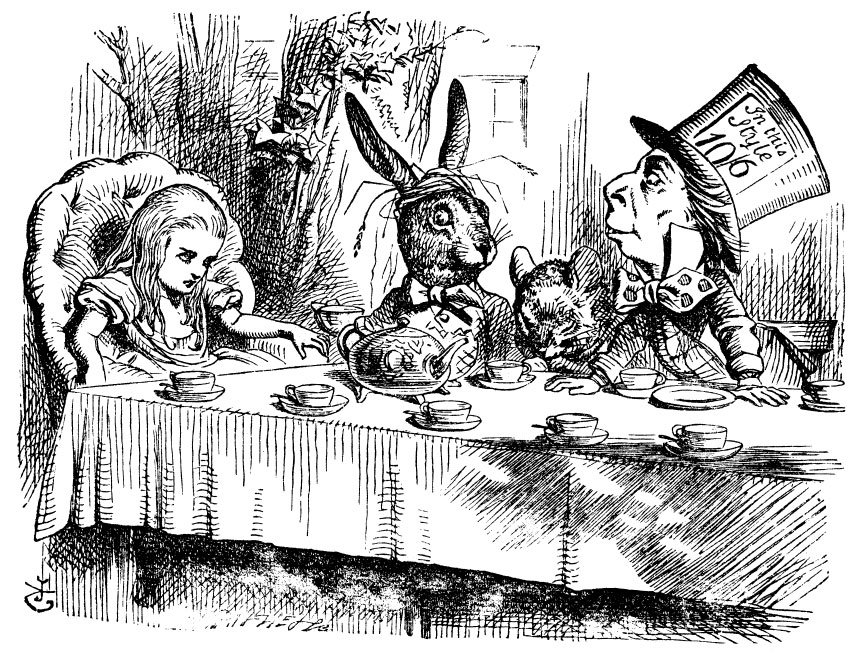
At the mad tea party.

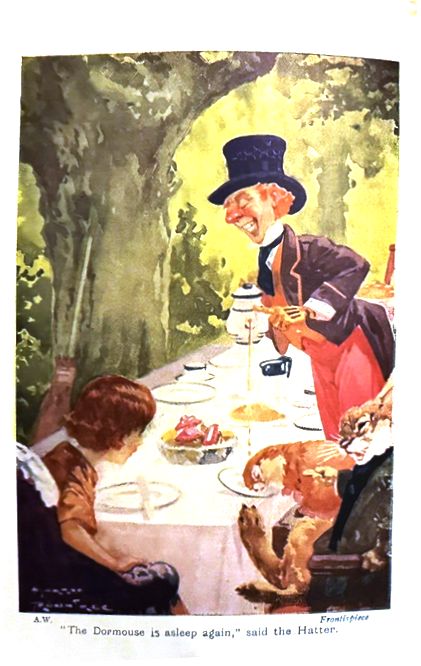
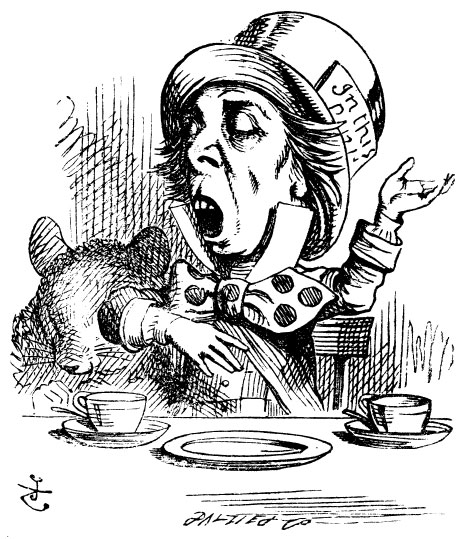
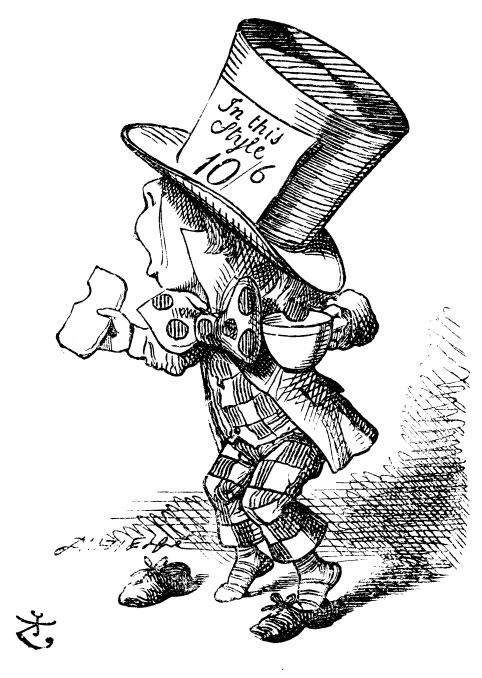
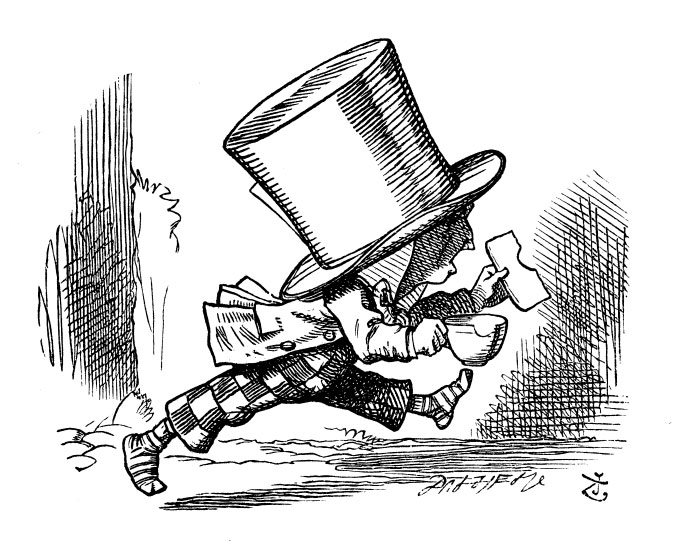
The Mad Hatter.

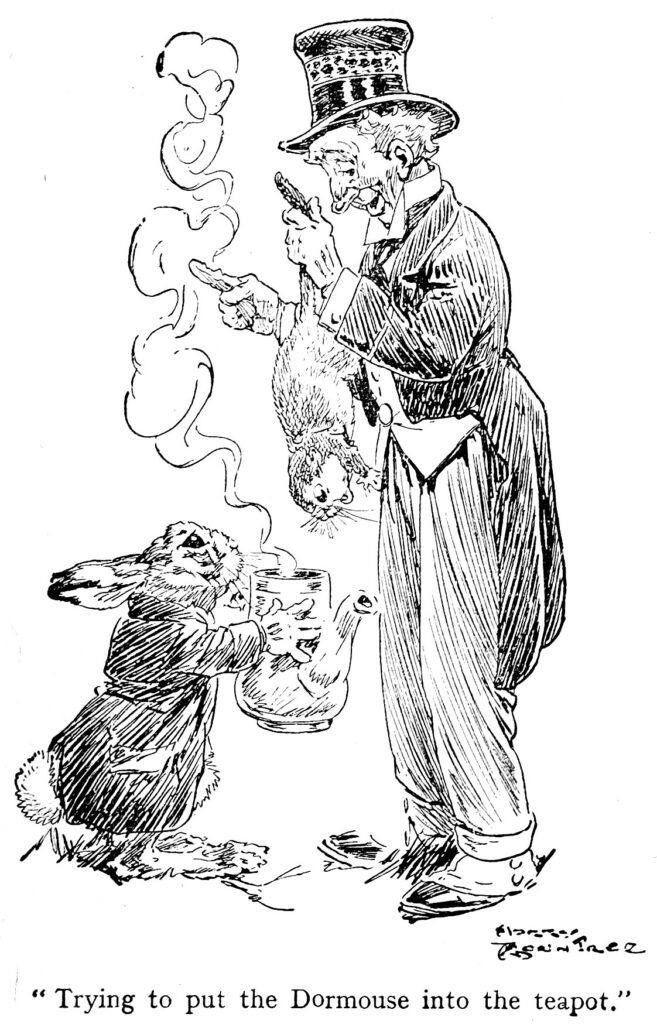
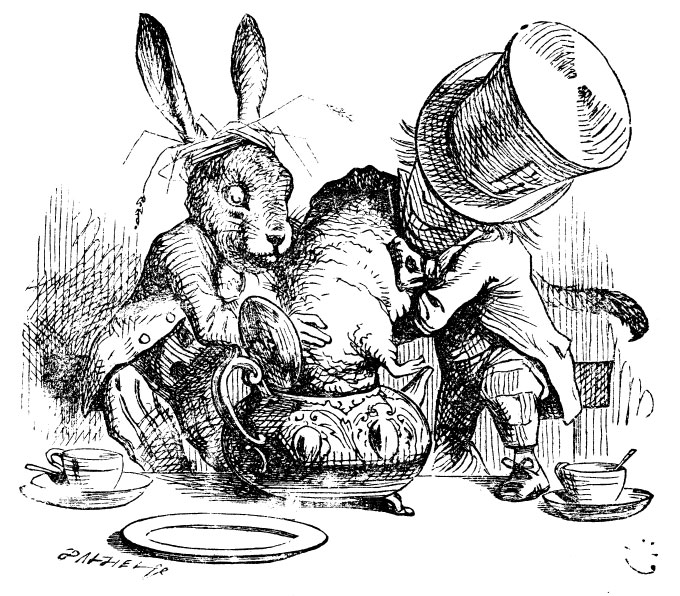
The Mad Hatter and the White Rabbit put the dormouse into the soup.

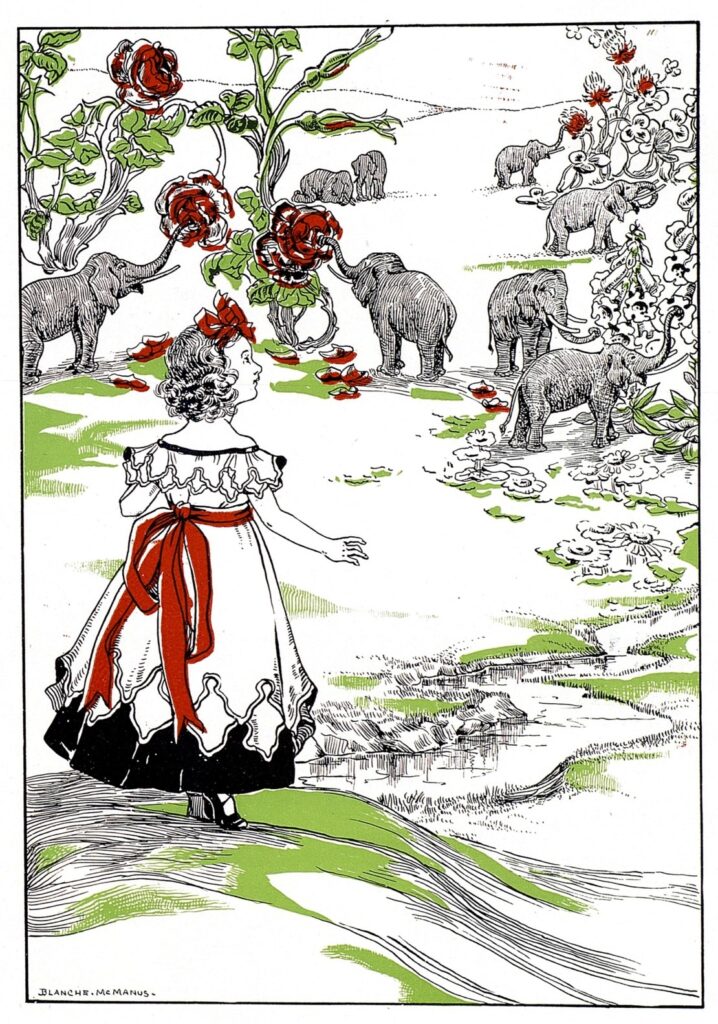
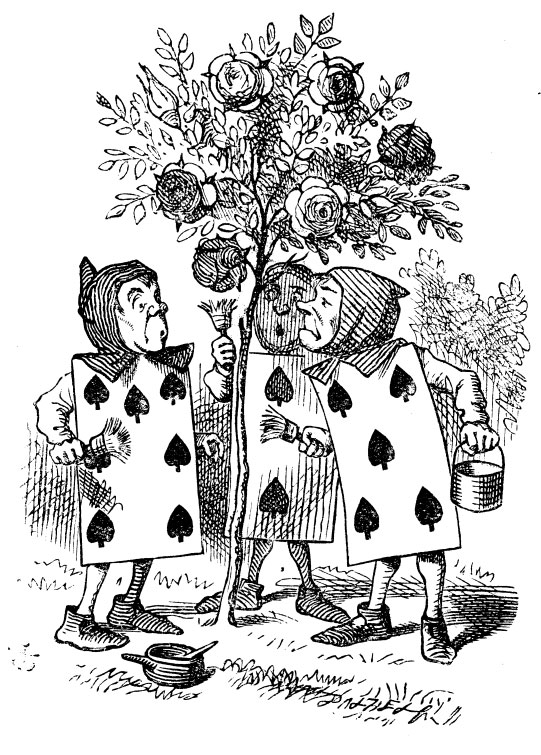
Colouring the white roses red.

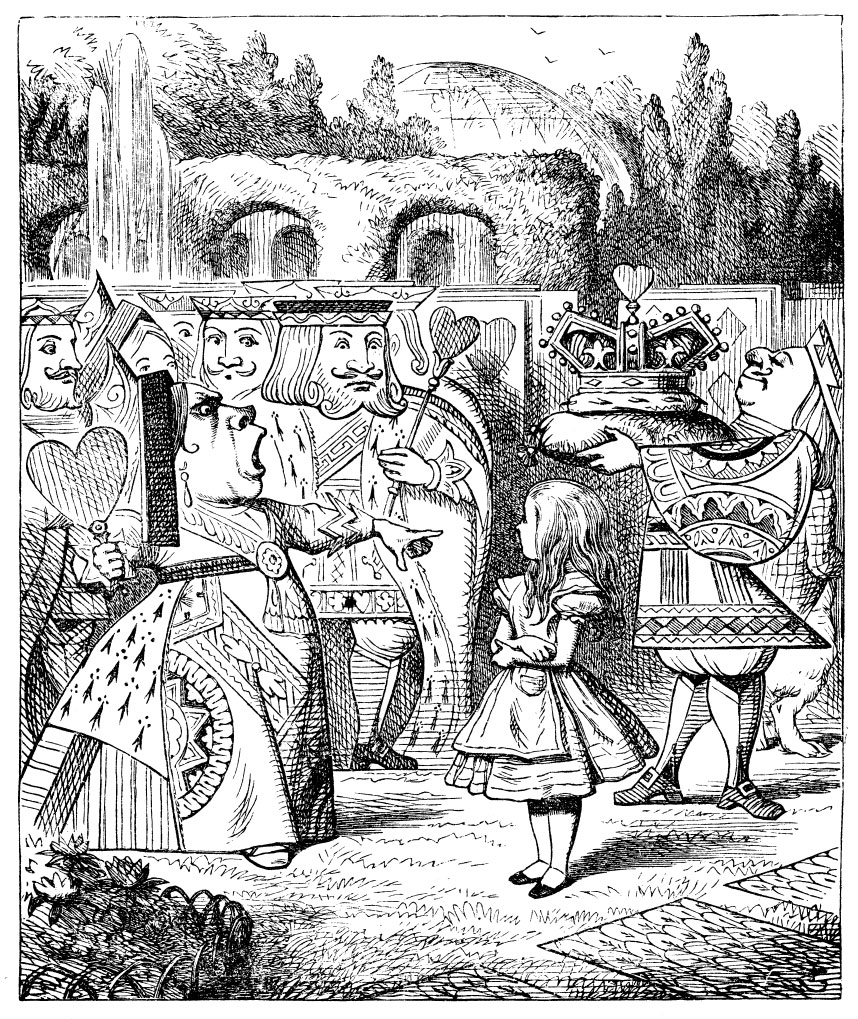
Alice meets the queen and “Off with her head!” she commands.

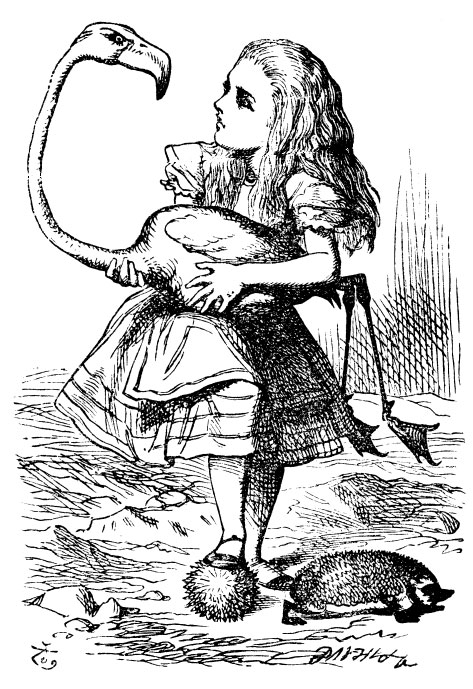
Alice playing croquet with the flamingo and hedgehog.


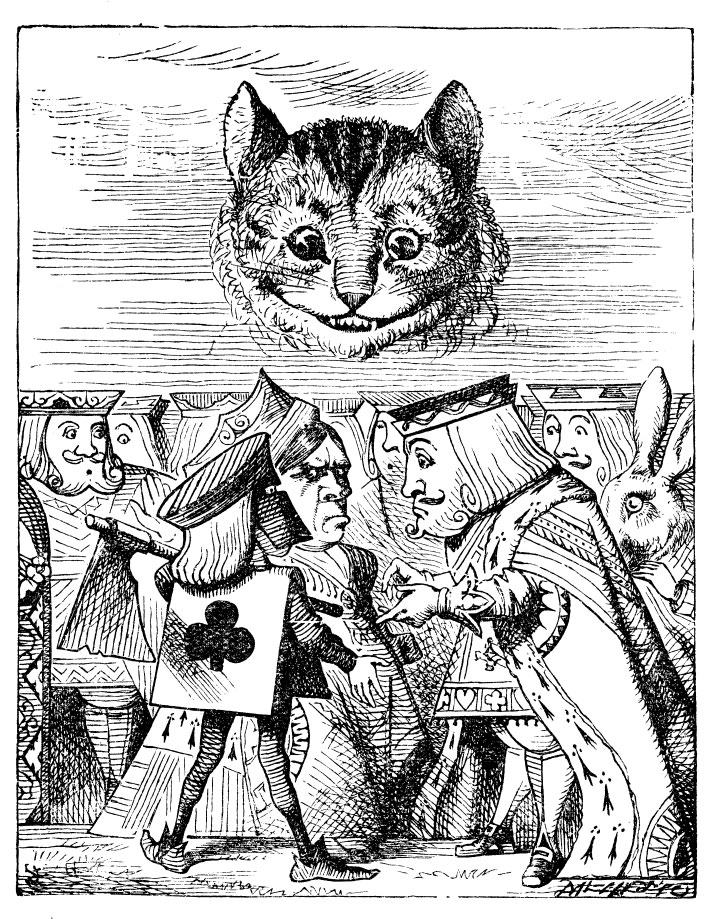
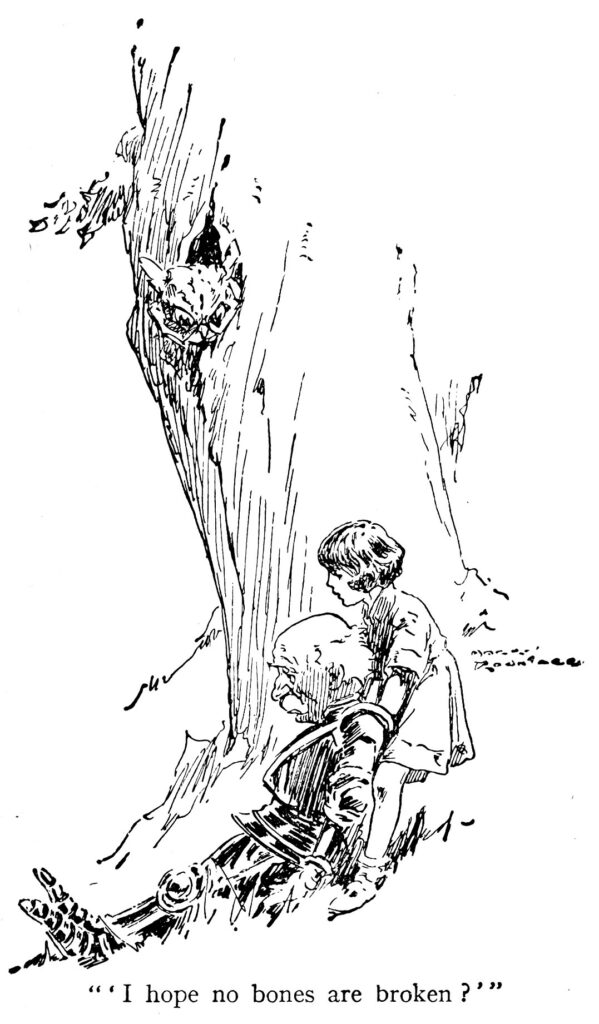
“Off with his head” queen said for Cheshire cat. The executioner said, “..you couldn’t cut off a head unless there was a body to cut it off from..”

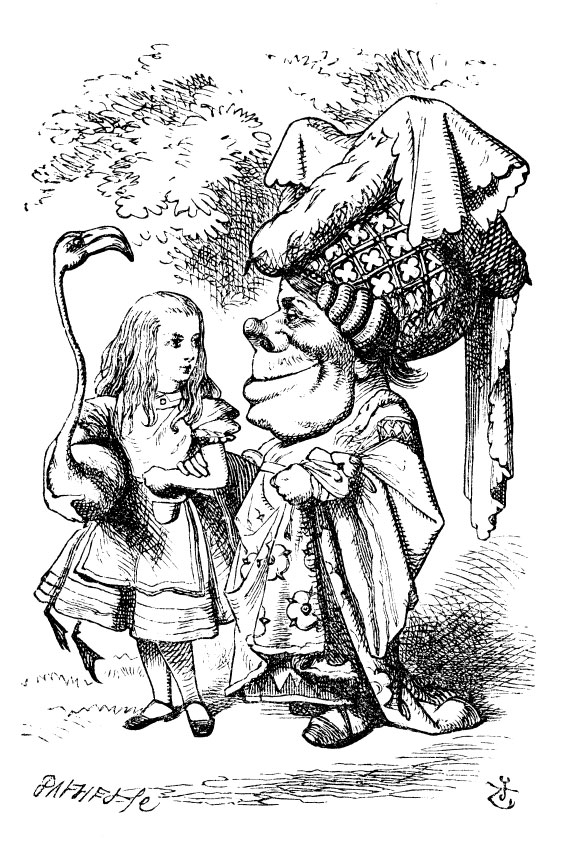
Alice and Duchess “Take care of the sense, and the sounds will take care of themselves.’ ””


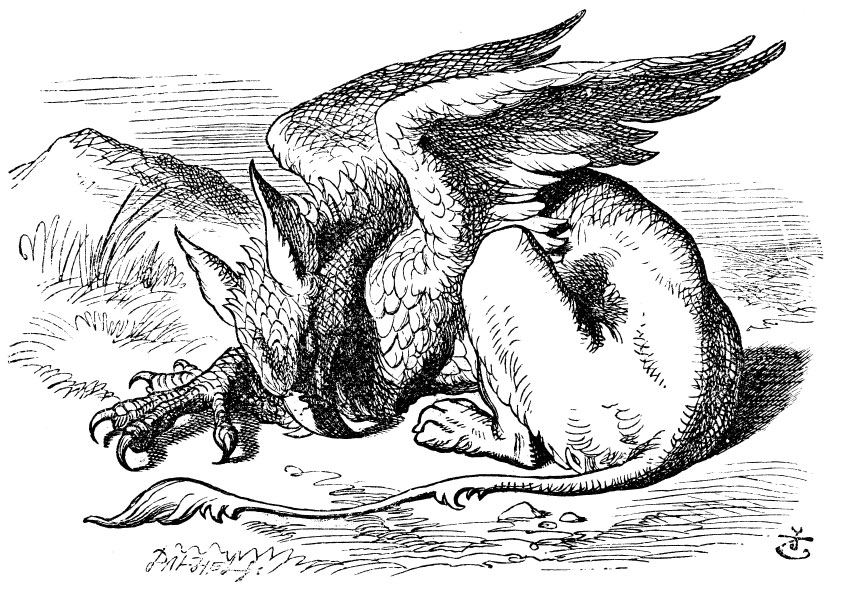
Gryphon was lying fast asleep in the sun.

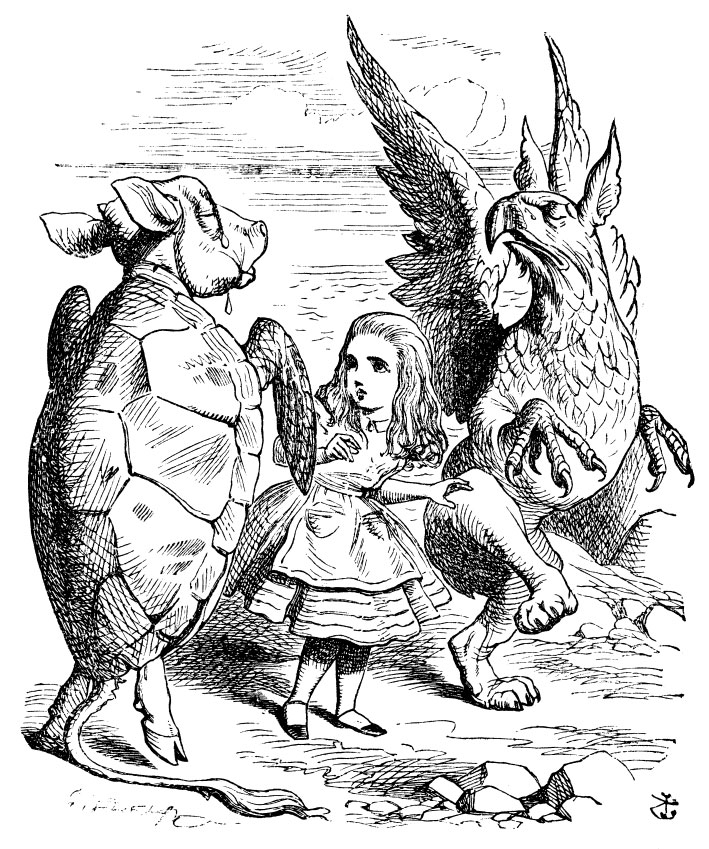
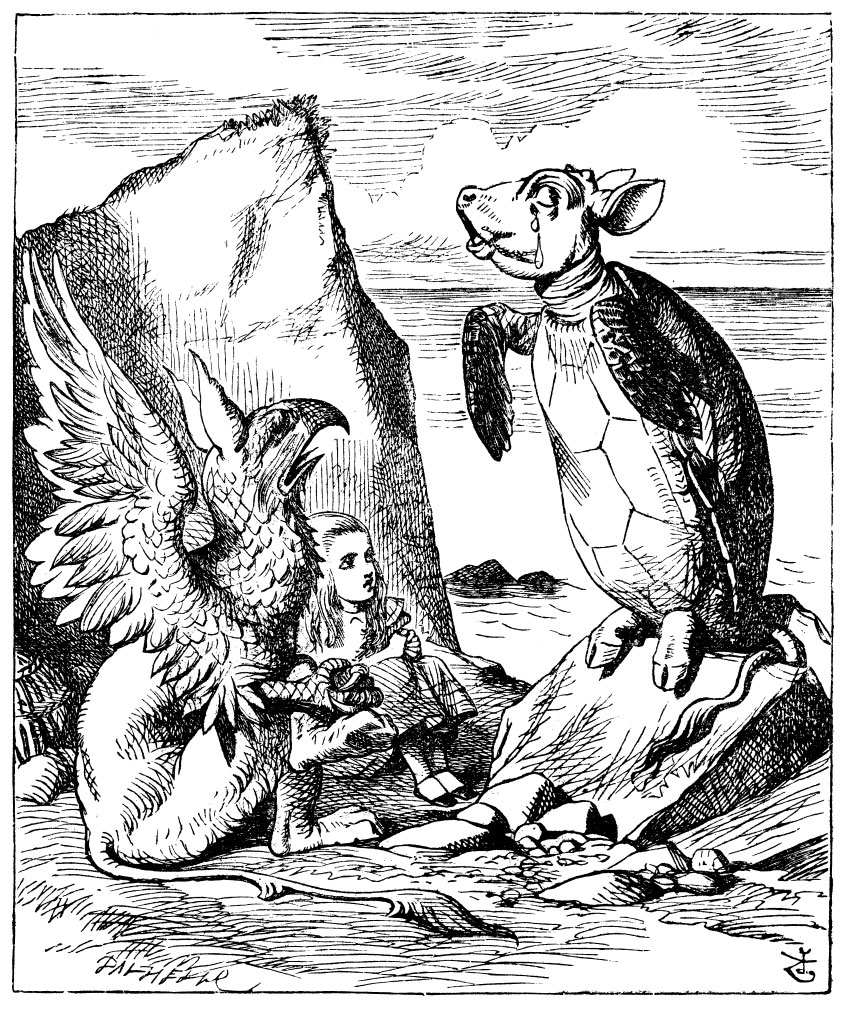
Alice hears the Mock turtle’s story.

So they began solemnly dancing round and round Alice.

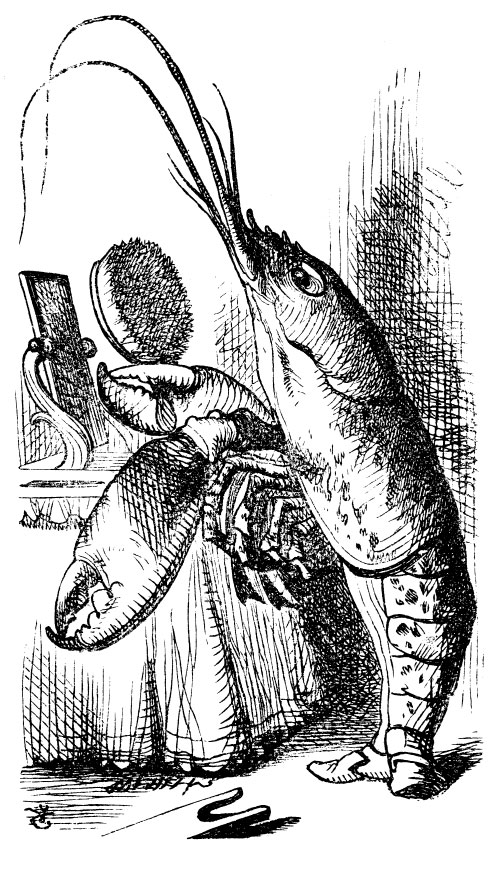
The Lobster quadrille.


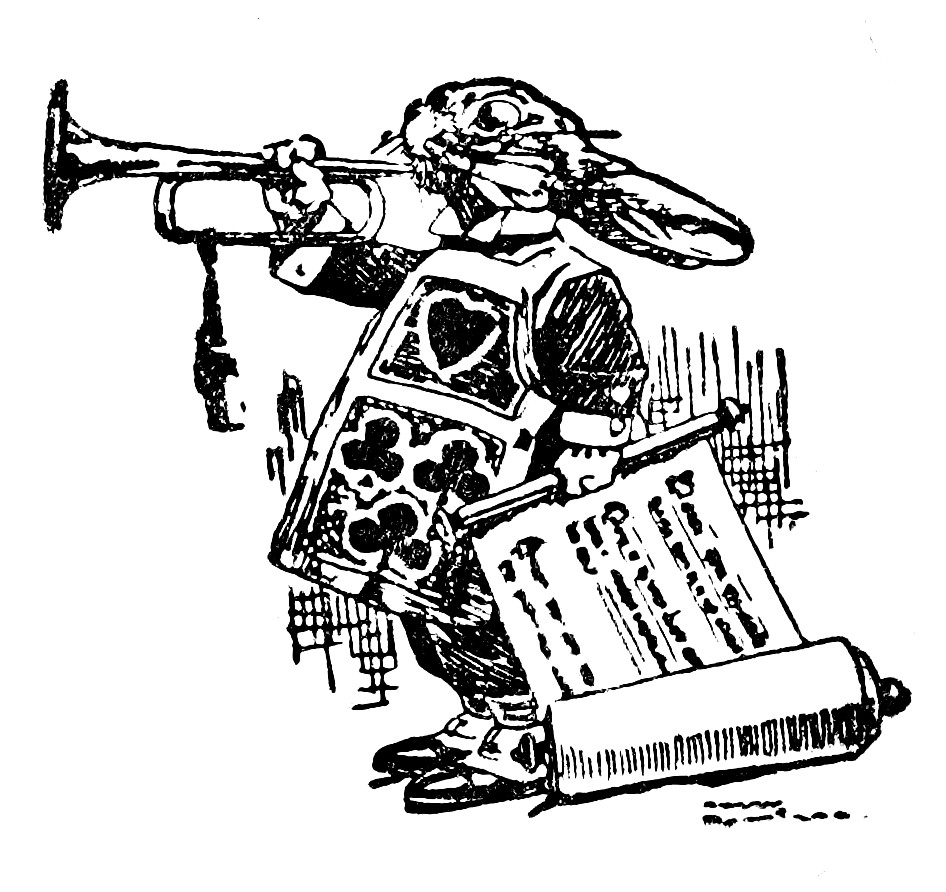
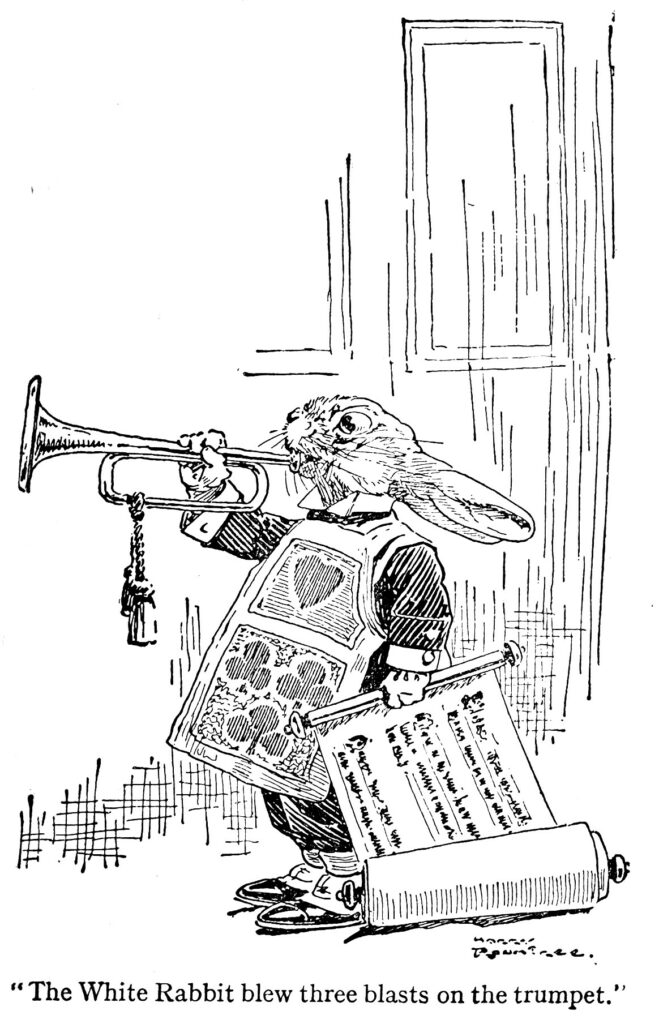
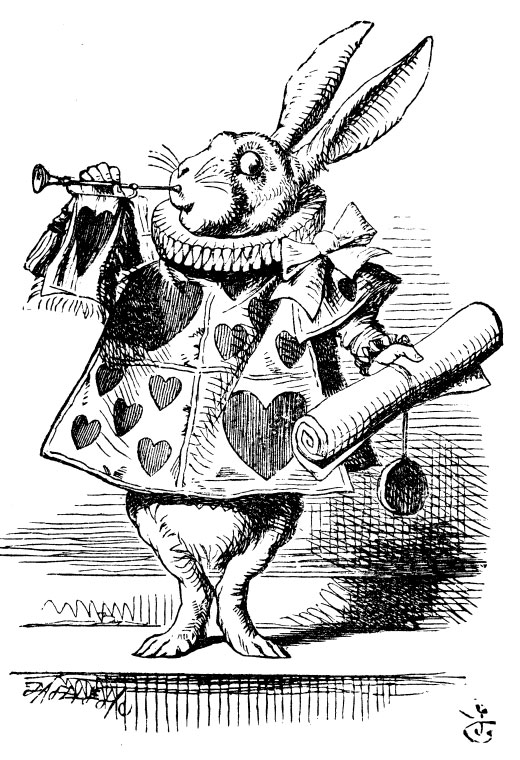
White Rabbit blew three blasts on the trumpet,White Rabbit blew three blasts on the trumpet,

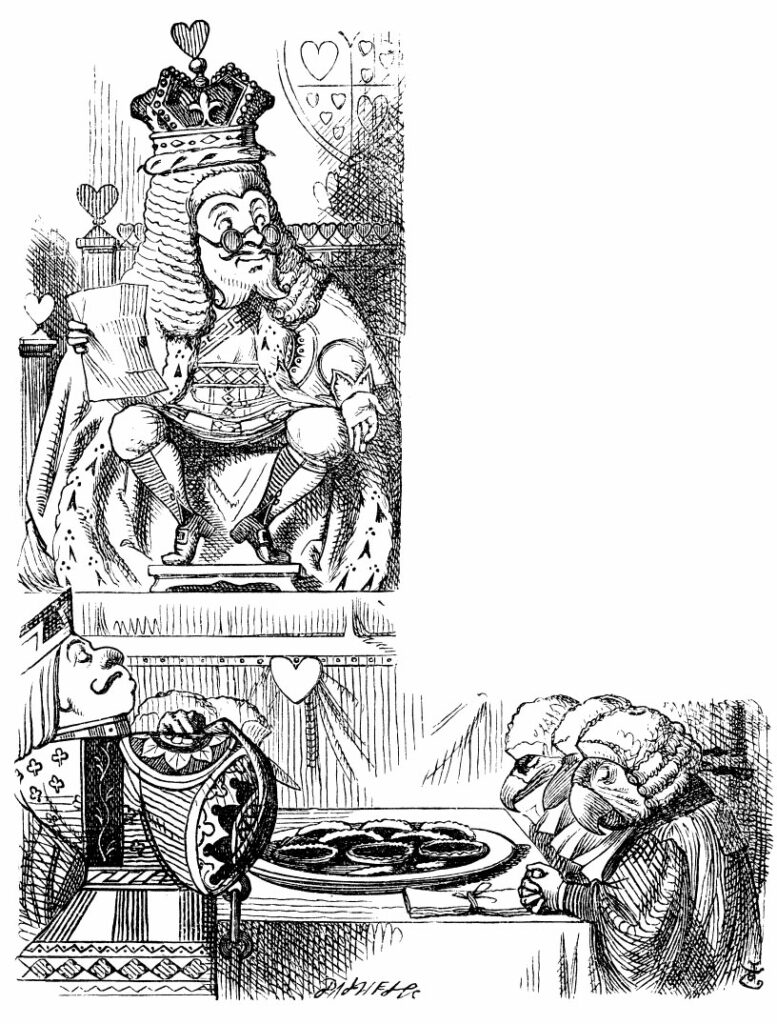
White Rabbit blew three blasts on the trumpet, and reads the accusation of stealing the tarts.

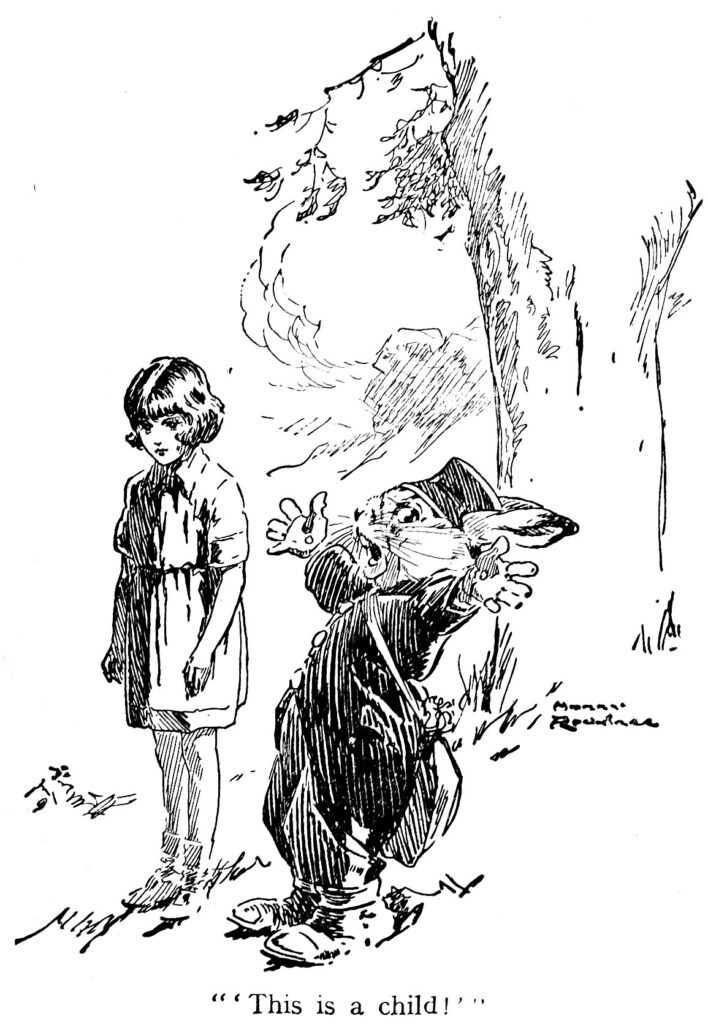
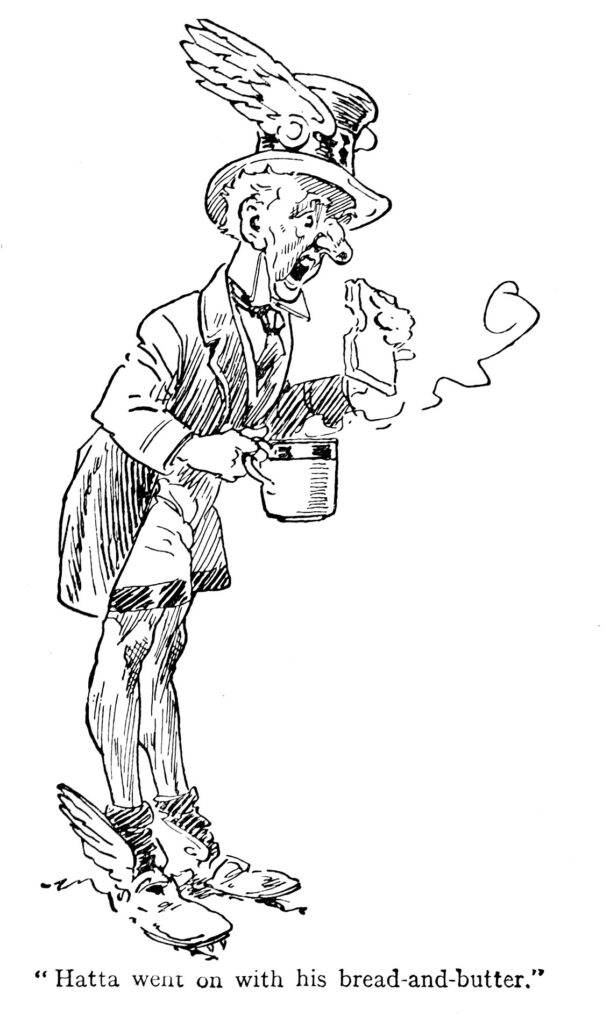
Mad Hatter is the first witness. He comes with a tea cup in one hand and bread and butter in the other.

“Td rather finish my tea,” said the © Hatter, with an anxious look at the Queen, who was reading the list of singers.

“You may go,” said the King; and the Hatter hurriedly left the court, without — even waiting to put his shoes on.


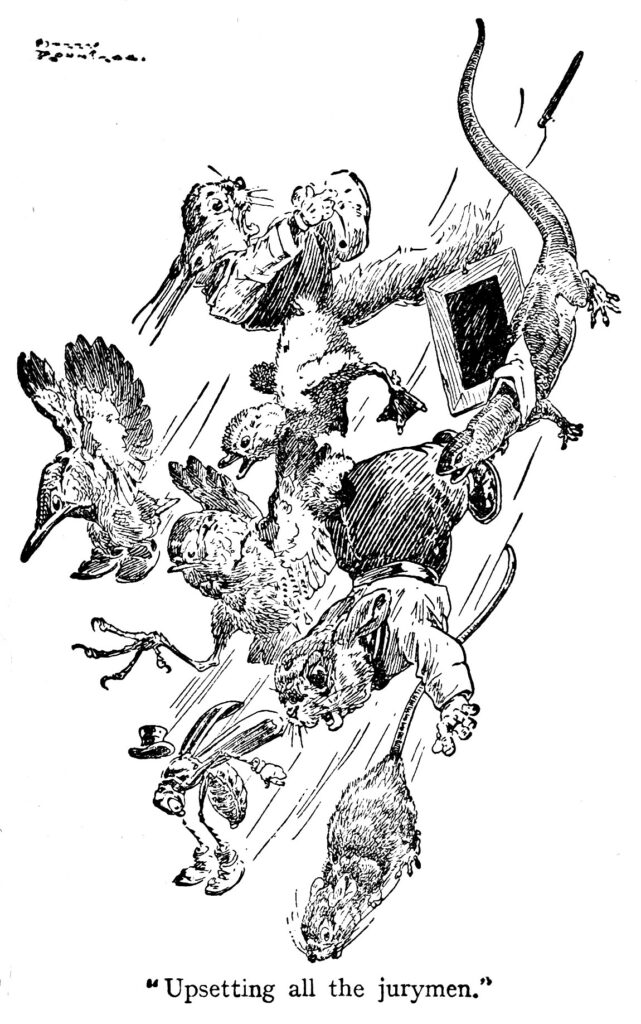
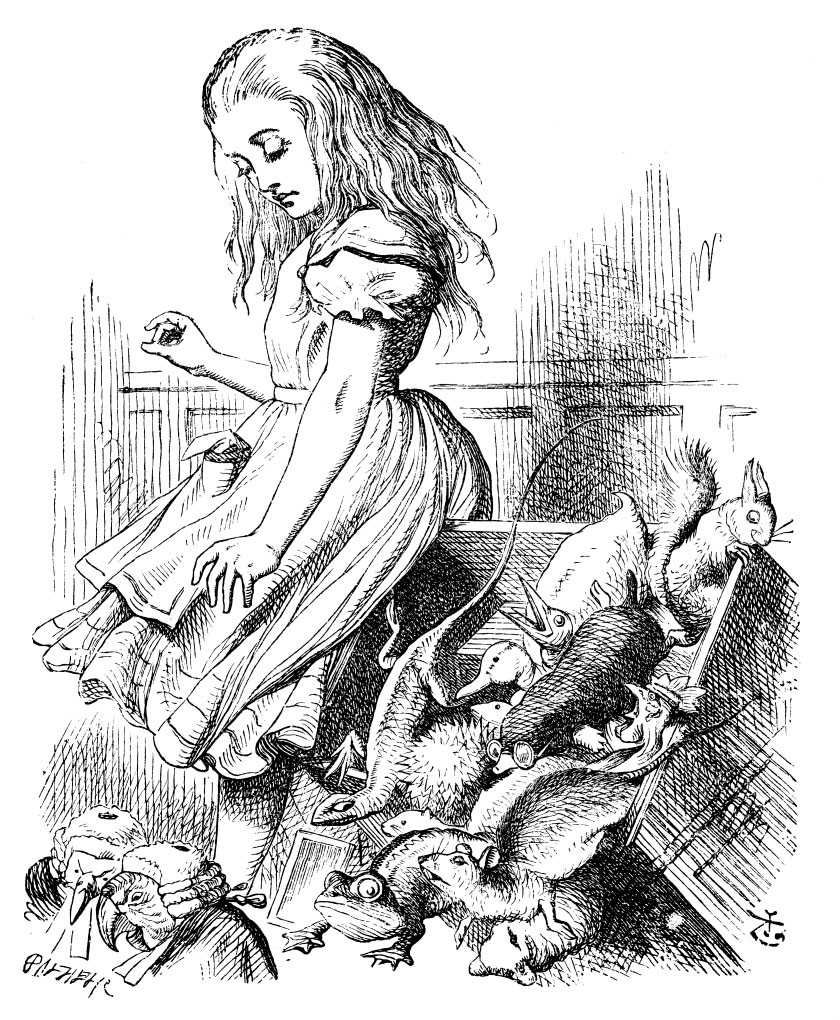
The large Alice tips the jury box sending all jurors in a panic.

“Let the jury consider their verdict,” the King said, for about the twentieth time that day.
”No, no!’ said’ the, Queen. “Sentence first —verdict afterwards.”


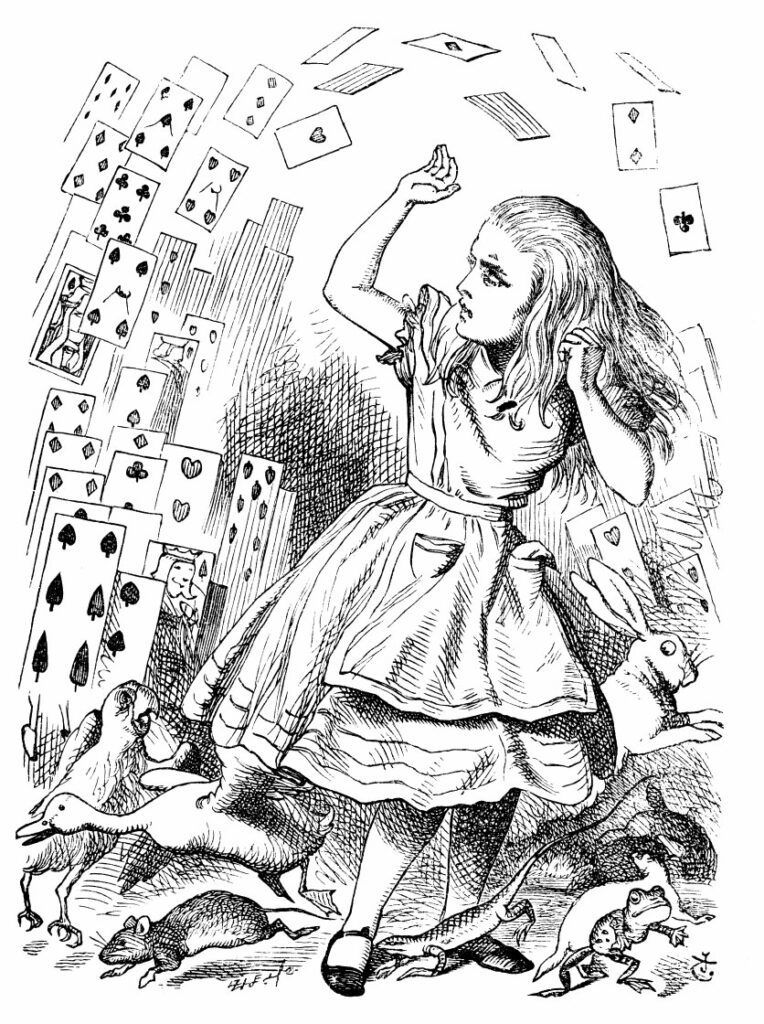
“Who cares for you?” said Alice, (she had grown to her full size by this time.) “You’re nothing but a pack of cards!”

At this the whole pack rose up into the air, and came flying down upon her…

Illustrations for Alice in Wonderland – Part 1 – Lewis Carroll

From the back advertisement of Carroll’s Eight or nine wise words about letter-writing (1890) illustration by John Tenniel.

Alice’s Adventures in Wonderland by Lewis Carroll (C. L. Dodgson) first published in 1865 might be one of the better known books in the world. There are several editions of it, though the text content is more or less the same, the illustrations are varied. The most famous of Alice’s illustrations are by John Tenniel. Tenniel did the 42 illustrations in the first edition and these same illustrations are found in most later editions. This series of posts is an attempt to create a collection of various illustrations for Alice in Wonderland from middle of nineteenth century. For an in-depth analysis of Alice I highly recommend reading Martin Gardner‘s Annotated Alice, which has a lot of trivia and information about the books, the characters and the author.

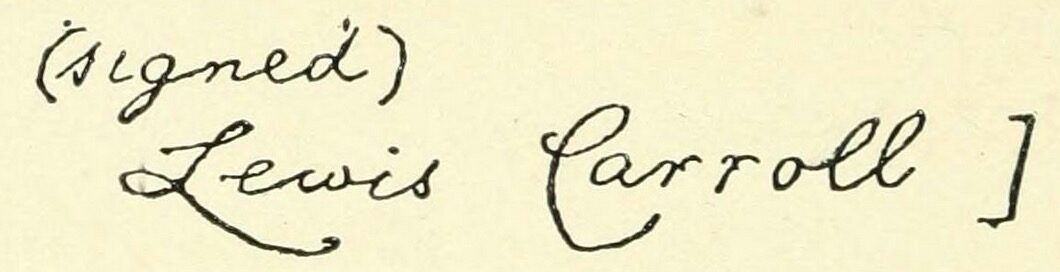
Signature of Lewis Carroll from the facsimile handwritten draft.

All images in public domain unless mentioned otherwise.

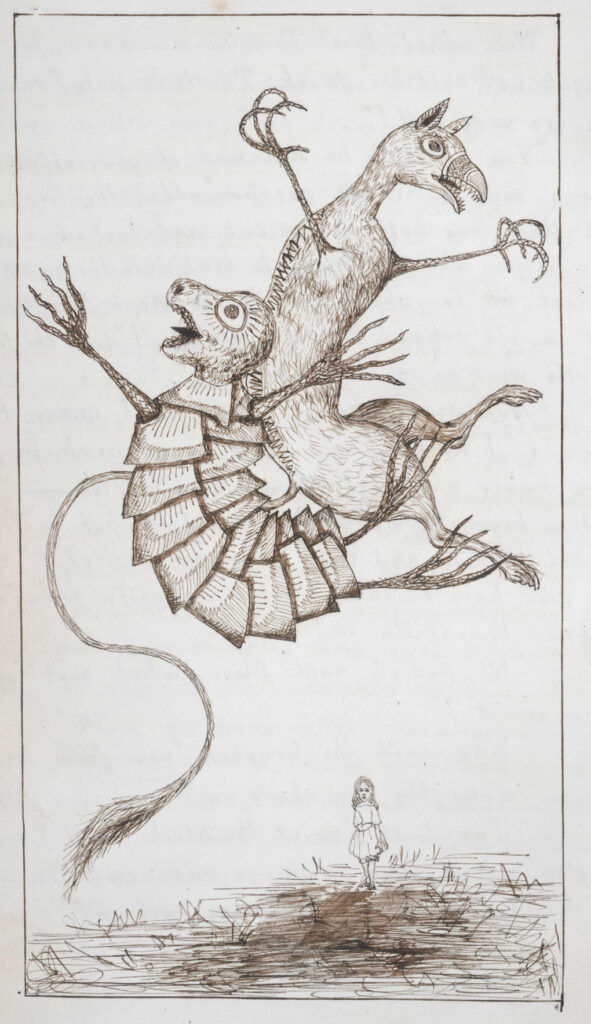
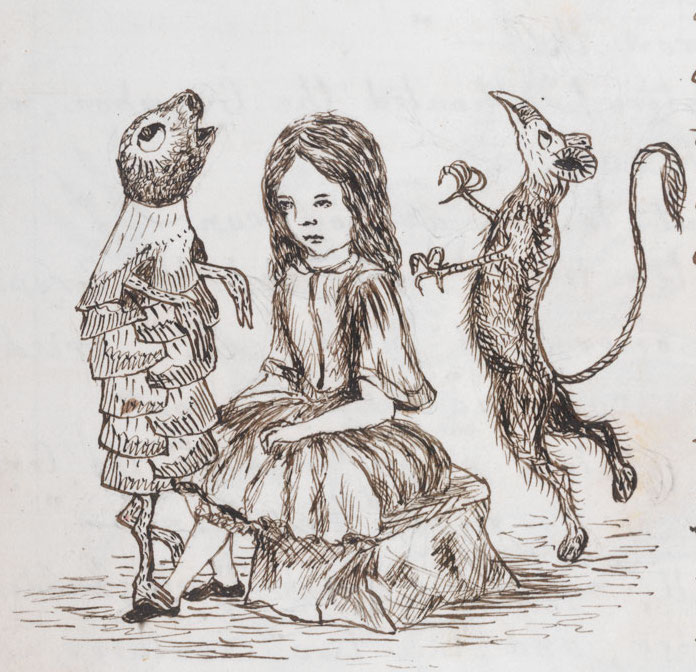
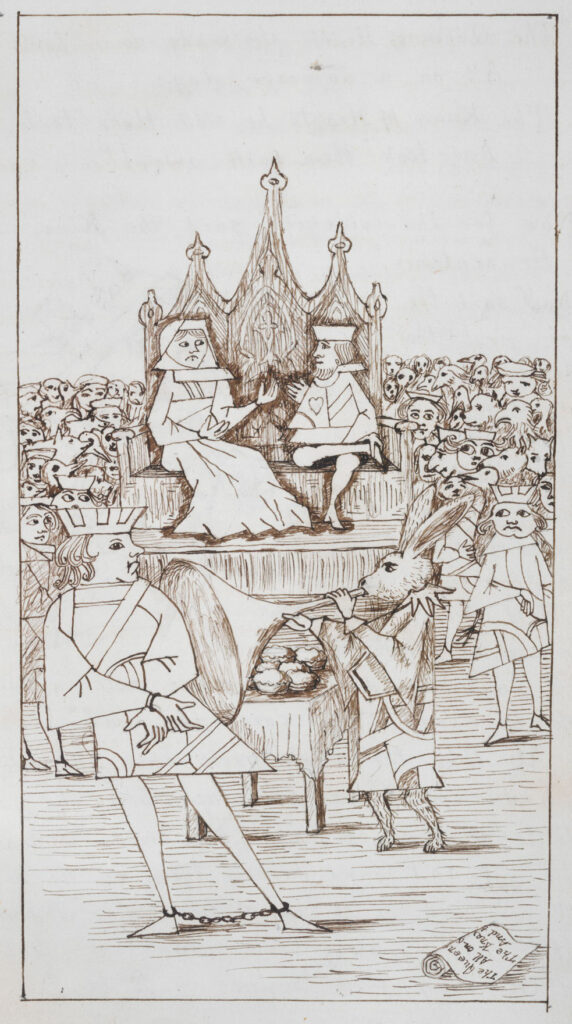
In this post, we start with the hand-drawn manuscript from Carroll himself which was titled Alice’s Adventures UndergroundMost of the illustrations that were done later follow these pen-drawn ones in content.

A treasured early manuscript version of one of the most famous and enduring children’s stories, Alice’s Adventures in Wonderland c. 1864. Link Originally from the British Museum

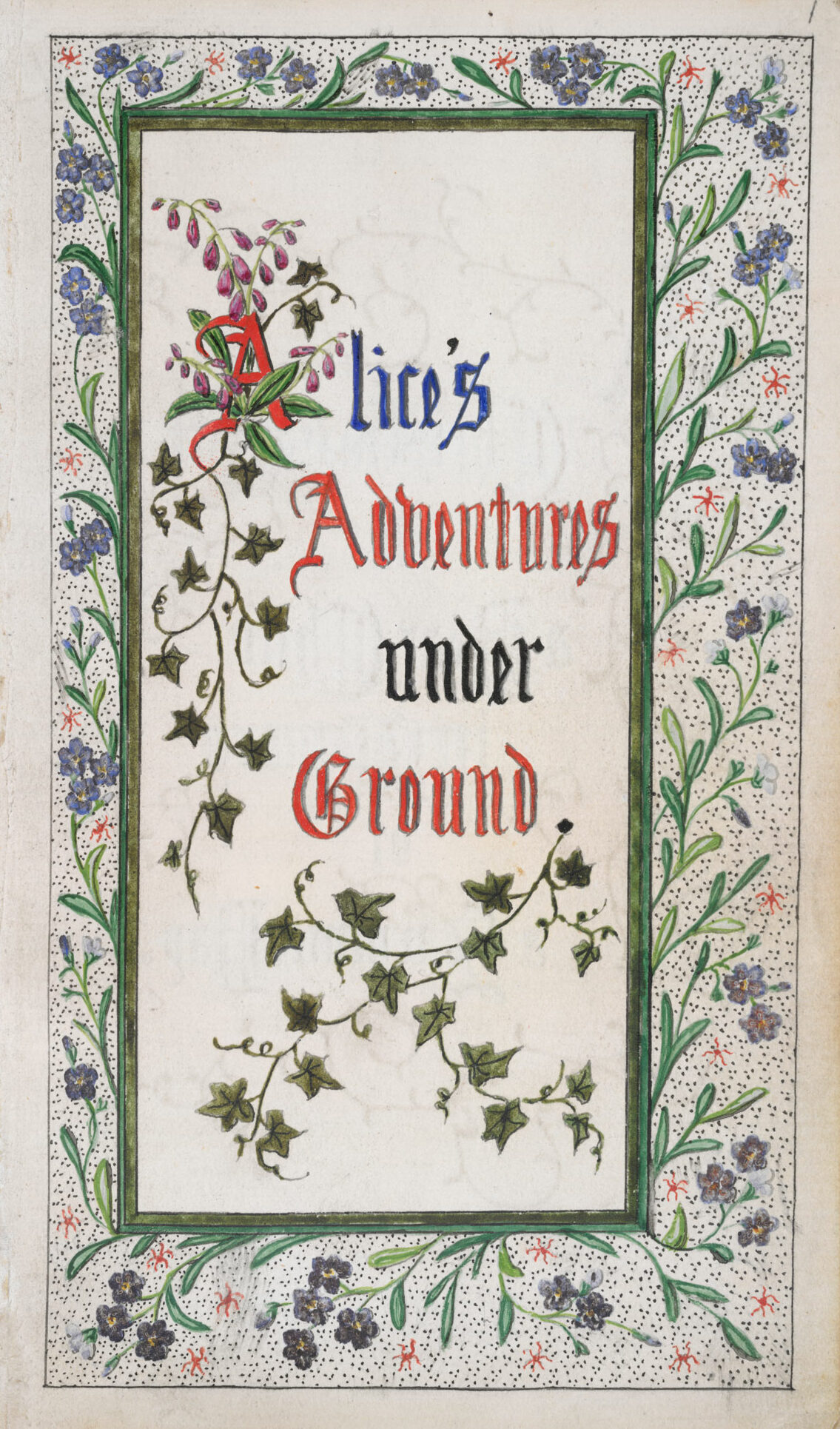
Original cover of Alice’s Adventures under Ground

The facsimile version contains 40 illustrations. These illustrations were then refined by Tenniel in his woodcuts for the first edition of the book. These pen drawn crude illustrations are also templates for most of the other drawings for Alice’s books.

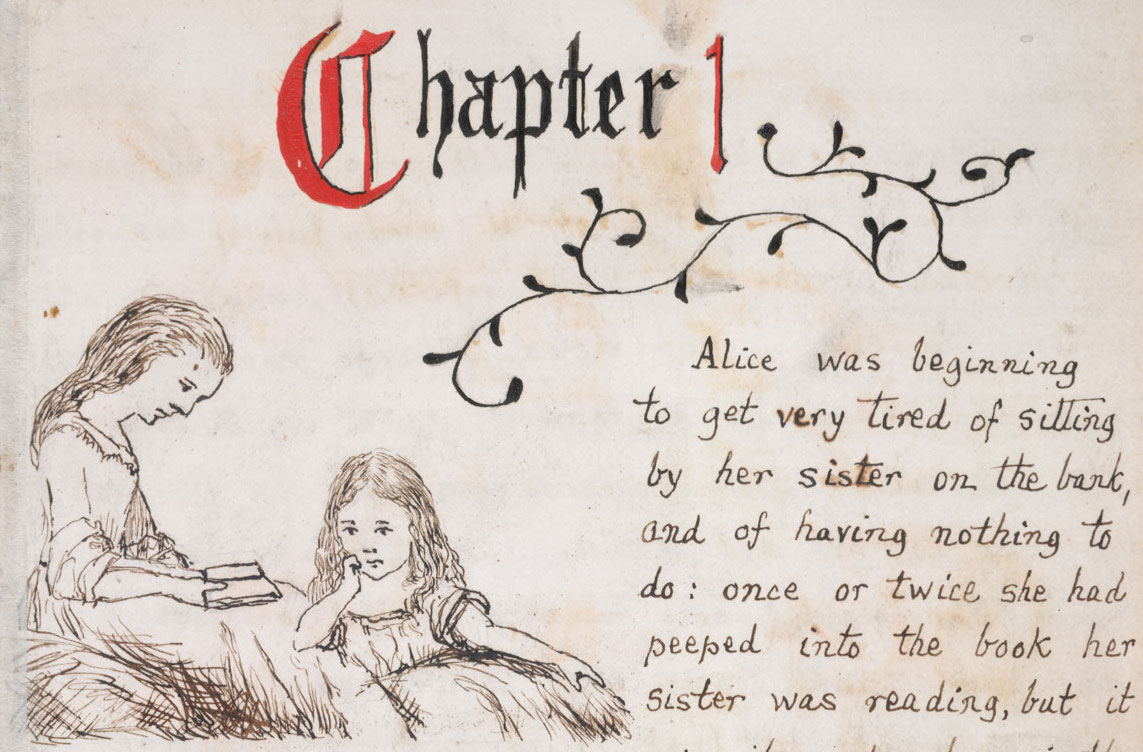
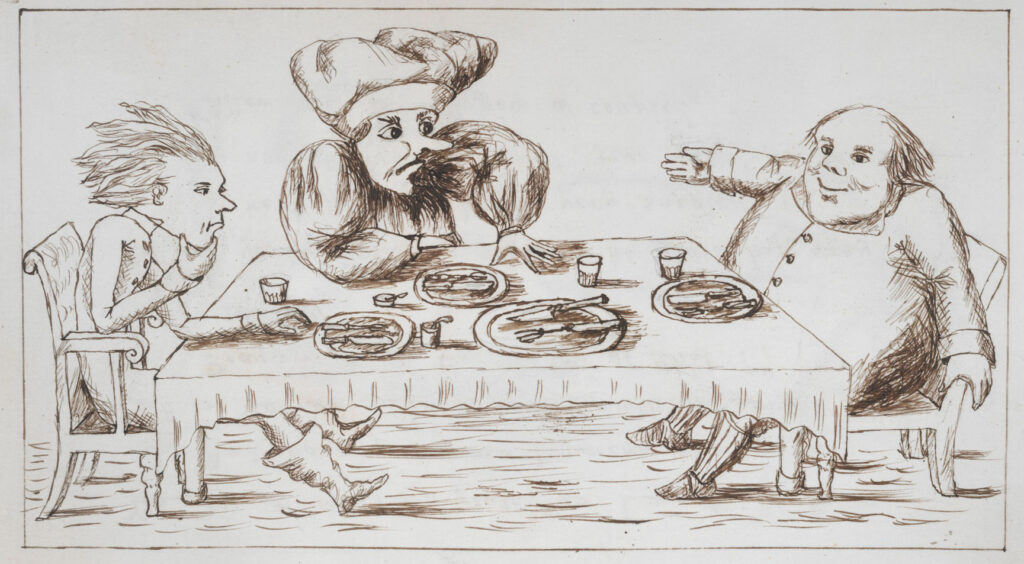
Alice was beginning to get very tired of sitting by her sister on the bank and having nothing to do
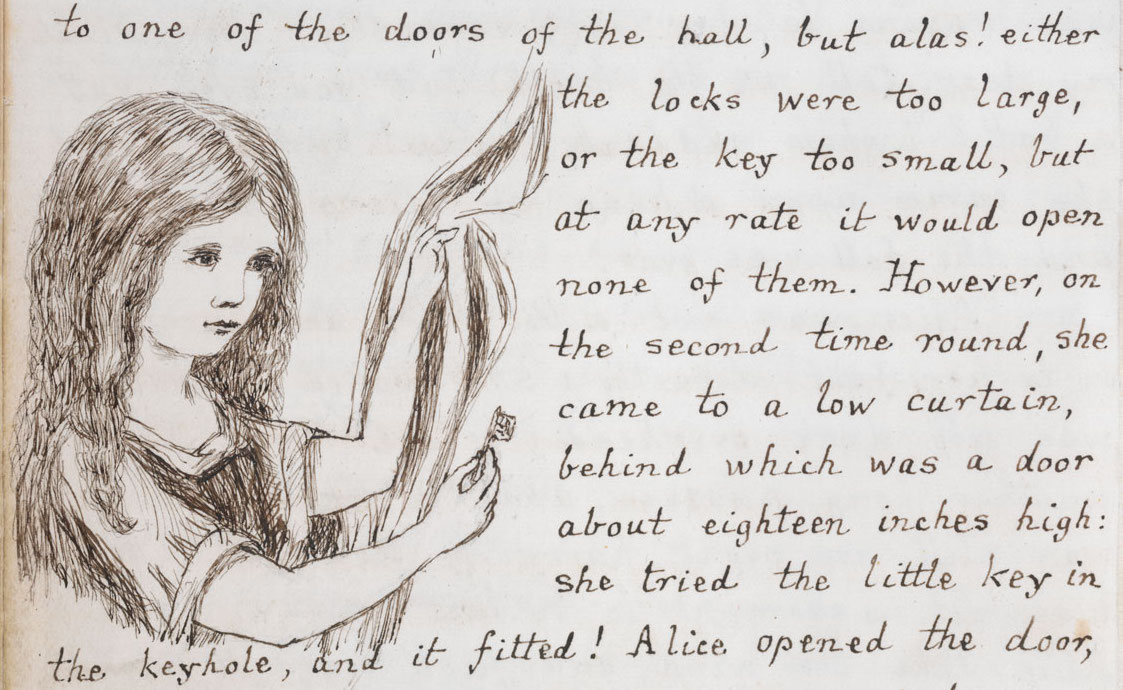
Alice finds a small door behind a curtain
Alice loses the key to the door
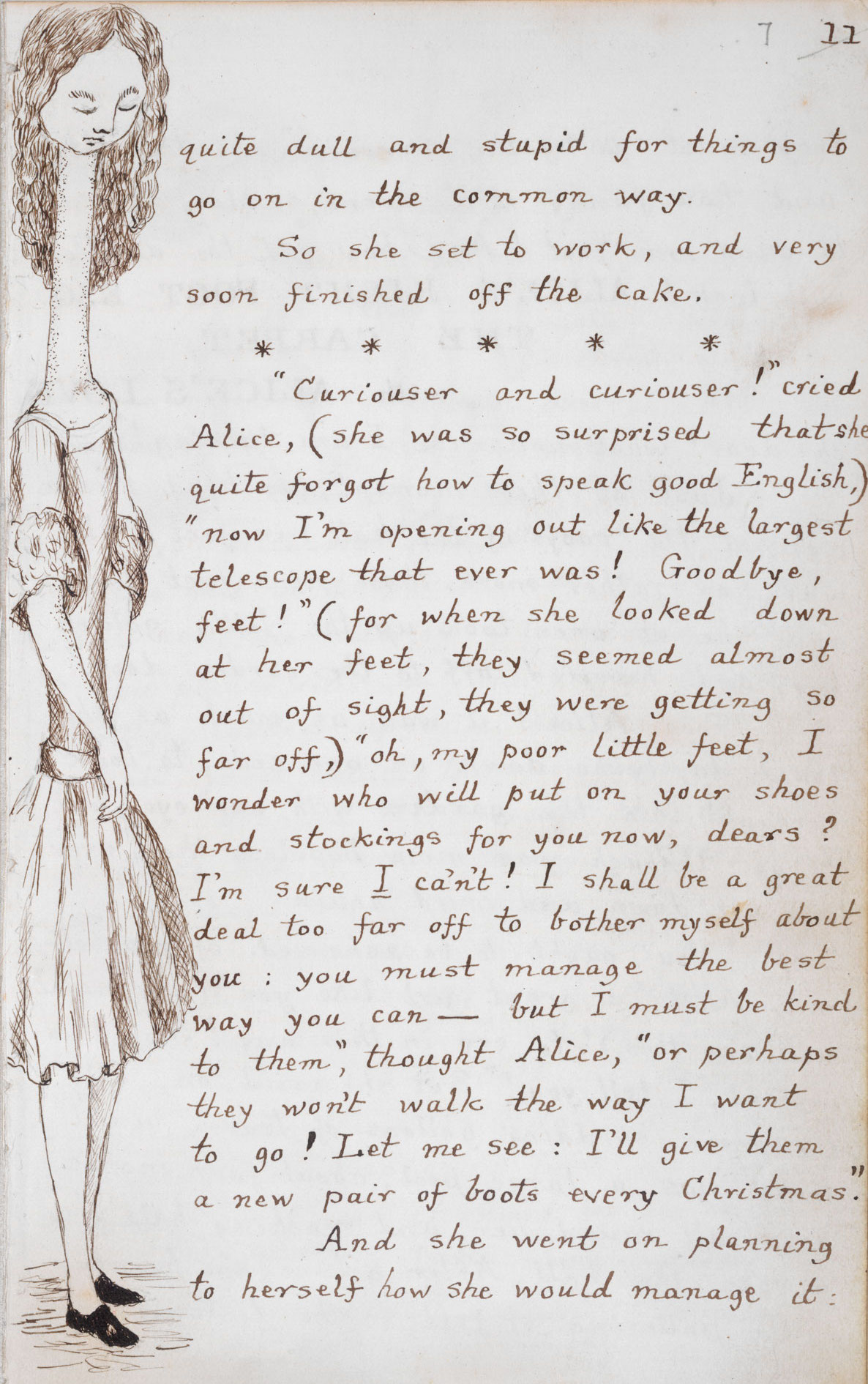
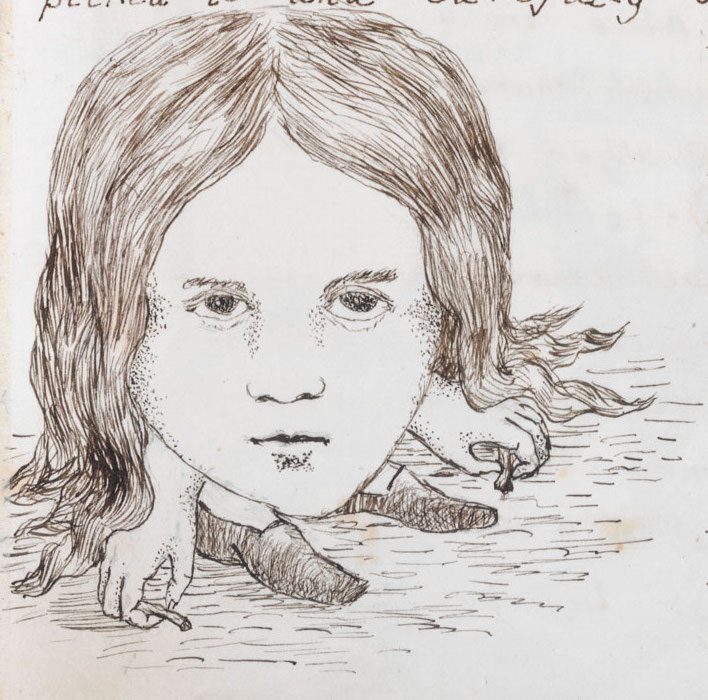
Curioser and Curioser, now I am opening like the largest telescope that ever was!
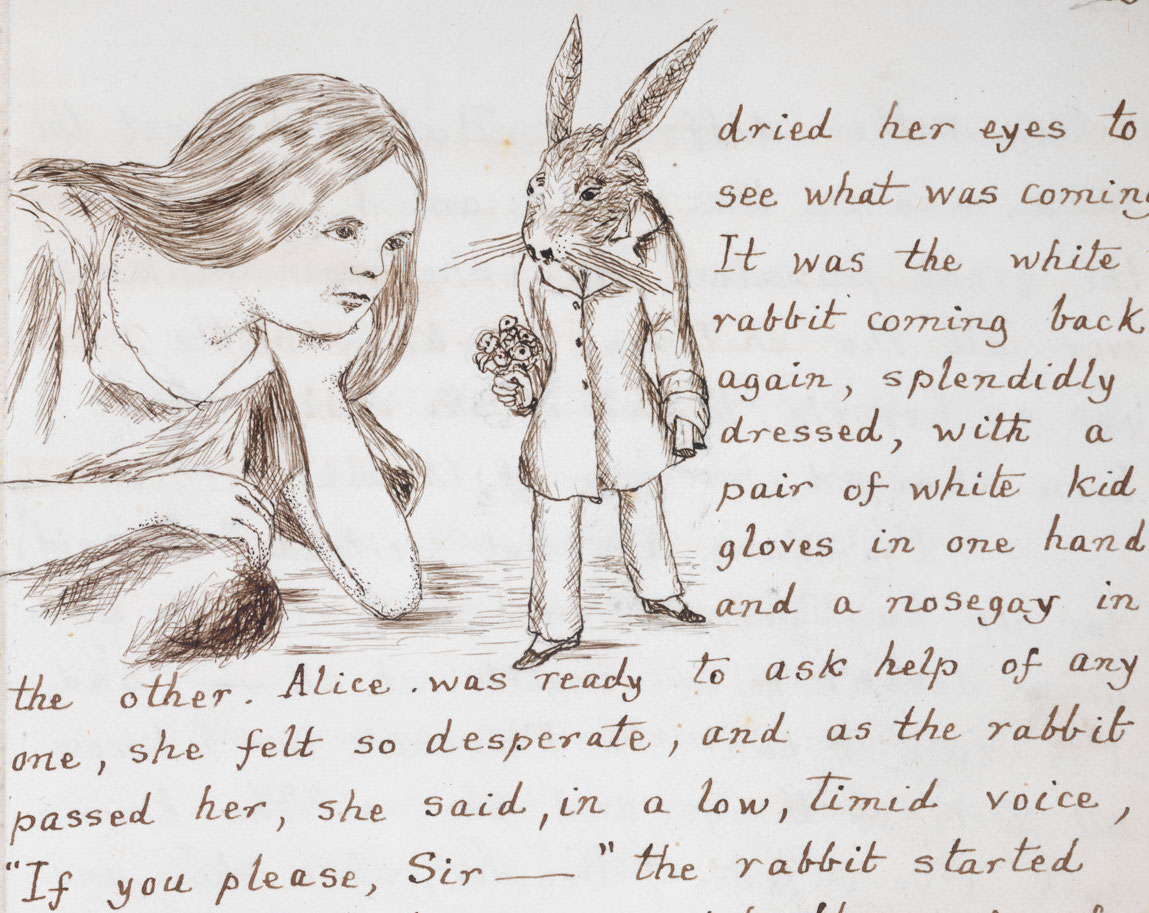
Alice meets the rabbit again and startles it
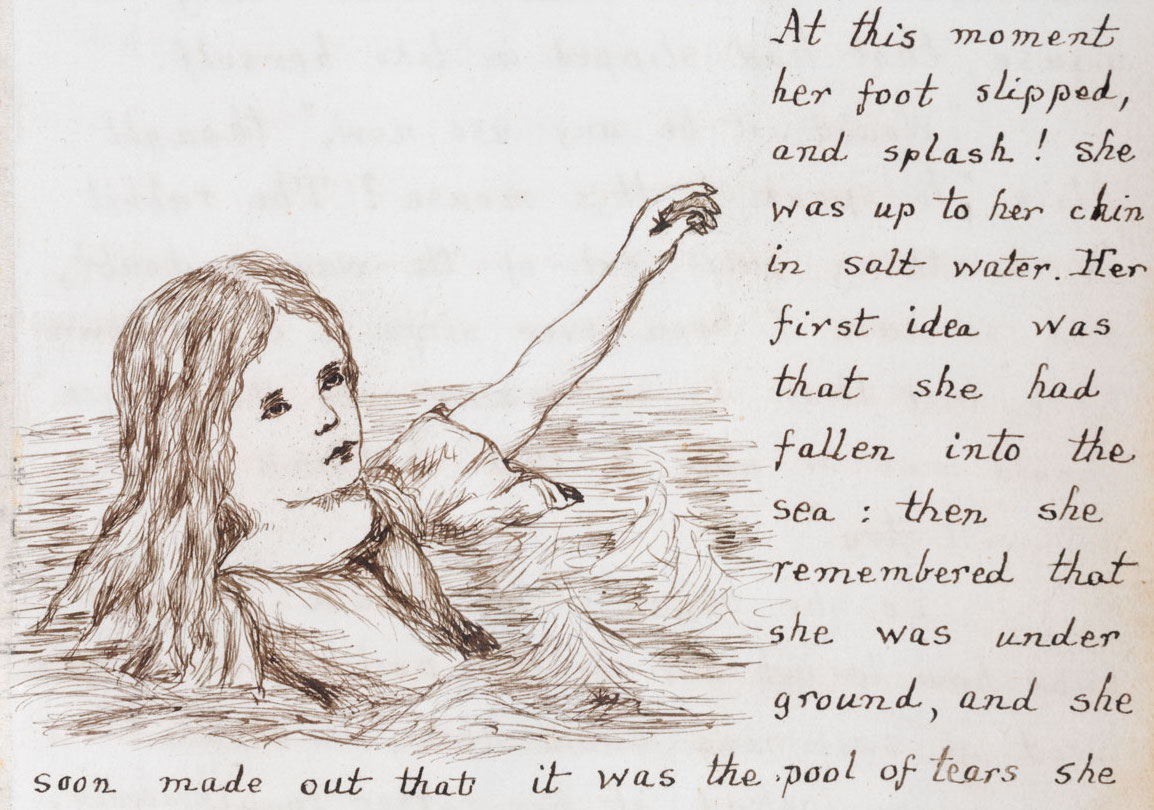
Alice falls into the pool of tears.

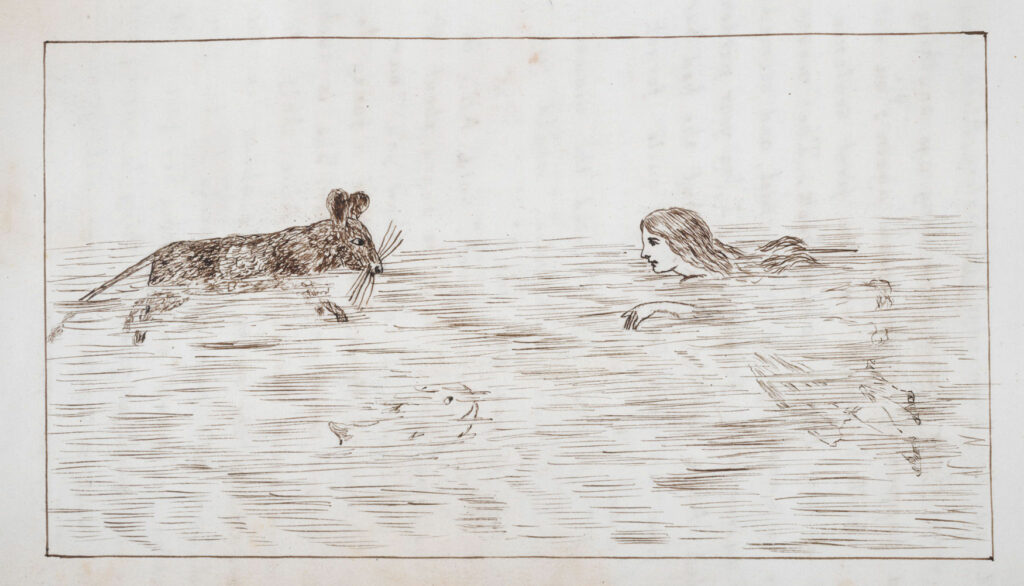
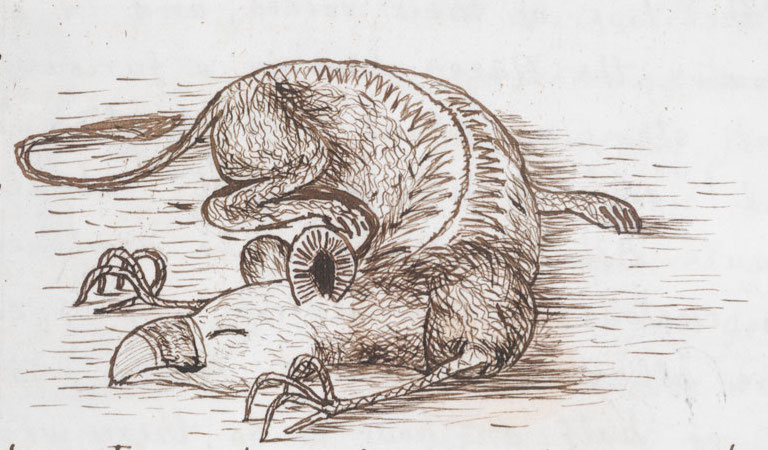
Alice meets the mouse in the pool.

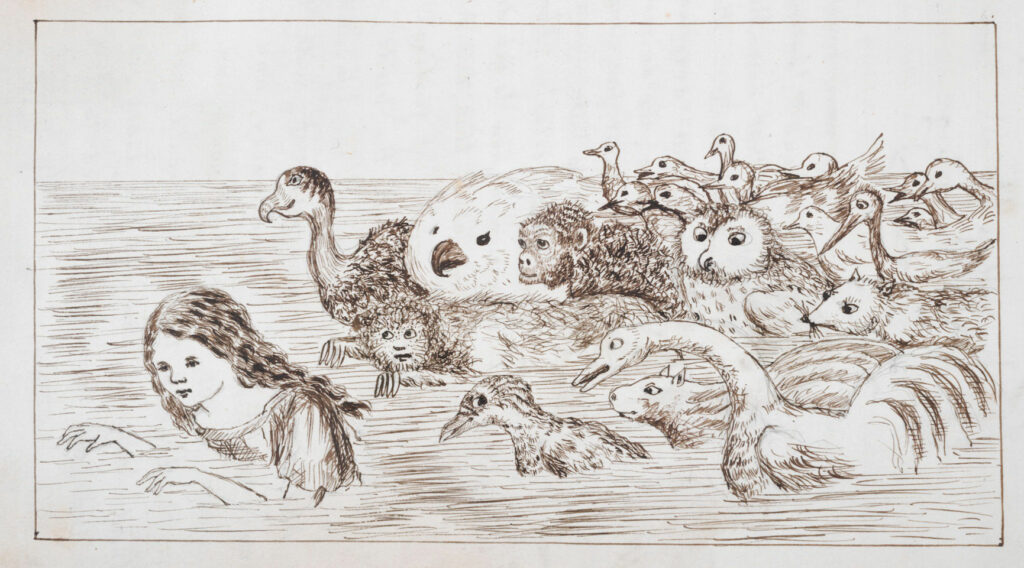
Alice led the way and the whole curious party swam ashore.


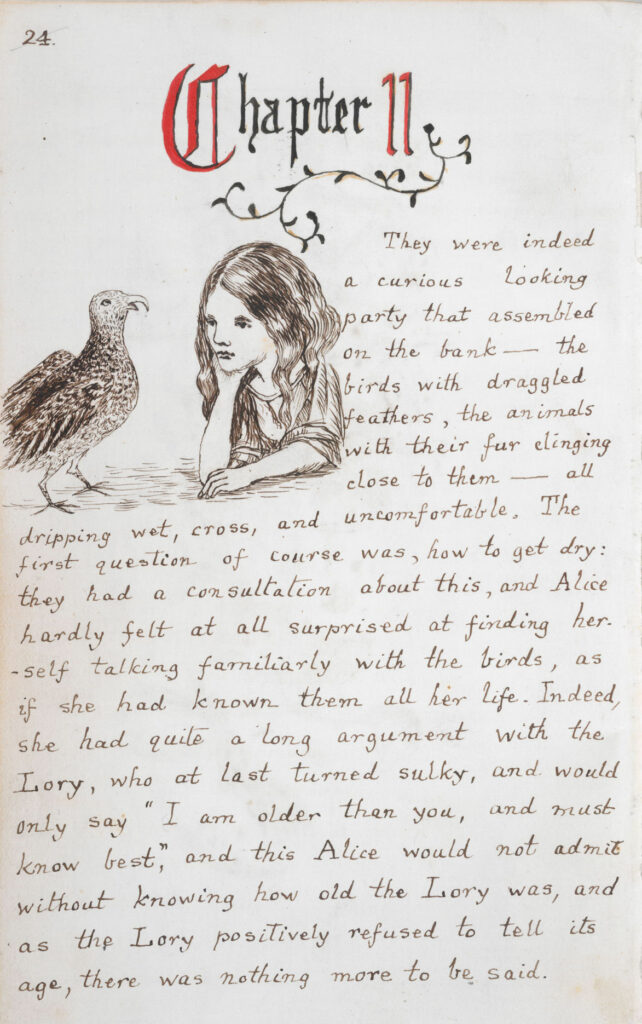
Alice has a long argument with a lory.


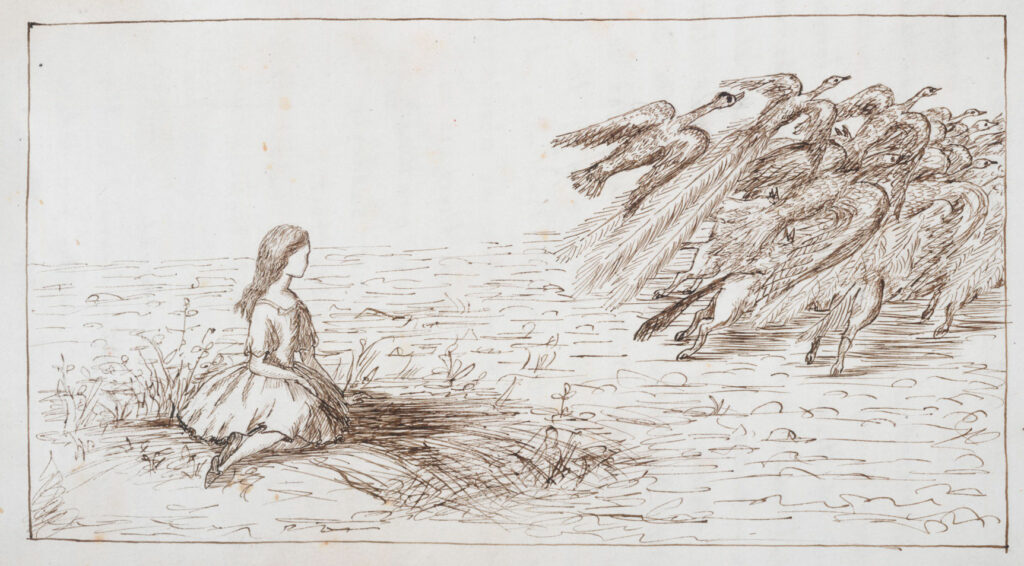
On various pretexts, they (birds) all moved off, and Alice was soon left alone.


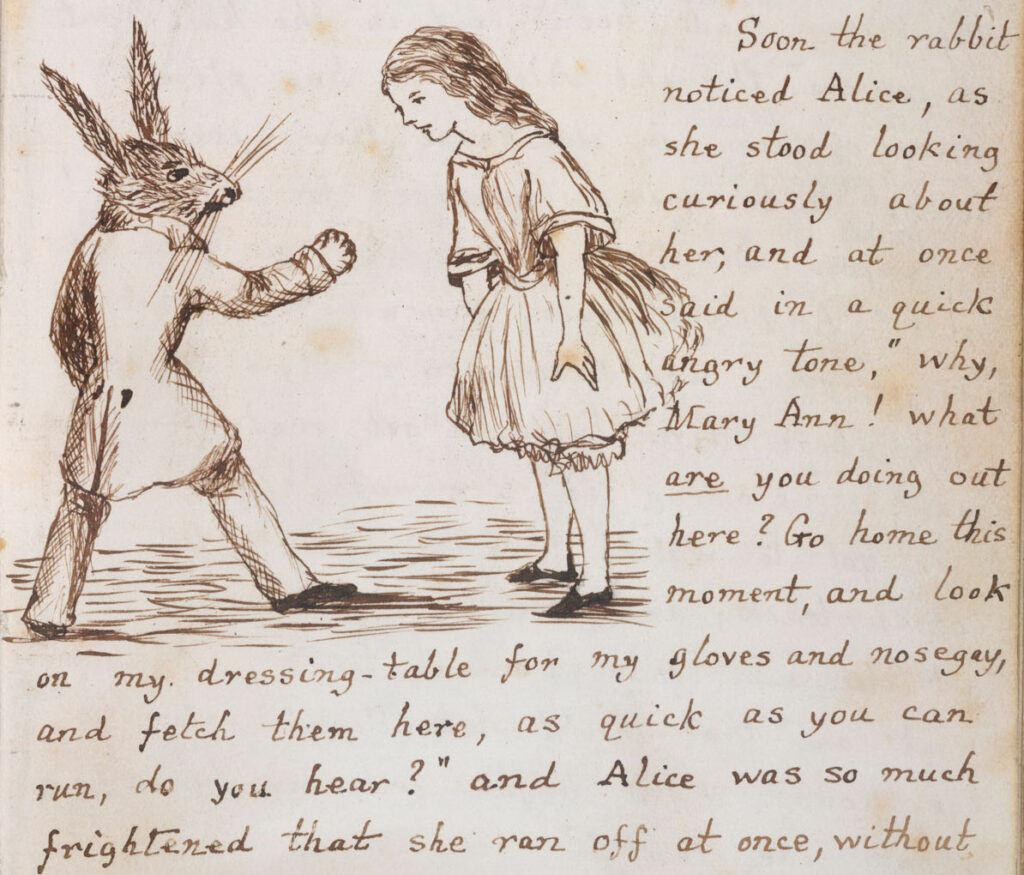
Rabbit orders Alice to fetch gloves and nosegay!


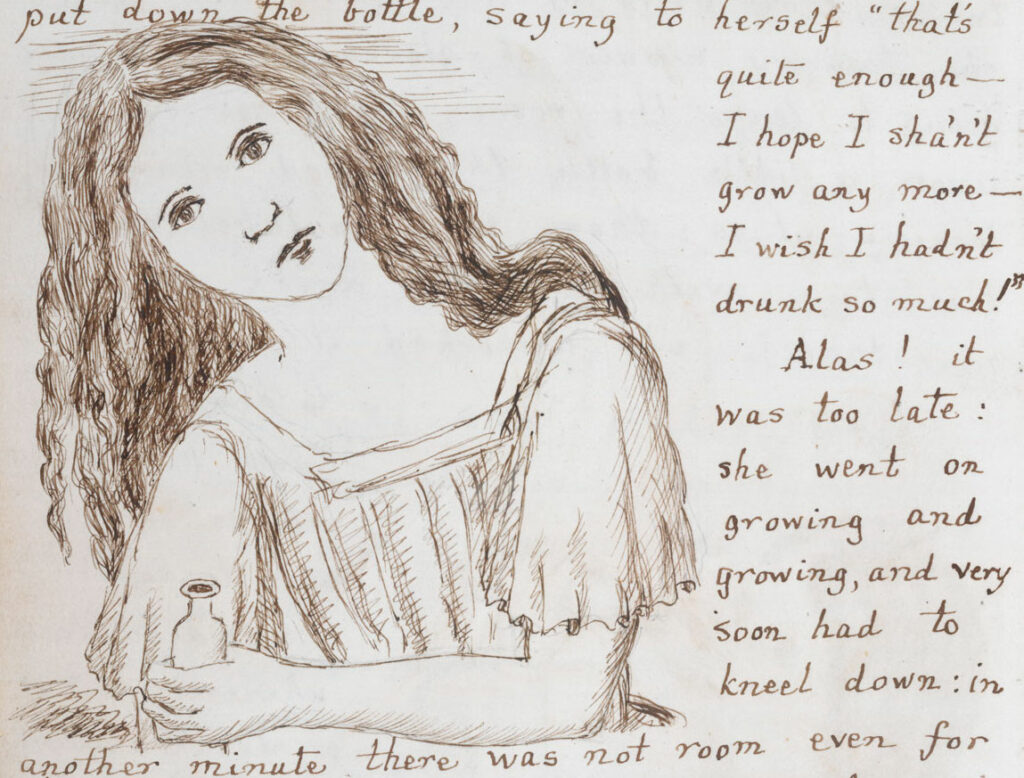
Alice finds another bottle and drinks it!


..and grows in size


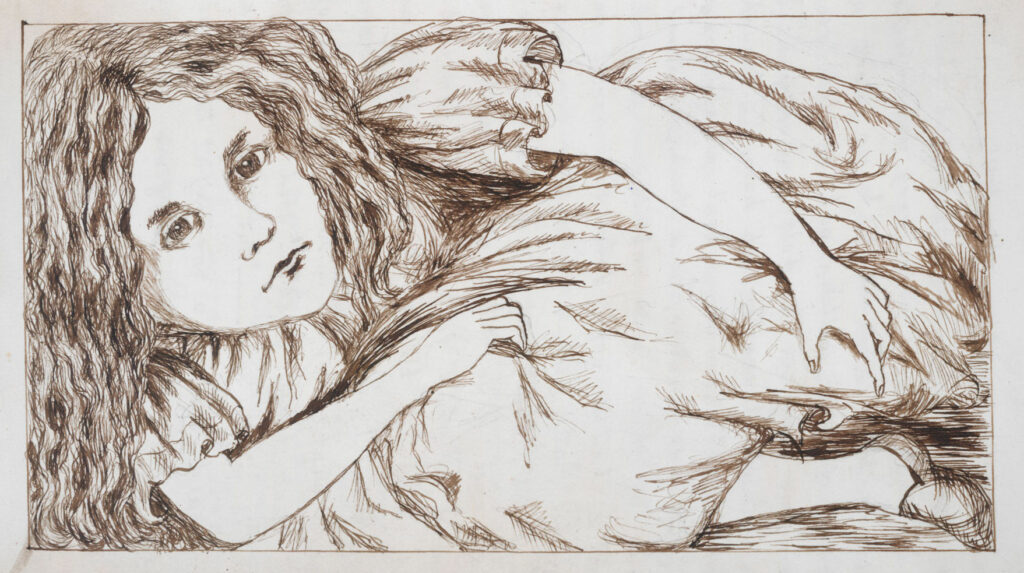
…till she is filling the entire room..


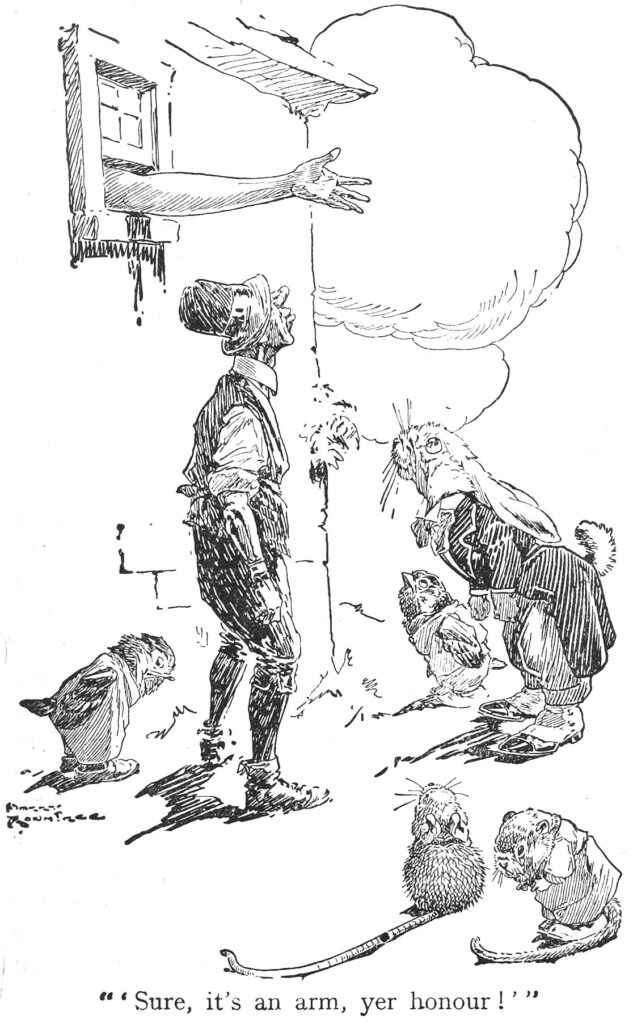
Alice’s hand comes out of the window of the house.


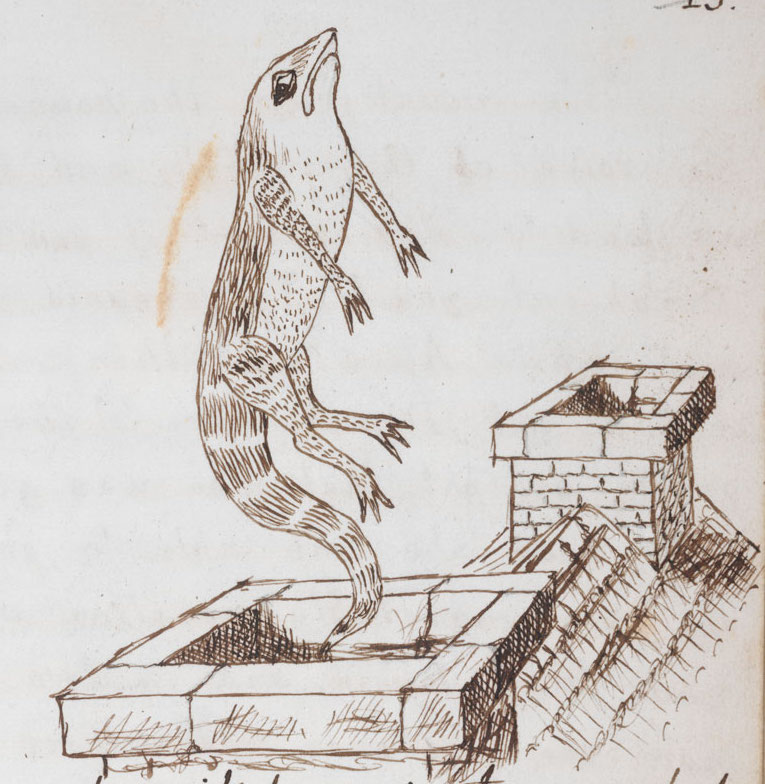
Alice kicks Bill, the green lizard, out of the chimney.


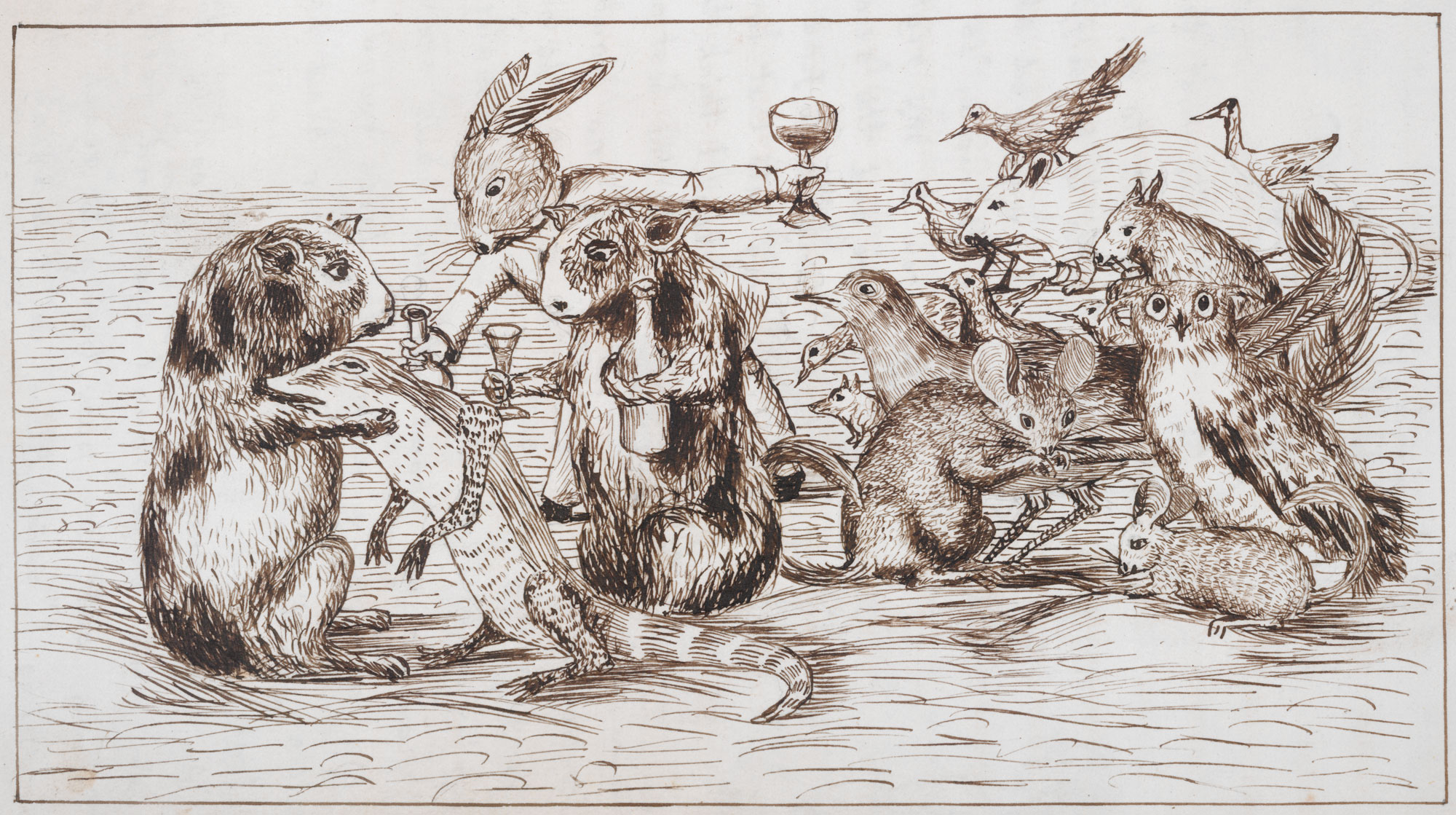
Animals taking care of Bill.


Alice meets the giant puppy.


Father William and his son.

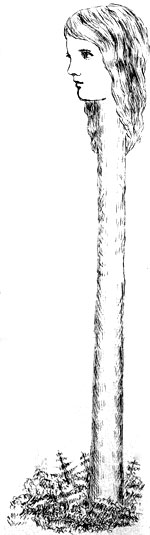
Alice eats a mushroom and her chin is stuck to her foot!


Then she eats more and her neck shoots through the trees!

“Serpent!” A pigeon calls Alice.


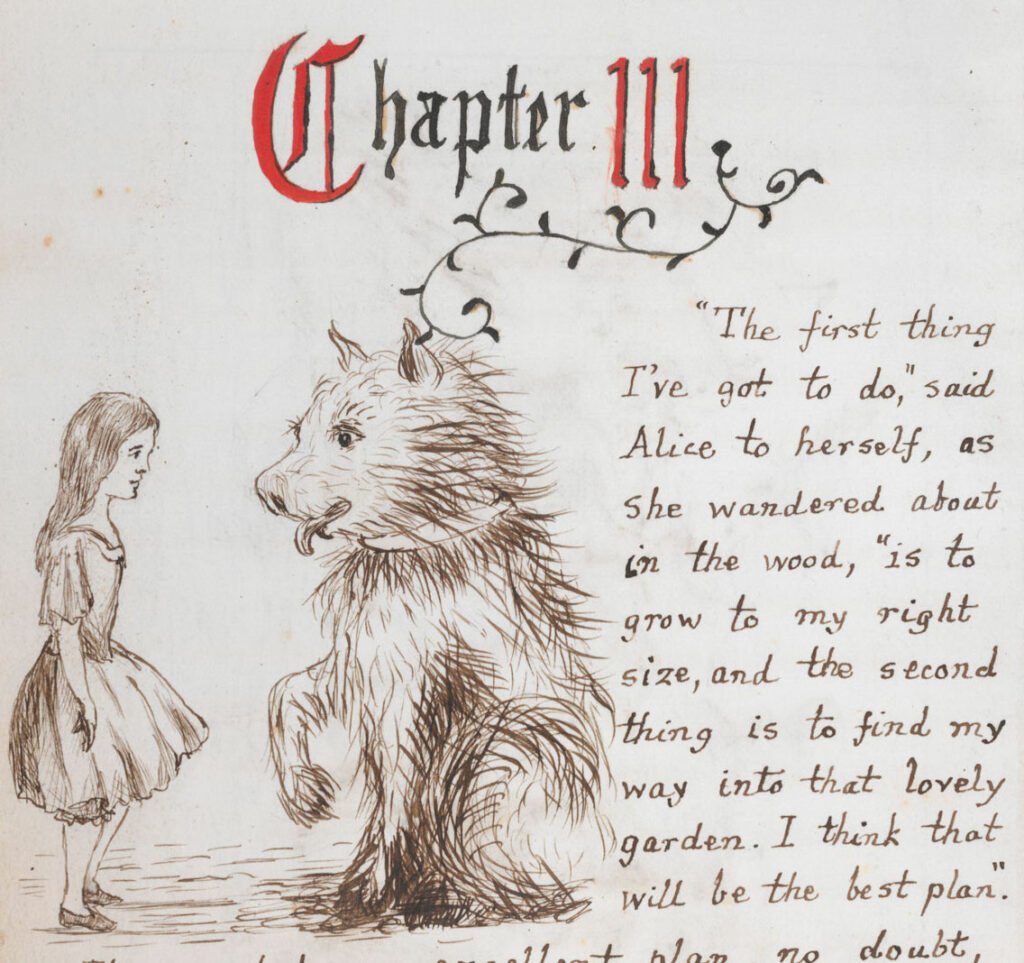
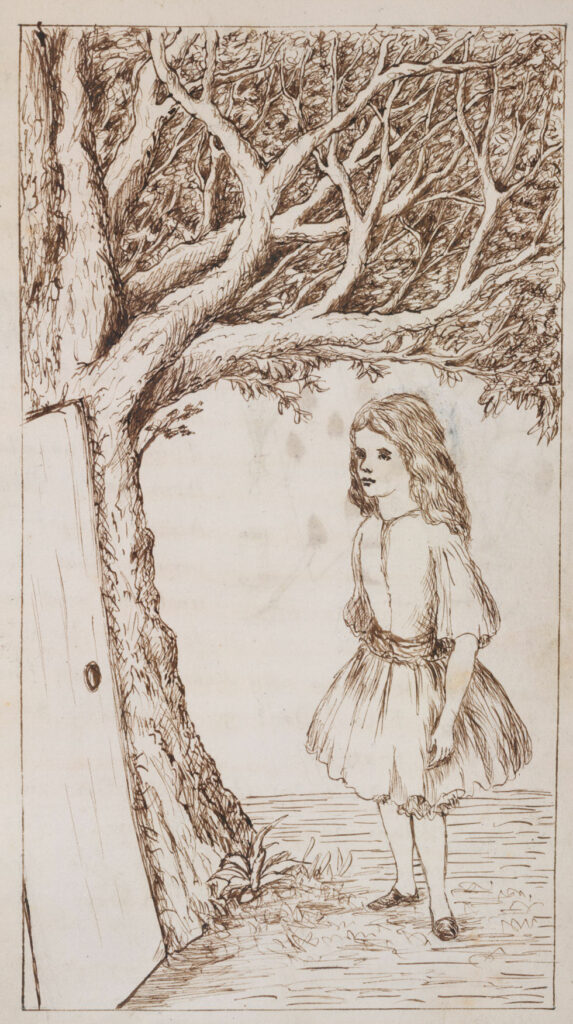
Alice is of the right size and wants to go to the beautiful garden via the door in the tree.


Cards are painting white roses red in the garden.


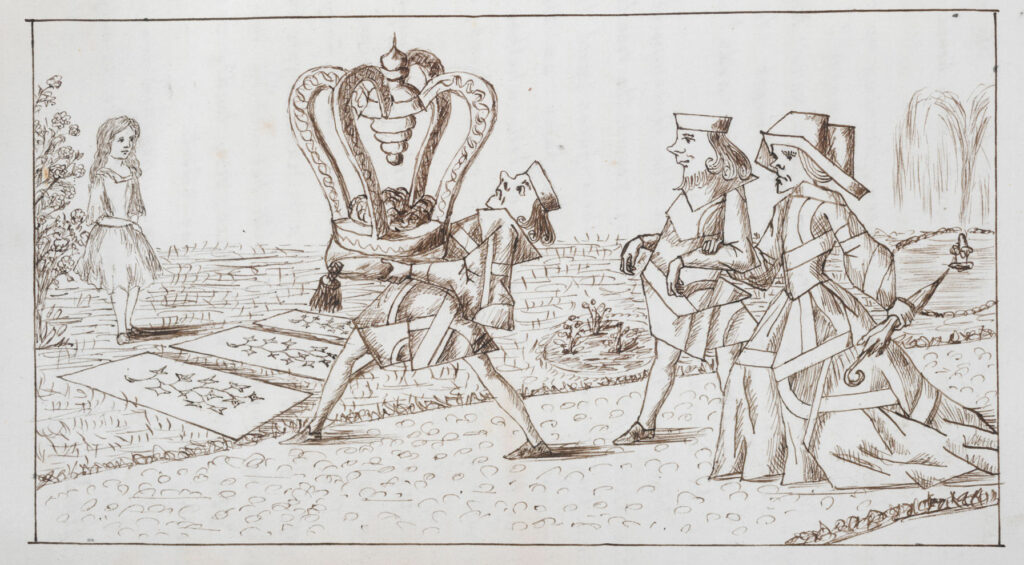
The king and queen of hearts arrive with a knave carrying the crown in the cushion.

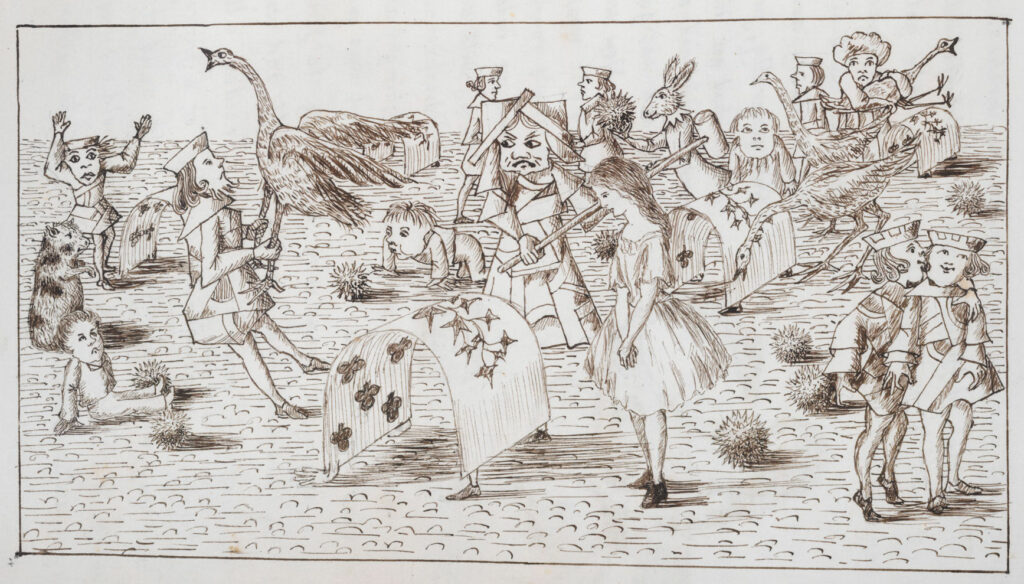
The curious croquet game.

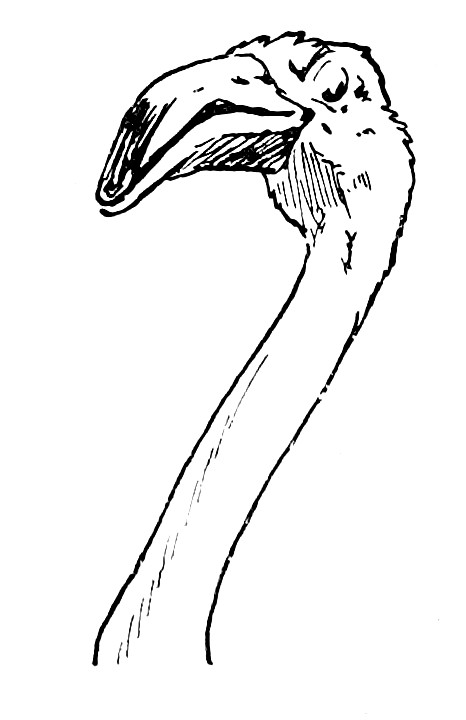
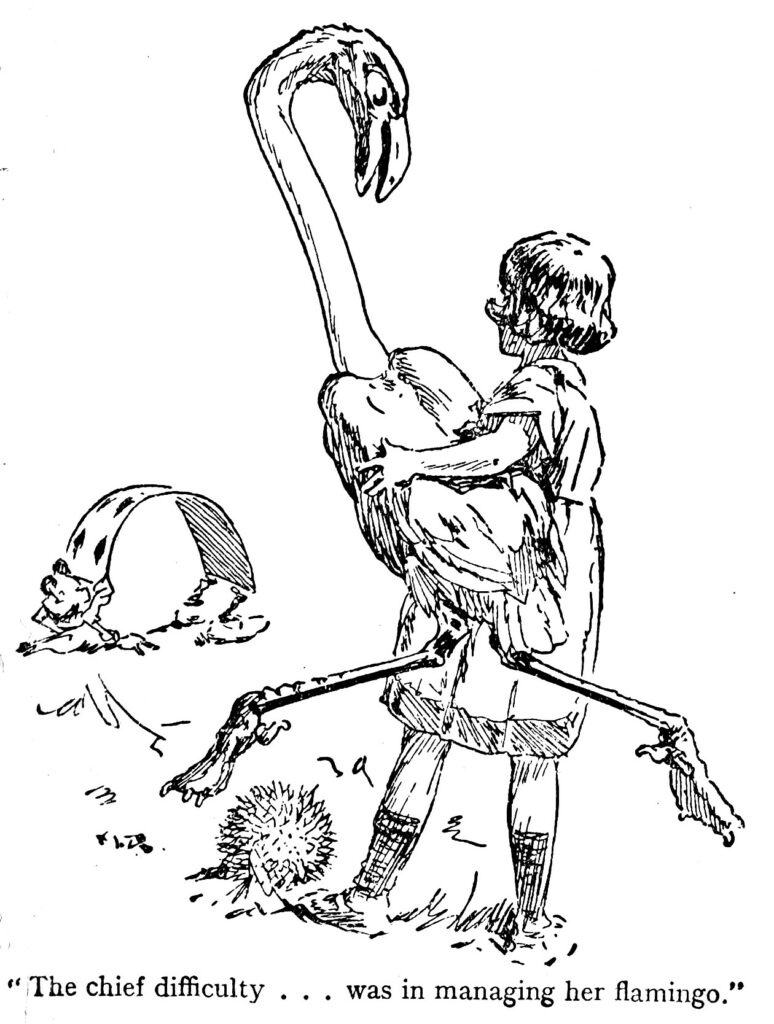
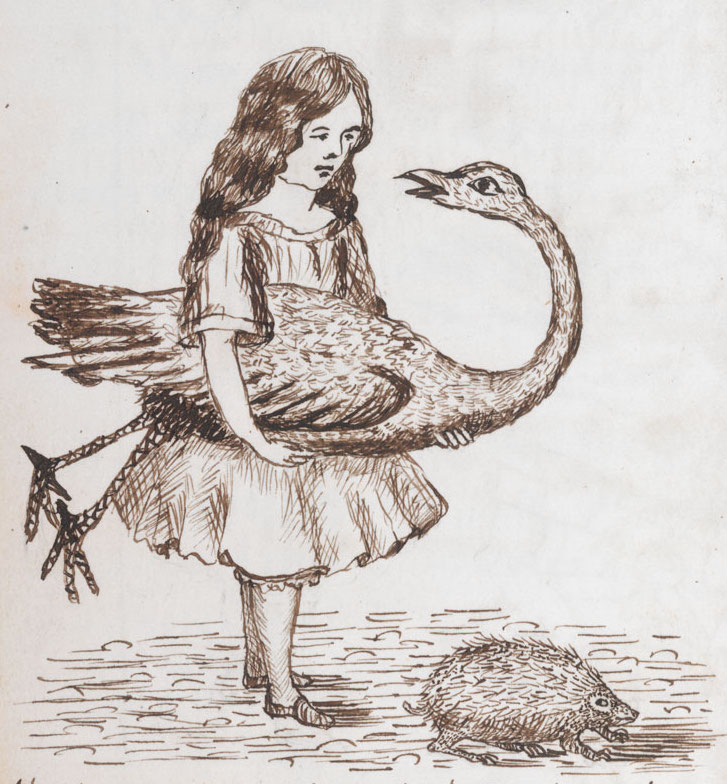
Alice tries to play the croquet game with a live ostrich as a mallet and a live hedgehog as the croquet-ball.


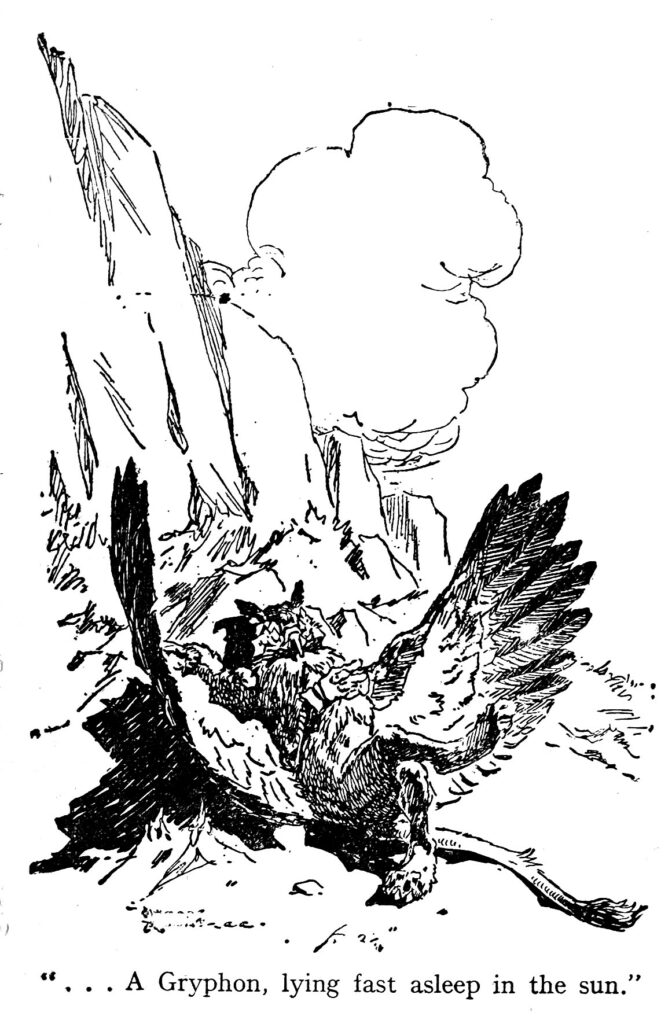
The gryphon laid fast asleep in the Sun.

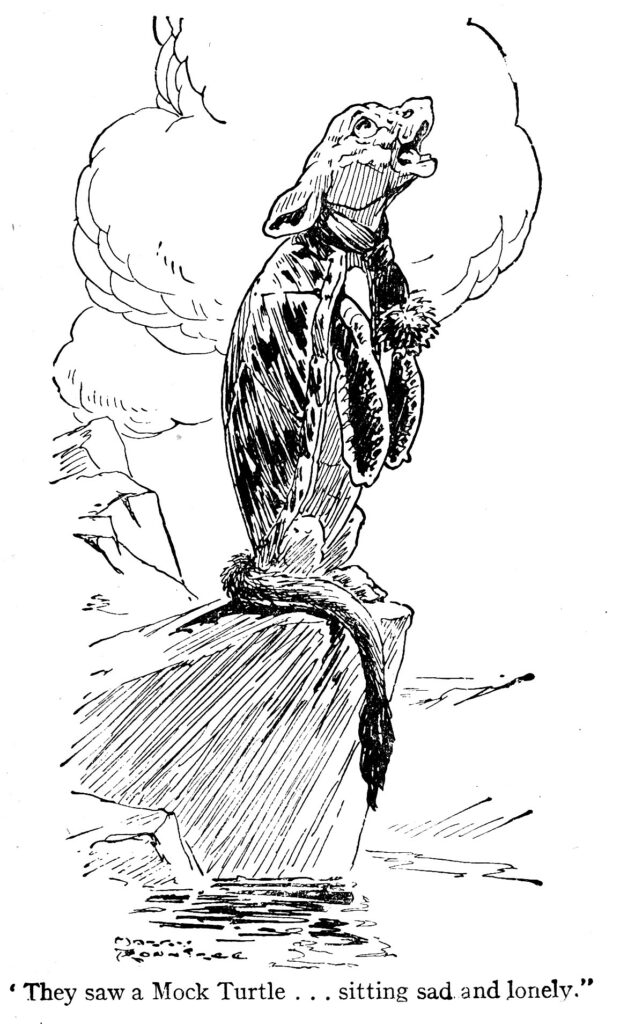
The Mock turtle tells his story.


The mock turtle and the gryphon in a tangle.


Mock turtle and gryphon sing and dance around Alice.

Sentencing of the knave of hearts for stealing of tarts.

“No!” said the Queen, “first the sentence, and then the evidence!”

Alice


Myriad Mystical Melancholic Marathon Mindless Meaningless Meetings

There are meetings and then there are more meetings. There are meetings after meetings and there are meetings before meetings. There are meetings in the office, and there are meetings in conference rooms, sometimes in the cafeteria. There are online meetings, there are face-to-face meetings. There are app-based meetings, there are audio meetings, there are video meetings. There is a plethora of meetings. Sometimes my entire working day was lost in shuffling my mind and shuttling my body between meetings. Many times I think just attending meetings is the work, perhaps the only work, that people do. Some people take meetings with almost religious fervour in both quantity and quality. For me, any meeting which lasts more than 15-20 minutes, unless meeting exceptional people or under exceptional circumstances, is just plain debauchery full of verbal diarrhea. Meetings should be precise and to the point, and should not devolve into a seemingly unending saga like a TV Soap opera.
But then, people don’t believe in short meetings. They want elaborate, longer meetings. Mind you I have nothing against longer formats, I would rather read a long-form essay than a character restricted tweet. But these meetings suck the very life out of you as they progress. I could never explain that feeling of uneasiness that crept over me whenever I have to attend the glorious meetings which go on for 2 hours and some more. Longer meetings are like their contents like a gas, nothing concrete.

meetings will expand to fill whatever time is given to them. – Prof. Hall

I would always see others attending the same meeting in the same room, for the same time but never seeing them bored even a zilch. If anything, their enthusiasm for the meeting (whatever the topic) seems to go on and on, as if they had a Duracell battery inside them, and me has just an ordinary battery which runs out of juice in between the race, with the finish line seemingly lying beyond the horizon.
duracell_bunny
Do these people drink Boost? Is that the secret of their energy? I have to know this…
But sometimes during these marathon meetings, I have managed to get some creative things done, insulating and isolating myself from the chaos and debris. The important word to note is “sometimes”. Most of the time I was bored to death, thinking about existential questions about life, the universe and everything. But instead of loaded questions like “”What is life about?”” I end up asking much mundane (and cheap) ones like “What is this meeting about?, instead of “What is my purpose in life?”, I ask “What is the update I have to give?” At times I had to give the same updates in three different meetings in a single week. And then people want to talk about optimisation and time-saving techniques and how we can become more efficient, of course in a meeting.
During such moments of philosophical delirium, I take solace in thinking about this quote from Alice in Wonderland:

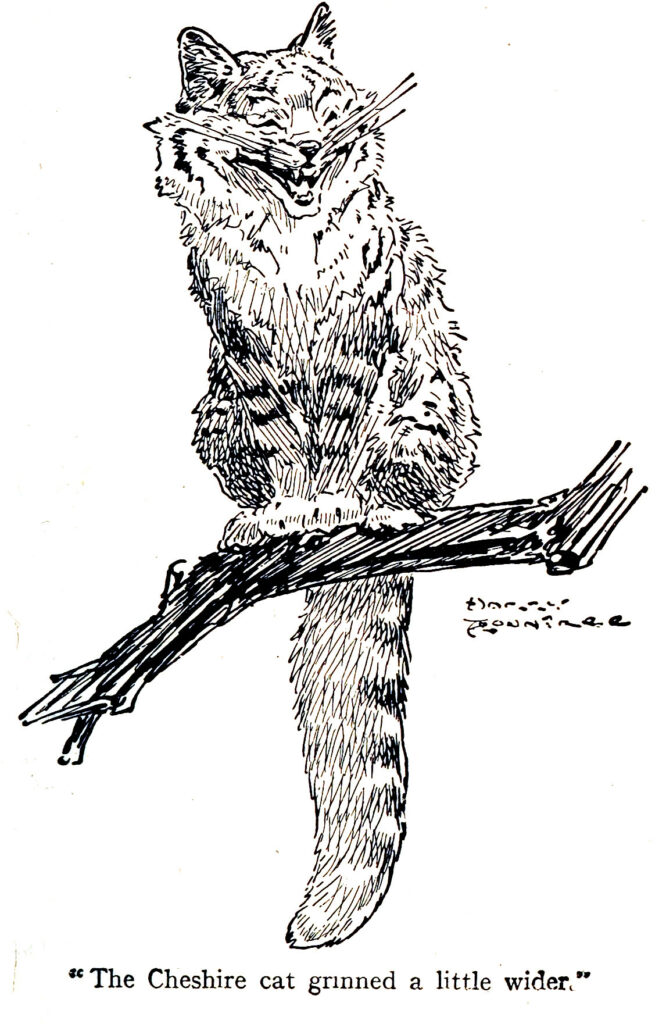
“ In that direction,” the Cat said, waving its right paw round, “ lives a Hatter : and in that direction,” waving the other paw, “ lives a March Hare. Visit either you like: they’re both mad.”
“ But I don’t want to go among mad people,” Alice remarked.
“ Oh, you can’t help that,” said the Cat : “ we’re all mad here. I’m mad. You’re mad.”
“ How do you know I’m mad ? ” said Alice.
“ You must be,” said the Cat, “ or you wouldn’t have come here.”

Of course, why would I go to a boring meeting which gives me both suicidal and mass-murderous thoughts at the same time, unless I am mad? After every single of these myriad marathon meetings, I would comment to myself with deep melancholy “I am never going to get back these hours of my life I have spent/survived in here”.
Screenshot 2019-10-27 at 2.04.12 PM.png

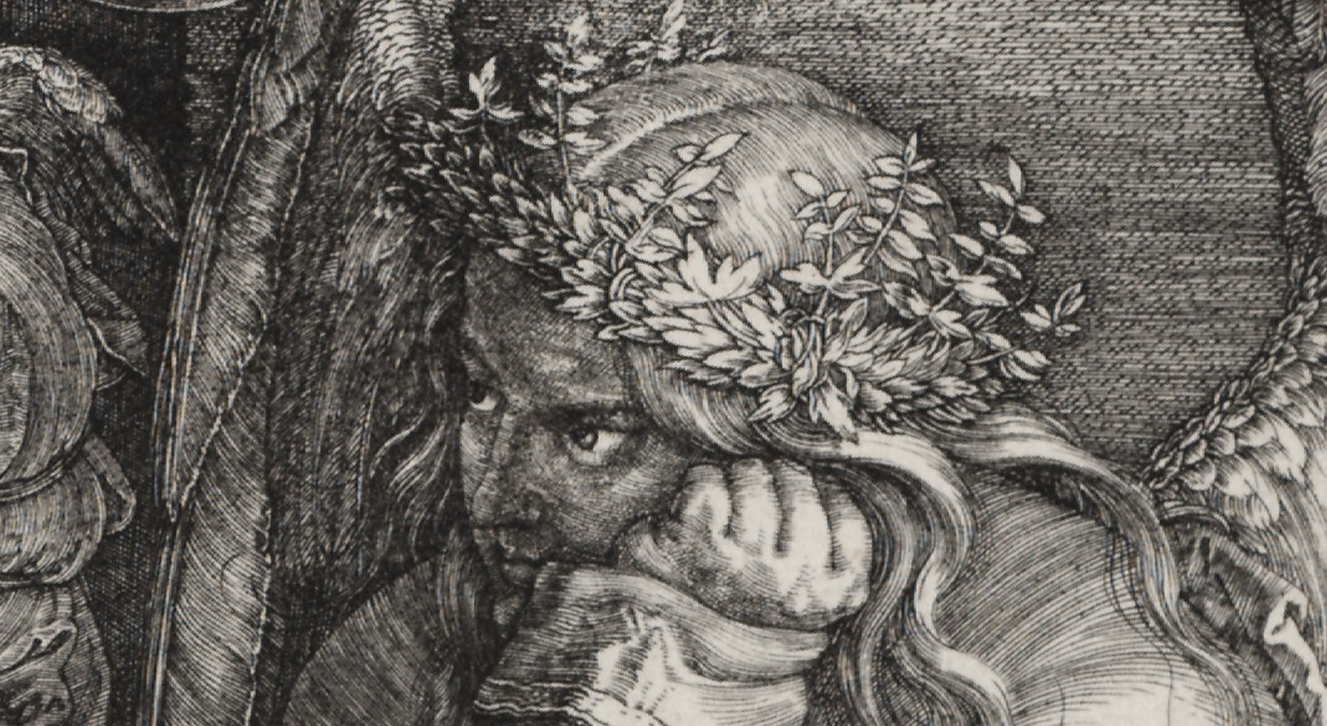
Detail from Melencolia I  by Albrecht Dürer

Not that I am the only one with these feelings, the shoulders are stooped, faces drained and brains faded for many fellow tortured souls. For all the knowledge of cognitive and educational psychology that many of my learned colleagues are making a living from, they just cannot ( or rather do not) want to see the problems with meetings which apparently stretch on and on. They think just sitting there will help in building the team and inspiring people and keep them updated. They are wrong. Meetings, especially the long ones, don’t help.
Motivation and concentration, cannot be kept on for long, especially in contexts in which you are passively listening to a subject of not your liking. And, as I have remarked in an earlier post, the passage of time can be very subjective. In the case of such meetings, it seems that we are moving very close to the speed to light, as time seems to mysteriously pass very very slowly. I have many times found myself saying, “It must be at least 15 minutes since they are blethering…” and to my surprise when I check the actual time it is not even 2-3 minutes.
Hai Ram! Anyay hi anyay…
हाय राम ! अन्याय ही अन्याय।।।
Another aspect of long meetings is that they are not only mentally, but also physically draining. Even if you are just sitting at one place during those two hours, somehow the entire body feels drained of its juice (remember the Duracell bunny). Physiologically perhaps this can be explained as the entire body system tuning itself to go to sleep as there isn’t much physical activity, added to lessened mental activity as well. Perhaps this is also the reason why people fall asleep during meetings.
1book25.jpg
But about the general idea of meetings that I have is neither subjective nor unpopular opinion. People have researched and have come to the same conclusions.

Yet as valuable and energizing as good meetings can be, too many meetings are seen as a waste of time — as a source of frustration rather than enlightenment. – Rogelberg, Scott and Kelly – The Science and Fiction of Meetings (2007)

Also, the misconception that some people had (and I guess they still do) is that meeting is a type of work. It seems to them that attending a meeting itself is equivalent to doing work. Maybe they are fans of Full Metal Alchemist and inspired by law of equivalent exchange they think meeting about some work is equivalent to actually doing the meetings. So how do we end up having so many meetings anyway?

People don’t do concrete things any more,” he says.
Instead he says there has been a rise of managerial roles, which are often not very well defined, and where “the hierarchy is not that clear”.
“Many managers don’t know what to do,” he says, and when they are “unsure of their role”, they respond by generating more meetings.
“People like to talk and it helps them find a role,” says the professor.
Many of these people can spend half of their working hours in meetings, he says.
–  Pointless work meetings

What this implies is that instead of doing actual work, people want to just talk about it. Yet some people, mysteriously seem to enjoy these meetings, some even recording attendance and taking meticulous notes, as if to provide an alibi for a murder.
Screenshot 2019-11-19 at 11.23.11 PM.png

Rogelberg, Scott and Kelly – The Science and Fiction of Meetings (2007)

 
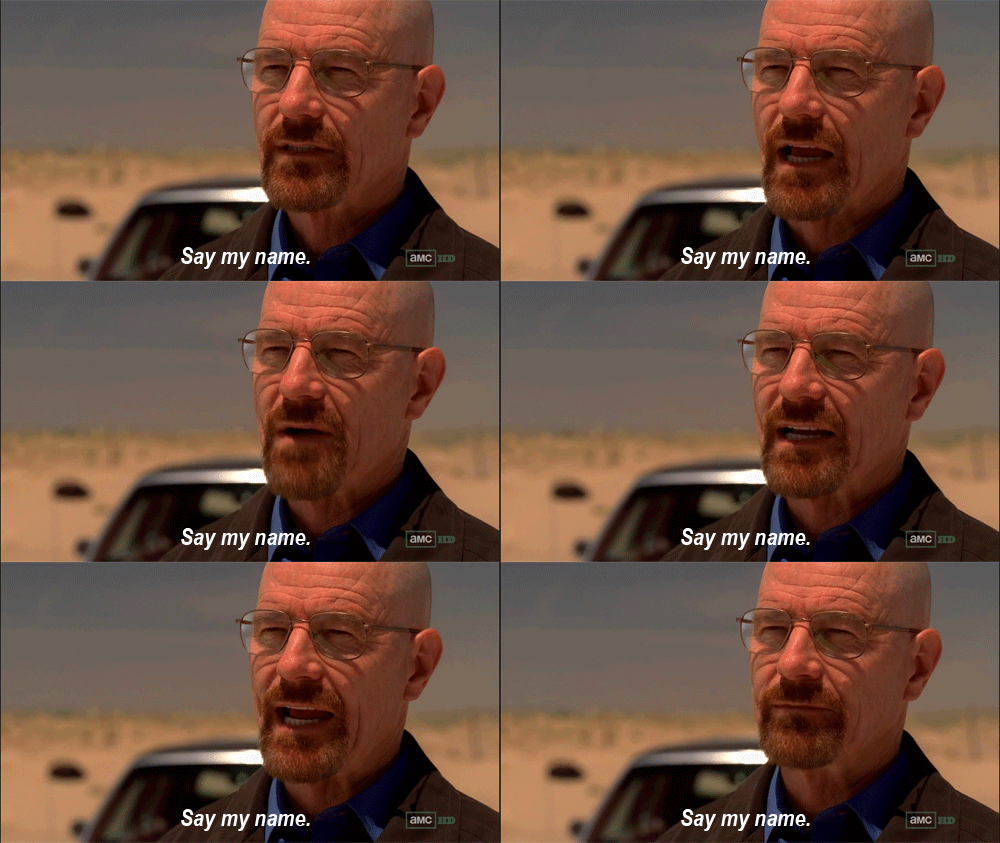
That being said, I always thought who likes such meetings and why do they like it? I had a folk-psychological theory that those who enjoy such meetings actually derive their energies from such meetings. But all these were just shower-thoughts, I mean during these mindless meetings you can think of having a hot shower, and also think about something else at the same time. Your brain saves you, it automatically tunes out of the ambient noise and enables you to do what you want to. But this too has its limits and it is not always possible to do it. This is done of course with a filter and a trigger word. The trigger word is when someone calls your name. At times the image of me as Heisenberg flashes in front of my mental eyes as if I have sadistically commanded them to
heisenberg-say-my-name.gif
And tathastu suddenly you are centre of attention and you have to pretend that you are supremely interested in the topic of the meeting (however boring) and have to respond. I still get goosebumps thinking about this (think PTSD level), imagine the trauma I must have experienced over the years. But the people who like such meetings seem to be immune to such traumas. Rather they thrive in such troubled waters.
The other reason that I had speculated for this was that these meetings are a form of a power play. Not the cricket kind, but the human politics kind. These meetings allow people to show the pecking order, and also allow them to tell other people things which they would not want to hear otherwise. It is to give those whom you like the work that they want and rest to the work they won’t.
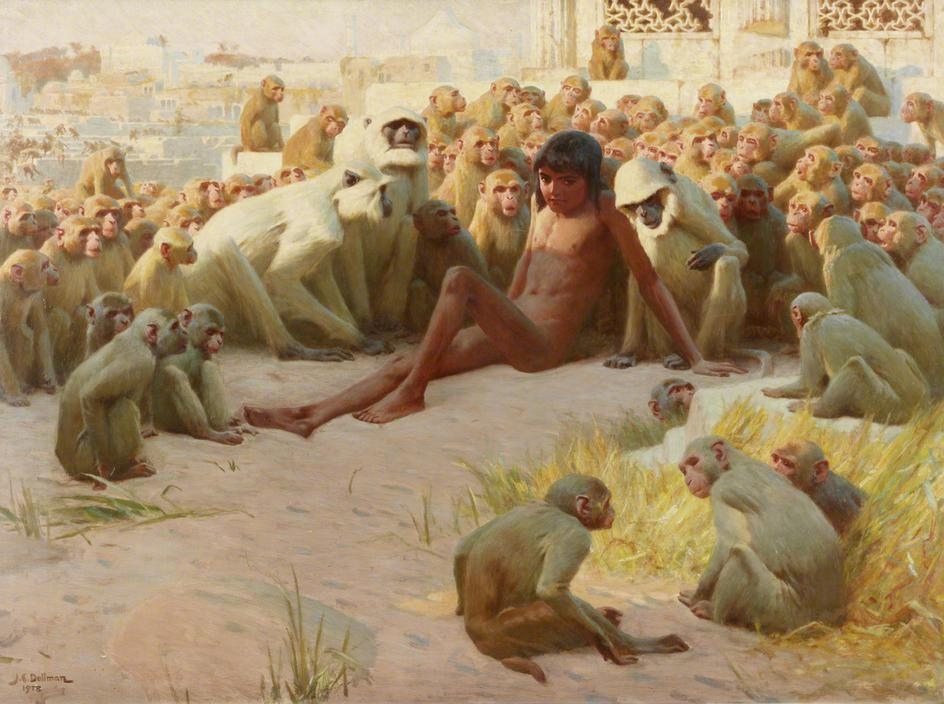
A colleague of mine, who has whitened (ok wait, not whitened but grayed 🙂 his hair dealing day in and day out people like these and had experienced such meetings much more than me, told me about the dichotomy of such work distribution. Work, according to him, is of two types: Monkey work and Donkey work. Now, as the name suggests, monkey work is like monkey work. Monkeys are jovial, they jump from tree top to tree top, eat fruits that they like, raid houses and steal from them, make noises and if you get too close to one they might attack you too. They are the Bandar Log of Kipling.
john_charles_dollman_-_mowgli_made_leader_of_the_bandar_log

In Hindi, Bandar means “monkey” and log means “people” – but can also be used for plurality hence the term simply refers to “monkeys”. The term has also since come to refer to “any body of irresponsible chatterers.”

All said and done, monkeys enjoy life, and people do remember them. They have their own charm and are the most visible and vocal people of the jungle (office?). Now I know, you must be making mental images of who are possible Bandar log in your office while reading this. But they don’t do any real work, they do pretend work. They want their names on events that are seen as glamorous and titles which pompous. But you assign them ass grinding work, they will throw a tantrum as if you have asked them their kidneys, for free. It is not that they don’t want to do quality work, in reality, they can’t get quality work done.
In most cases, the monkey working class is also of the mediocre people which I had written about in the past. It is beyond their ken and competence do get actual work done. Perhaps it is the infinite monkey theorem at work.

The infinite monkey theorem states that a monkey hitting keys at random on a typewriter keyboard for an infinite amount of time will almost surely type any given text, such as the complete works of William Shakespeare. In fact, the monkey would almost surely type every possible finite text an infinite number of times. However, the probability that monkeys filling the observable universe would type a complete work such as Shakespeare’s Hamlet is so tiny that the chance of it occurring during a period of time hundreds of thousands of orders of magnitude longer than the age of the universe is extremely low (but technically not zero).

chimpanzee_seated_at_typewriter
Since we do not have infinite time or millions of Bandar log in our office, the chances of them producing any intelligible work is extremely low (but technically not zero). So now you know why work doesn’t get done.
If at all, such work befalls on them like on the protagonist of a Greek tragedy, they insist on having an ensemble of underlings to work with under them. They will assign all work to them and only pitch in when to take the credit. They usually undertake work which does not have concrete objectives, or immediate deliverables. They like work which is vague, sounds inscrutable and is heavily jargonised. And they look and dress much well. They look and talk sophisticated but on a closer/deeper scrutiny what remains is only sophistry. Such are the monkey-work people.
On the other hand, the Donkey work people suffer similar fate to the eponymous animal. They do drudgery and actual work which is not glamorous. They work tirelessly and without much hope for recognition. Most actual work in the office is done by them. And in these meetings, this distinction is made clear.

If you work more, more work will come to you. If you work less, less work will come to you.

The offices run on the basis of the work of the Donkey-work people. Boxer the cart horse from Animal Farm can be considered as a Donkey-work person, though all of us are not that naive or ignorant. Screenshot 2019-11-20 at 11.05.58 AM.png

Animal Farm (1954)

Another aspect of such meetings is the apparent loss of time-sense some people experience when their turn to speak, Csikszentmihalyi will perhaps call it as flow state. It feels like those old people who usually don’t get to talk, and when they get someone they just keep on going. It is as if some people have to complete a quota of words in front of a captive audience in order to satiate themselves. Even if what they are saying is of no importance, or is not in the agenda of the meeting or is meaningless mindless mouthing. It is like a poison that they want to remove from their bodies and minds and in lieu inject it on the hapless captive attendees. There is no dialogue, only monologue. In doing so, they inadvertently, and purposefully they hijack the agenda of the meeting. They will go on and on about ephemeral experiences they have had, for example, elaborately explaining elegant endoscopy (or enema, choose what you will).

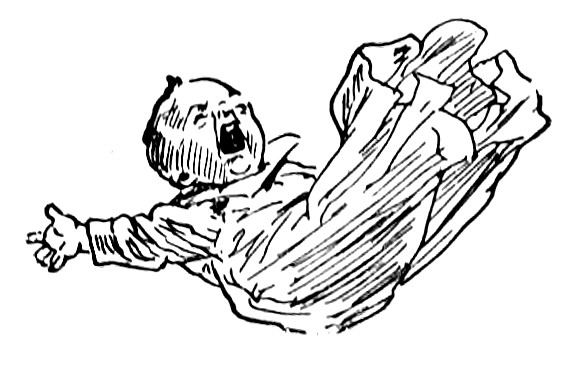
The cry baby gets more attention.

Initially, I used to think, it is harmless banter, excruciatingly boring at worst but then it turned out to be sinister scheming. This is true for humans as much as for animals. In birds, the more vocal and active chick gets all the food, while not so vocal ones are starved and at times kicked out of the nest by their siblings. In the case of humans, this is observed too. Babies who cry more, get more food and parents time. They know how to manipulate people around them even by faking crying.

The infants exhibited crying behavior that seemed to become more sophisticated with increasing age. This marked a proactive stance in communicating with the mother on the part of the infant. Interestingly, at 11–12 months, “fake crying” was observed during a naturalistic interaction with the mother. This implied that deceptive infant behavior could be seen at quite an early stage.

Now, I am not sure if this trait is carried to adulthood or it is learned during the intervening years, but they get the same modus operandi seems to work on adults also. In these meaningless meetings, the banter can be seen analogous to crying, and attention whoring. The hijacking of the agenda has another purpose, to eat up the time allotted to others, in case you want to say something of value, such delays will cut down your time. Such episodes remind me of an aunty who makes horrible food but insists that everyone must eat it to the full and also praise her culinary skills.
And if they can, people will put all the content of what they have to speak on slides. If you can’t read it yourself (even if you are seated in the front row), because they have put 10 bullet points at 10 point font on a single slide? Not a problem, they are just anyway going to read aloud the slides. Technology scaffolded GIGO. When I see such slides, the designer in me dies a thousand deaths. And people are This goes against good design principles of presentations. Powerless Pointless Talks (PPTs) can be indeed empowering for these people. I can go on ranting about this, but since this is not the central theme of this post, hence I will stop here.
Another category of monkey workers are sly. When they have to address such meetings or are tasked with providing some answers they work as follows. They will identify possible candidates who might have the knowledge that they require. lf Suppose fate has it, that it is you who they seek. Then they will clandestinely ask you something about some other topic and slowly, but surely drift to the subject they want. Then they will ask you detailed questions, and innocently you will answer. The episode ends there, or so you think. Next time in the meeting, you hear your own words coming out of their mouth. No, you are not controlling their minds! But this is a way of appropriating knowledge. They feel elated and intelligent by telling all others what you have told them and not at a single point giving you any credit or even hinting that they asked you anything. Such is the state of people and the purpose they use the meetings for,
Some of these were just some empirical, albeit biased speculations. Can there be a scientific explanation to this messy behavior in meetings? It turns out there is. Recently a group of psychologists from Sweden did actually study work meetings. And this study enables us to understand many things about meetings.
They say meetings provide an outlet both for people to show off their status or to express frustration. Mine is, of course, the latter case (at least I would want to identify myself as such, my residual self-image), while the monkey people show off their status. They say despite there being more meetings “few decisions are made” and people can have a low opinion of work meetings, yet their numbers keep increasing.
The Swedish study takes another take on the long meetings:

Meetings can “arouse feelings of meaninglessness”, he says. But he argues that is often missing their point.
Once in a meeting – particularly long ones – their function can become “almost therapeutic”.
Regardless of what they are meant to be discussing, they serve a purpose as an “opportunity to complain and be acknowledged by colleagues”.

But this certainly becomes a farce very quickly.

But people going to many meetings can lose patience – and can spend much of the time playing with their mobile phones, say the researchers.

A very common scene in meetings that I have had to endure, and surely you have too.

“Some people find this frustrating and question why they must endure them.”

Then he comes to the crucial insight of the study.:

But he argues that negativity towards meetings can be because their real purposes are misunderstood. (emphasis added)
But he says the real purpose of such meetings might be to assert the authority of an organisation, so that employees are reminded that they are part of it.
Such meetings are not really about making any decisions, he says. (emphasis added)

Screenshot 2019-11-20 at 11.25.06 AMScreenshot 2019-11-20 at 11.25.25 AM

Levels of meeting and power play.
“When you have meetings with colleagues at the same level, as a professional, you get to discuss different issues that interest you,” he says.
When the meetings are dominated by different levels of status, they become a “power struggle” and leave participants feeling frustrated.
He also says that meetings can unfairly become the focus of other dissatisfactions.
“People often feel marginalised. They feel that they have no influence or position. In these cases, the perception is that meetings do not improve anything, but actually cause even more frustration.”
–  Pointless work meetings

Anyways, now we know why the malaise of meetings is not going to go away, as it is

  • considered as a legitimate form of work by people who do not produce any concrete work;
  • a way to show off one’s status and power in the workplace among your peers;
  • a way to dominate and frustrate hapless underlings;
  • a way of attention (and implicitly resource) grabbing behavior.

So much for the seemingly myriad and mystical, yet melancholic and mindless meaningless marathon meetings, hope to see you in your next one (No, I really don’t).