The year Nineteen Eighty Four is long past us, in fact next year it will exactly 30 years in the past. But if we consider the dystopic vision of George Orwell from the novel, seems with each passing day we are approaching it with ever increasing pace. As if prophetically the Orwell thought about in the middle of last century are coming true. It is as if those in power are taking cues from Orwell’s books.Some famous lines from Nineteen Eighty Four included the following:
War is Peace
Freedom is Slavery
Ignorance is Strength
And
Big Brother is Watching You
Two more individuals also told us something similar. One is a comic book writer and other is a paranoid hacker in the true sense of the word. Alan Moore in V for Vendetta tells us a story of not so distant future, which is very Orwellian. He says in an interview, it was idea in V, that there should be cameras on streets, which is what is implemented in London now. This is like an unintentional self-fulfiling prophecy. Though Alan Moore makes his case, it is after all a fictional story. Given that it might happen, but it is fiction. As is the case with Orwell’s works though fictional it has some real and frightening take home points, so is also with Alan Moore’s V for...
I will now come to the hacker. Richard M. Stallman, aka RMS aka Father of Free Software movement. Some of you might be surprised when I am making this claim. What does software have to do with dissent, or for that matter treason? But there are good reasons to make and substantiate this connection.
About the poster:
The idea behind this poster comes from Nineteen Eighty Four by George Orwell and current affairs in the world. Across the world it seems that any dissent against the government or those in power is seen as treason. Hence “Dissent Is Treason”This rhymes thematically very well with other in Orwells book which include “War is Peace. Freedom is slavery. Ignorance is strength.”
Similarly no matter how wrong the government is doing, however brutal they may be acting any voice of concern is treated as one would treat treason. The questioning of government and its actions which is essential in a healthy democracy is itself under attack.
In this poster the deer has one of its horns twisted in a way which is not normal. This “abnormal horn” metaphorically represents the view point which majority does not see or share. This can be concern for environment or disadvantaged groups, or against nexus of corporates and politicians. The list is endless. But any deer with such a horn, will be shunned in deer society. Similarly in our society usually people who have points of view which conflict with powers to be are treated as traitors. Their acts of exposing the guilty as that of treason. But in fact such individuals are people with extraordinary courage. They include people like Julian Assange, Edward Snowden and countless others whom wedo not know but are thankful.
The deer image is from an old issue (c. 1870) of Journal Of Bombay Natural History Society.
I visited Boston for two weeks. As a bibliophile I was looking forward to the bookstores that the town has. As I am always on a budget, the aim was to find used book stores. So I got some recommendations from Louis and read some reviews. So have visited these stores so far (in order that I visited them)
Harvard Book Store
There was some author signing event at the Harvard store, where people were waiting in a huge queue for the author to visit. The Harvard Store has a section in the basement in which they have used books. The prices are reasonable starting at ~ $2. There are some new books with heavy discounts also. The sections are arranged according to subjects, but you may find books out of their subjects in some parts. The science/mathematics section was okay, nothing really great, though I bought quite a few. One of the gems was a book by Lewis Carroll for $2.
The upper section has the new books categorized by subjects. But unfortunately the physical sciences section was dumped in an aisle between two sections to make space for the author signing event. Anyways, the books I brought from there are below: Books brought from Harvard Book Store Corner view of the store
Raven Used Books
Raven books visit was unplanned, but was on the agenda. Fate, I had to visit this shop.
We went to a Staples shop after Harvard Book Store. Right bang opposite this we spotted the Raven Used Books. Raven Used books from across the street
A closer look. Raven Used Books from across the street
Inside the store, which is in the basement of the building book shelves full upto the ceiling of the store greeted us. The philosophy section was categorized according to author list. The collection was extensive and very well organised.
I got lost and forgot to take any pics. But Alpesh did, and below are his pics from the store. Books at Raven Store Books at Raven Store Books at Raven Store Books at Raven Store
I got these two books from Raven. They had a nice poster and bag for the store, which I have forgotten to take a photo of. Next visit in that region sure to take it. Books from Raven
Update: Raven poster and closeups are below. Raven store door Raven store timings Raven Poster
Museum of Fine Arts
Museum of Fine Arts Main Entrance
The Museum of Fine Arts in Boston had a free entry day so we went there. Nothing specifically was on the agenda. When we went there The Great Wave greeted us. So it was here that I came to this was a painting by Hokusai. There was a Hokusai exhibit going on. Serendipity. I had seen the great wave as an fractal, but did not know about its origins. So here it was in full glory! The presentation was great. The main bookstore at MFA The main bookstore at MFA
Anyways, after roaming in the museum for a couple of hours, we got to the book store. There were many books that I would have wanted but they were fairly expensive. Just before I was leaving I got a gem A Tolkien Treasury for $5, in a reduced price section. Book from MFA Tolkien in Detail
The MIT Press Bookstore
The minimalist and the cleverly designed logo of the MIT Press is something that cannot be easily forgotten. I discovered the MIT Press shop by chance. We were walking out from Kendall MIT Train stop towards I saw the logo and bingo there was the shop.
I was in a hurry so did not go in the shop.
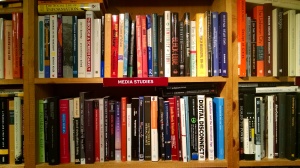
The next day we went to get coffee near the MIT store. And we saw two trays of books outside the store. Books on sale on the pavement
The prices were in the range of $3-$5. It had a small notice which said pickup your book and pay inside. This was cool. A sale at MIT Press shop!
Evening we went back to the store. The store is well stocked, and also has books from other publishers (I had thought it would be only MIT Press books). There was a section with discount. Handwritten reviews of the books
The reviews of the books were handwritten small notes. You can see it in the picture above.
I got Mandelbrot’s biography for $6.95. And three other books. Books bought are shown below.
Update: During the MIT Media Lab visit came to know the designer of the MIT Press logo. It was Muriel Cooper, who is also a co-founder of the MIT Media Lab. MIT Press Logo in Media Lab Exhibit Three Pioneer of Media Lab: Seymour Papert, Marvin Minksy and Muriel Cooper Muriel Cooper info panel at Media Lab Exhibit
Commonwealth Books and Old Prints
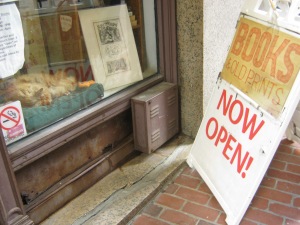
This was another serendipitous find. I had read it in the reviews. But when we went to downtown Boston, we were not looking for it. Inside a little lane I found this shop waiting for me. Commonwealth Books & Old Prints
This was one really well stocked shop. With books till ceiling all around. Books by subject, and authorwise too. Below are a few snaps from the candystore of books. The prices were okay, $6 was the minimum. They also have old prints kept among the books. The philosophy section was huge. The science section was a bit of disappointment, though there were some good books on HPS there. I got a newtons biography in the Canto series from there. Books at Commonwealth store Books at Commonwealth store
The store also has a resident cat named Dusty. Dusty the cat Books at Commonwealth store Books at Commonwealth store
The arts section was great. I got a book on Durer’s life and work. And hardbound book of Graphic Works of M. C. Escher. Books at Commonwealth store
This was a really good find.
Honor System
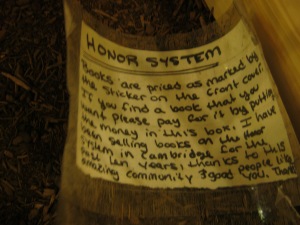
Honor System Card
Honor System
 Books are priced as marked by
 the sticker on the front cover.
 If you find a book that you
 want please pay for it by putting
 the money in this box. I have
 been selling books on the Honor
 system in Cambridge for the
 past ten years. Thanks to this
 amazing community & good people like
 you. Thanks
This is something that I discovered while walking out of the Harvard metro station. Serendipity. There was a spread of books under a tree with no seller to be found around. There was a box in the centre with a little handwritten sign next to it. The sign is produced above.
I collected a bookbinding book by Dover for $2. Dropped two one dollar coins in the box and was happy!
Next post adventures of next week!
The writer Umberto Eco belongs to that small class of scholars who are encyclopedic, insightful, and nondull. He is the owner of a large personal library (containing thirty thousand books), and separates visitors into two categories: those who react with “Wow! Signore professore dottore Eco, what a library you have! How many of these books have you read?” and the others — a very small minority — who get the point that a private library is not an ego-boosting appendage but a research tool. Read books are far less valuable than unread ones. The library should contain as much of what you do not know as your financial means, mortgage rates, and the currently tight real-estate market allow you to put there. You will accumulate more knowledge and more books as you grow older, and the growing number of unread books on the shelves will look at you menacingly. Indeed, the more you know, the larger the rows of unread books. Let us call this collection of unread books an antilibrary. Black Swan – Nassim Nicholas Taleb
I have had a similar experience about myown book collection. People expect that if you have books then you must have read them. But this is exactly what I hold the books for, a reference tool for further knowledge. And then they have a beautiful word in Japanese which describes the spirit in which you buy more unread books.
Tsundoku:buying books and not reading them; letting books pile up on shelves floors or nightstands
How to score brownie points over one’s opponents?
Or
How much lower can one stoop academically?
Disclaimer: This story has a no particular names, feel free to fill in what you like. This is not a work of fiction.
This is a story that I heard recently. Though the events mentioned in the story are almost 2 decades old. The story is set circa 1996. The
story is an esteemed academic institution in the state of UP.
In this institute in a particular department, among many other faculties there were two protagonists of our story. For the sake of keeping a track of their activities let us call them X and Y. Now as it happens in many academic institutes, and in between many academics, X and Y did not go along very well. Added to that they say that X was a bit eccentric to put it mildly and a crackpot to put it okayishly. Less said about Y is better. It would be rather revealed by actions. They would fight bitterly and did not see each other in a good light. Now, it so happens that in this institute at end of the semester the students are given feedback forms for each of the courses that they take. For this purpose another faculty member distributes the forms on the last day of the course. These forms are collected, sealed and given to the HoD for evaluation. Based on the feedback the HoD calls the faculty member to discuss issues worth discussing. This entire process is supposedly confidential and the discussion happens after the exams are over.
Now it so happened that in this fateful year, Y went on the last day of X’s class to give the feedback form to the students. The forms were duly collected, sealed and given to the HoD. Now comes the interesting part of the story. When the HoD started to read the feedback forms, he noticed that a few of them were a bit too harsh and nasty. Now it so turns out that though X was a bit eccentric, but was quite popular with the students. So this naturally created a doubt in the HoDs mind. Why only this year the students have given a bad review of X?
So the HoD glanced through the feedback forms which were a bit too negative. And guess what! He discovered that the handwriting in all of them was uncannily similar. How can different students writing negative feedback have all the same handwriting? Well one explanation is that they all conspired to do so. Practicing for hours on end to make sure all of their handwriting are similar! But an easier one is that a single person must have written all these negative reviews! Keeping this in mind the HoD compared these negative feedback forms with the handwriting of people he knew. And then guess what it matched the handwriting of someone from his department!
Now you will get 10/10 points if you have already guessed what happened next. It so turned out that the handwriting on the negative feedback sheets matched that of Y. After this Y was summoned by the HoD to explain this uncanny resemblance between the handwritings. Well Y did not have much of an answer, even if any answer was given, it is not known to us. Perhaps Y will remember this episode for life. So after this Y was punished for faking student feedback form. This perhaps would be unique charge against a faculty in a premier institute. The punishment was of banishment from the department for one full semester. When he came back he was super embarrassed due to this. Or as they would put in Hindi किसी को मु़ह दिखाने लायक नही राहा
And it so happened that this episode was followed by exit of Y from this institute a few years later. It is said that in the new institute that Y joined he continued with his old ways of deceit and treachery, and of cheap tactics. The only difference being that there was no one here to challenge Y and his cheap ways. The sad part is that this continued for over a decade and Y was able to form an empire at the new institute. But then the Indian academia has many such people.
Reflecting on this I think how much lower can one fall academically to score brownie points over one’s opponents? On another hand I feel like laughing at botched up attempts to do this, reminds me of Rowan Atkinson’s Black Adder.
What kind of person would indulge in this behavior? Is such a person fit for any confidential work? And why should any academic institute harbour such a person?
This story needs to be spread, told and retold for Y is still out there…
I like to think that the book writing, public outreach activities can be not oppositional to doing research. I have been inspired to do research projects by thinking about different ways of talking to the public, and I think that you can get the word out there even to your own scientific colleagues by writing a good book.
via Sean Carroll| Layers Of Reality |.
A couple of years back I shifted to a flat. We did not have a single plant in our house. So we brought a couple of pots in which to put some plants. We started with “money plant” but it seemed it did notlike growing in our window. We tried many other things but none survived. All of them would die, perhaps due to lack of sunlight or some infestation.
It so turned out that the sweet potato is not that sweet after all. It has a low GI (glycemic index). Some of the sweet potatoes that we had brought, and kept in the corner developed some really cool purple coloured shoots. We then thought of planting these and see. And grow they did. The shoots grew at an astounding rate, as if they were on some sort of steroids. Withinn a week they scaled the height of the window (~ 5 ft.). We had to manage them horizontally afterwards. But this was it, the plants became very dense and we planted some more. So we had a nice vine over the window. We never bothered to see if they
had grown any roots that we could eat. It was more used like an ornamental plant.
When we shifted to our current home we brought the pot with us. For travel, we had cut all the branches and left the root intact. But after coming the new house, where we had access to the sunlight. The plant did not grow, it died. That is when we planted some new shoots in the pot, two of them. And then forgot about them. We water them daily but, it was in a rather inaccessible corner of the balcony so, we could not look at it properly.
It so happened one day I noticed something strange. Something (most probably a bird) had dug out the soil in that pot and uncovered what was unmistakably surface of a sweet potato. There were beak like marks on the surface. It was like a treasure was exposed. I promptly covered the exposed area with extra soil. It was then that I noticed that the plant had grown a lot but since its branches were hanging low and at an angle than hid it from us, we had not seen them.
So, this is the background. Yesterday, being a Sunday we decided to take out the potatoes out. So what follows is a picture essay of uncovering the harvest of the sweet potatoes.
The Plant with its leaves.
Put a paper on the floor to collect the soil.
Beliefs make it easier to go through hardships, even make them pleasant.
You go against popular feelings; you criticise a hero, a great man who is generally believed to be above criticism. What happens? No one will answer your arguments in a rational way; rather you will be considered vainglorious. Its reason is mental insipidity. Merciless criticism and independent thinking are the two necessary traits of revolutionary thinking. As Mahatmaji is great, he is above criticism; as he has risen above, all that he says in the field of politics, religion, Ethics is right. You agree or not, it is binding upon you to take it as truth. This is not constructive thinking. We do not take a leap forward; we go many steps back.
It is necessary for every person who stands for progress to criticise every tenet of old beliefs. Item by item he has to challenge the efficacy of old faith. He has to analyse and understand all the details. If after rigorous reasoning, one is led to believe in any theory of philosophy, his faith is appreciated. His reasoning may be mistaken and even fallacious. But there is chance that he will be corrected because Reason is the guiding principle of his life. But belief, I should say blind belief is disastrous. It deprives a man of his understanding power and makes him reactionary.
Open your eyes and see millions of people dying of hunger in slums and huts dirtier than the grim dungeons of prisons; just see the labourers patiently or say apathetically while the rich vampires suck their blood; bring to mind the wastage of human energy that will make a man with a little common sense shiver in horror. Just observe rich nations throwing their surplus produce into the sea instead of distributing it among the needy and deprived. There are palaces of kings built upon the foundations laid with human bones. Let them see all this and say “All is well in God’s Kingdom.” Why so? This is my question.
One of my friends asked me to pray. When informed of my atheism, he said, “When your last days come, you will begin to believe.” I said, “No, dear sir, Never shall it happen. I consider it to be an act of degradation and demoralisation. For such petty selfish motives, I shall never pray.” Reader and friends, is it vanity? If it is, I stand for it.
via Why I am an Atheist.
1 The problems of academic misfits
===================================
Many things are said which might require a background without
which they may appear to be incoherent, or is it that they are
actually incoherent and background is not required at all?
Maybe I should less drink coffee, otherwise such sense making
non-stuff comes of me out ….
Miserable lives, pathetic people:
1
——
What happens when you get stuck up with a job that you do not like,
but have to do it because you could not get to the place you wanted
to be in? At times you feel that the place doesn’t deserve you. You
are over-smart for the place. The place is meant for people who are
far behind you in the evolutionary seqeuence. This is the feeling
that many people in my working place share. They think that they
are smart, and are stuck up at this place because of some bad
luck. Their heart doesn’t lie in the work that they are doing, but
somewhere else. So what do they do to overcome this personal
failure of theirs? They make an attempt to make other people’s
likfe miserable, just as their own is. I am particularly using the
word attempt, as it does not succeed. This just shows the
pathological state of mind they are in. Their personal failure of
not being able to get into a place where they think their
intelligence might be in good company, is displayed in the malice
they carry around with their persona.
2
——
They would take up smallest issues and make mountains out it. Hold
a personal vendetta against the ones they dislike. This comes to
fore in public meetings where their pathetic attempts to undermine
other people’s work. So pathetic are their attempts that one can
only but laugh at their incompetence even in doing this. This
reminds of the series of Rowan Atkinson called The Black Adder. Its
dark comedy all around. They should forget about getting to their
dream place with this kind of incompetence. Most of them are
rejects from places of so called “higher intelliegence” who by hook
or crook somehow found their way in this space. Others tell you
that their know this person, or is related to that person /who/ is
at this high position. Maybe they all conspired to get them
here. They were so incompetent that even such people in high
position could not get them to their dream places. And what is the
result? They are perpetually under cloud of failure, and hence they
want to see others also fail. How can others succeed when they, the
intelligent beings of the lot, have failed?
3
——
People who have realized this truth behind their hollow lives give
them the most fear. Because they know these people are not going to
be intimidated by the false aura of intelligence they carry around
them. These people can see through them for what they are. They do
not give them the false respect that they force their juniors and
people working under them to give them. “Call me Sir!” they say, as
if the British crown has knighted them. And they are offended deeply
if they are not called so. This behaviour is anti-academic, if
nothing else. In other places I have seen even the most senior most
scientists being called by their first names. But these “academic
misfits” think otherwise, to boost their fragile self-ego they make
the people under them give them respect forcibly. This perhaps
gives them a 10 footer.
4
——
The very fact that they were not able to get to a place which they
so much desired, but instead their getting into a ‘popular’ place
makes them think that all around them are like that. For jandiced
people the whole world appears with a yellowish tint. So it is with
this people suffering from academia misfitia. They think they being
so much intelligent and superior to others are stuck here, /hence/
the other lesser mortals must also be so. So they think that all
others in such a place are also misfits, and perhaps of a worse
kind (we yet don’t even have a PhD!).
5
——
To justify their presence in a place where they do not belong what
do they do? They change the goals of the place so that they will
somehow fit in the new goals. This is the easiest thing to do. When
facts are against you, you change the standards of
measurement. This is much like what Rutherford had said about
science: “Science is what scientists do.” So the goal of a place is
the work that people there do. This way they can justify whatever
work that they do, no matter whether it fits the agenda of the
place or not. But what do they do when you point out that this does
not fit into the original agendas? They know they cannot get any
higher in academia, if they could they would not be here. So they
adapt a time tested approach of being a douchebag. If you cannot
rise above others, make others sink. Make their work look as if it
is nothing, as /compared/ to theirs. Attack them in public seminars
to make them look like fools in front of the people. But even this
attempt ends in failure. How much failure one can take? Then they
claim that theirs is a ‘serious’ kind of work and any other work
which they do not do is a ‘popular’ kind of work, not worthy of
anything. And academics is serious work, not popular. If it is so
why are they in a place where this happens? This is because they
are themselves not good enough for serious work, perhaps only
semi-serious work, hence they are stuck here.
6
——
And what is the nature of ‘serious’ work that they take pride in?
It is the pinnacle of a huge commercial industry, where they are
basking in lights given off from others. There is a joke which is
similar to this situation. A scientist, one by one plucks of all
the legs of a cockroach and yells it to after pulling out one
leg. Initially the cockroach tries to run with the remaining legs,
but after last leg is removed it can no longer run. The scientist
concludes that the cockroach cannot hear when all the legs are
removed. This joke is related to much of the ‘(semi?)-serious’ work
by the misfits. They do the first error in statistics, confusing
correlation with causality (no wonder they are stuck here). They
think that it is their final leg pulling which produces the
required results and this they get published in the ever breaking
news hungry pop-media! All the false pride that they carry and
respect that they get is due to the position they got themselves in
by hook or by crook. It is this position as gatekeepers of the last
leg, they have developed the pathetic arrogance that they have.
There is much to say about these matters, but that will be another
post….
M. K. Gandhi Harijan Vol VII, No. 31 pg. 1, 9 September 1939 Text Books
The craze for ever-changing text books is hardly a healthy sign from
the educational standpoint. If text books are treated as a vehicle for
education, the living word of the teacher has very little value. A
teacher who teaches from text books does not impart originality to his
pupils. He himself becomes a slave of the text books and has no
opportunity or occasion to be original. It therefore seems that the
less text books there are the better it is for the teacher and his
pupils. Text books seem to have become an article of commerce. Authors
and publishers who make writing and publishing a means of making money
are interested in frequent change of text books. In many cases
teachers and examiners are themselves authors of text books. It is
naturally to their interest to have their books sold. The selection
board is again naturally composed of such people. And so the vicious
circle becomes complete. And it becomes very difficult for parents to
find money for new books every year. It is a pathetic sight to see
boys and girls going to school loaded with books which they are ill
able to carry. The whole system requires to be thoroughly
examined. The commercial spirit needs to be entirely eliminated and
the question approached in the interest of the scholars. It will then
probably be found that 75 per cent of the text books will have to be
consigned to scrap-heap. If I had it my way, I would have books
largely as aids to teachers rather than for the scholars. Such
textbooks as are found to be absolutely necessary for the scholars
should circulate among them for a number of years os that the cost can
be easily borne by middle class families. The first step in this
direction is perhaps for the State to won and organize the printing
and publishing of text books. This will act as an automatic check on
their unnecessary multiplication.
Recently while writing my thesis, I came across a strange error while compiling with LaTeX. The problem arose when I gave a cite command inside a caption environment. The caption was for a figure. For example \caption{This is the caption for a figure. From \cite{friend2005}}
This gave the following error:
! Argument of \Hy@tempa has an extra }.

<inserted text>

\par

l.89 ...sity estimate. From  \cite{friend2005}}
?
Runaway argument?
\@captype {\@firstoftwo {\@ifstar {\HAR@acite }{\HAR@fcite }}}\def \reserved@b
\ETC.
! Paragraph ended before \Hy@tempa was complete.
<to be read again>
\par
l.89 …sity estimate. From \cite{friend2005}}
?
A little googling around I found this site which solved the problem in a second.
So the command should read like:
\caption{This is the caption for a figure. From \protect\cite{friend2005}}
And the problem is solved. In case you are wondering what \protect does look here.